
The arguments for an anti-Trump revolution
The US president is right that European civilization is in danger, but he’s wrong about who poses the threat: it’s Putin and himself
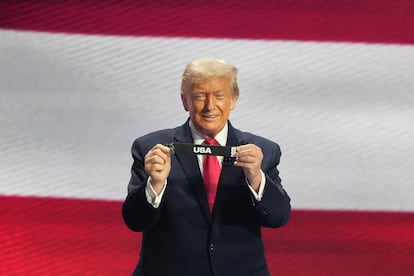

Donald Trump, in his recently published National Security Strategy, argues that Europe is facing the collapse of its civilization. He is right. But he is wrong about who is threatening it: it is neither immigrants, nor “woke” culture, nor EU institutions. It is, in different ways, himself and Putin. Trumpism is waging an assault against the European model; a counter-revolution must be mounted.
Last week’s installment of this column was titled “How to Become Independent from a U.S. That Has Become an Adversary.” The U.S. security document confirms unequivocally that Washington is no longer an ally but an adversary. Back in February, Vice President J. D. Vance, who came to Europe for the Munich Security Conference, warned us that our problem wasn’t Putin’s missiles: it’s us, the Europeans, with our model. Faced with this evidence, we must become independent. And, in parallel, we must mount a counter-revolution, the other essential leg for the European body to move forward.
Public opinion is becoming increasingly clear on this. A survey commissioned by the magazine El Grand Continent, conducted by Cluster 17 in nine European countries, indicates that 48% of respondents consider Trump an enemy, four percentage points higher than in the previous poll. It is somewhat surprising that 40% still think Trump is neither friend nor foe. But awareness is growing.
The survey was published at the Grand Continent Summit, the annual conference organized by the magazine in the Aosta Valley (Italy), which brings together leading politicians, business leaders, historians, political scientists, and representatives of civil society. This columnist attended the forum — on a trip paid for by the organizers — and participated in the panel presenting the study.
The study not only reveals a growing awareness of the Trump challenge, but also a European society marked by anxieties and concerns. Added to the threat of war posed by the Russian imperialist regime is the perception that the U.S. is becoming an enemy, one on which we depend for military assistance, intelligence, and technology — or rather, technologies — with devastating potential. These technologies are a fundamental tool in the assault that seeks to dismantle the European integration model and instead favor the rise of European national-populist movements aligned with Trumpism.
Awareness of what Trumpism is and the depth of this unease are the foundations upon which to build a political process for achieving Europe’s independence — overcoming our current status as a military protectorate and digital colony — and for developing a counterrevolutionary political strategy. We must work with this raw material. The official sessions and private conversations held at the Grand Continent conference have yielded a wealth of interesting analyses and proposals in this regard.
In terms of independence, the path is difficult but clear. We must create digital sovereignty. The conference has placed great emphasis on the fact that regulatory activity and competition enforcement alone are insufficient. It is essential to advance in the development of European infrastructure assets. Currently, we not only depend on others for digital platforms, algorithms, and cutting-edge technologies, but we also suffer from a lack of control over — or sufficient capacity within — infrastructure networks, whether cloud computing, satellite networks, cables, or adequate data center capacity. We lack the entrepreneurial culture and the support of capital markets to produce globally competitive enterprises. This issue is fundamental. There is no sovereignty of any kind without digital sovereignty. Without it, we are vulnerable to the onslaught of mind-manipulation maneuvers; to the threat of the activation of “kill switches,” buttons that deactivate functionalities, which can have profoundly disruptive impacts.
We also need to create our own defense capabilities. Europe has taken steps forward with increased military spending and a stronger industrial base. But we are still a long way from possessing the real strength to be considered a power that commands respect and consideration. Again, there is a problem of assets, of those enabling resources that would allow us to be self-reliant; and there is, of course, a problem of aligning our wills to make the abstract sum of each European country’s investments credible. Reuters reported that the U.S. wants Europe to shoulder the bulk of the alliance’s conventional defense efforts by 2027. Let’s seize this opportunity to take a leading role and also assume shares of capacity and management expertise. It will serve us well.
Today, Europe is divided into areas with differing perceptions: the Baltic and Nordic regions, and Poland, are on high alert; Germany is determined to take a major step forward; France and the United Kingdom, the two nuclear powers with the most credible armed forces, are mired in political crises and budget constraints; and the South says the right things but doesn’t do enough, due to a misguided sense of security. This sense of security is misguided because the problems that affect some Europeans affect us all; and because a Shahed drone fits perfectly in a shipping container. It doesn’t have to fly from Moscow to create an incident; it can do so from nearby international waters.
All of the above is complex. But perhaps even more complex is designing a counterrevolutionary strategy to prevent the Trumpist assault from succeeding in nullifying our possibility of building independence, annihilating our willpower and chances of success by elevating forces that align themselves with Trumpism.
For this, radical changes are necessary. It is essential to find a political narrative that resonates emotionally. National populists skillfully exploit this terrain. Responding with mere rationality places us at a losing disadvantage. In this arena, we must also recover traits of optimism and enthusiasm, and abandon that pessimistic and gloomy demeanor that defines us all too often. Furthermore, it is imperative to understand that this assault calls for a different kind of cooperation among pro-European democrats: one that is far more loyal, far more effective, far more generous. Everything is at stake. Thirdly, we need to escalate the ambition of our projects. We must design a comprehensive counter-revolutionary strategy against an adversary determined to attack. Please abandon childish squabbles and focus on repelling the brutal attack coming from across the Atlantic, while simultaneously facing an armed assault from Russia.
The cornerstone of all this must be a new issuance of Eurobonds to finance the construction of the necessary European assets. And in this context, as one conference participant emphasized in a private discussion, it will be necessary to break the delusional commitment we Europeans made in the dismal trade agreement reached at the Trumpian golf course in Scotland — the one that tied us to massive, ill-conceived European investments in the U.S., investments that would effectively bolster, at our own expense, the advantages of an adversary power. That money is needed to create European assets; it cannot be squandered to tame the American beast. It doesn’t need to be stated explicitly, but we must be clear that we must not do this.
We must move full steam ahead toward the pragmatic federalism envisioned by Mario Draghi, a true intellectual beacon for Europe in these dark times. We must forcefully advance in designing a strategy that short-circuits the national-populist attack. This doesn’t depend solely on politics. Civil society is called upon to do its part. Europe is indeed facing a civilizational erasure. We know who threatens it. Let’s roll up our sleeves, Europeans.
Sign up for our weekly newsletter to get more English-language news coverage from EL PAÍS USA Edition









































