
A bad deal
Brussels’ capitulation to Donald Trump’s tariff imposition demonstrates the European Union’s geopolitical weakness
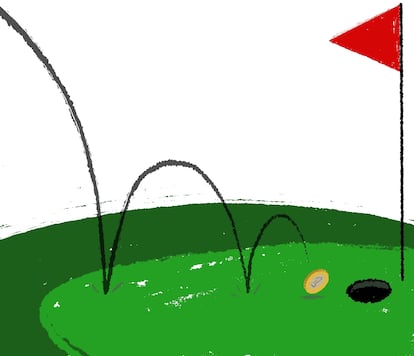

The president of the United States, Donald Trump, and the head of the European Commission, Ursula von der Leyen, on Sunday announced an agreement that avoids a trade escalation but leaves a bitter taste in the mouth on the eastern side of the Atlantic. It’s hard to even call it an “agreement” when the European Union accepts, without any compensation, a 15% tariff on the bulk of its exports to the U.S. and also commits to buying $750 billion worth of energy from that country, as well as to make unspecified investments worth another $600 billion, and to increase its acquisition of American military equipment.
All this without any concessions from Trump, who in fact maintains a 50% tariff on aluminum and steel and who, in order to negotiate it separately, has not included a key item in the general 15% tax: pharmaceutical products. Only one sector stands to benefit from the negotiation: the automotive industry, which would go from the current rate of 25% to 15%, a reduction that is the result of pressure on the Commission President from her fellow German conservative Friedrich Merz, adding insult to injury for the other EU partners.
At a time when the EU is facing the need to finance its strategic autonomy, the investment commitment to the U.S. is difficult to understand. Especially since, according to the Draghi report of September 2024, the European Union has an investment gap of €800 billion per year. Even the staging of what was supposed to resemble a high-level meeting was a defeat for Von der Leyen, who traveled to Trump’s golf club in Scotland on Sunday for the official photo.
Yesterday, the euro suffered its second-largest fall of the year. For investors, ending uncertainty and the threat of a trade war prevails over the surcharge that European exports will face starting this Friday. But by no means can it be said that this is a good deal for Europe; in von der Leyen’s own words, it was “the best we could get.” The 15% is obviously less than the 30% Trump had threatened with as of August 1 or the 20% he announced on the misnamed Liberation Day in April. However, the result is that products the EU sells to the U.S. will go from bearing an average surcharge of less than 5%, according to data from the European Parliament, to around 17%. Initial estimates indicate that this could subtract two or three tenths of a percentage point from European GDP growth, a significant impact when the economy of the Twenty-Seven is expected to grow by barely 1.1% this year and 1.5% the next.
The “deal” with the United States highlights Europe’s geopolitical weakness, already evident in the conflicts in Ukraine and the Middle East. Now the EU has given up on asserting its economic clout. Von der Leyen accepted Trump’s framework from the outset by limiting the negotiations to trade in goods (where the U.S. has a deficit with the EU of $235.6 billion in 2024) while excluding America’s large surplus in services (around $109 billion) from the equation. And all this with a supposed partner that has proven to be completely unreliable.
Europe cannot resign itself to irrelevance or accept Trump’s disdain for multilateralism. It must, therefore, work to eventually reverse a draconian agreement that serves little more than as a lesser evil. Failure to do so would mean abdicating a substantial part of the European project and its potential to be a strong international player—currently hampered by the fragmentation of interests among the 27. A European Union committed to a rules-based global order, including the rules of trade.









































