
Maduro’s capture boosts support for Trump among Venezuelans and Cubans: ‘He’s a man of his word’
While most Americans disapprove of the arrest of the Venezuelan president, admiration and gratitude toward the Republican has grown among these two exile communities
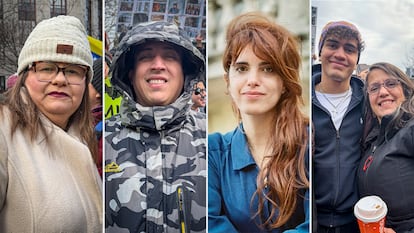

A statue of Donald Trump should be erected right next to that of Simón Bolívar in the main square of Caracas’ historic center. That way, everyone who passes by will remember that Venezuela was first liberated by a Venezuelan… and then by an American. This is suggested by Carlos Muñoz, an electrician who has lived in the United States for 10 years. He believes that this would be the best way to honor Trump and offer some joy to people like him and fellow Venezuelan, Yanet Tensenberg. “The only way they would have left the government was with a military intervention,” he says. She nods along, adding, “Trump is a man of his word.”
Many of those gathered outside the Southern District Court of Manhattan on January 5 say they haven’t slept in days. They’ve been excited ever since their relatives in Venezuela woke them up and told them that Nicolás Maduro had been captured by the U.S. government and taken to the Metropolitan Detention Center in Brooklyn, to appear before a judge in the building across from where they were now standing.
In his first term, Trump promised to land Marines in Caracas. It never happened. In his second administration, he deployed a military force in the Caribbean, starting in the summer of 2025. Some didn’t imagine that this would culminate in an attack on Fort Tiuna, the stronghold of the Maduro government.
In fact, after his return to the White House, many of the Venezuelan exiles who supported Trump in the November 2024 presidential elections felt cheated. They felt that he had just used them to get their votes in Florida, the state where nearly 400,000 of them live, out of the 1.3 million Venezuelans residing in the United States. Around 90% of Florida supported the Republican candidate.
Several of Trump’s actions disappointed the community: the suspension of Temporary Protected Status (TPS), which protected some 600,000 Venezuelans; the reception at the Miraflores Palace of Special Envoy Richard Grenell, who negotiated the return of six U.S. hostages; and Maduro’s willingness to receive deportation flights, despite having severed relations with Washington in 2019.
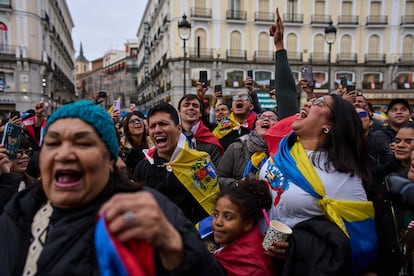
What Venezuelans in the U.S. were hoping for was the overthrow of the Maduro regime. This change would give them back a prosperous Venezuela, rather than one that continues to create exiles, as has been happening for more than 10 years. The exile community was angry that the government continued to strip them of protections like humanitarian parole and other programs, or detain and deport them as presumed criminals to countries like El Salvador.
With the start of 2026, things changed, at least for the more conservative faction of the Venezuelan exile community. For them, Trump was suddenly absolved. “I know that many migrants are upset about the deportations and the elimination of TPS. But if there’s a transition to democracy in Venezuela, there will be a country to return to,” says Boris Molina, 59, who left the country when Hugo Chávez came to power in 1999. His brother is among those who fear deportation: he’s an asylum seeker.
Bárbara, a 50-year-old woman who prefers not to give her last name, argues: “Trump now says that Venezuelans will be protected. And I’m immensely grateful to him. I love Donald Trump, the only president in the world who turned his attention to Venezuela, the only one who felt compassion for the people, who are starving, who have no gasoline, who are suffering.”
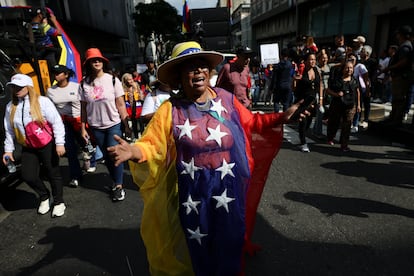
There are other Venezuelans who find it unacceptable that the United States captured Maduro. Or that Trump boasts of controlling Venezuelan oil and deciding the country’s future. Yonatan Matheus, a human rights activist, is concerned about “the seriousness that the Trump administration’s actions represent for sovereignty and the rule of law.” Others, however, like José Hernández, the former Venezuelan representative to the Organization of American States (OAS) Committee on Hemispheric Security, insist that there was no other alternative for their country: “Calling us cipayos [puppets] is just part of the sad narrative imposed on us. Venezuela is better off today without Nicolás [Maduro].”
Cubans celebrate
Contrary to the response from the Venezuelan diaspora, the recent intervention in Venezuela has been criticized by most Americans. A poll by the data analytics firm YouGov shows that 56% disapprove of their government’s actions, while 66% believe that Trump should have sought congressional authorization to proceed.
“Americans are very divided over the operation in Venezuela,” says David Smith, an associate professor of American Politics and Foreign Policy at the University of Sydney. “They’re very uncertain about what will happen next, and even many Trump supporters dislike the idea of the United States ‘running’ Venezuela, as Trump has suggested.”
“Americans want much more attention to be paid to solving their domestic problems, especially the cost-of-living crisis,” the academic argues. “Many of them will see this intervention as a costly distraction that could ultimately leave the United States embroiled in another endless war.”
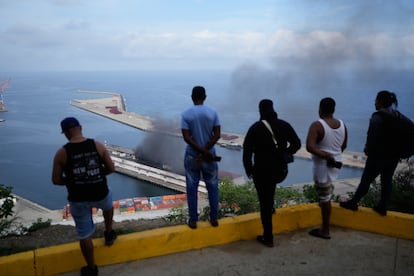
However, another diaspora has joined in celebrating the recent events in Venezuela: the Cuban diaspora. Strong ties between the two countries date back to the 2000s, when Chávez was in power. In a Cuba that was mired in an unprecedented crisis caused by the collapse of the Soviet Union, Venezuela filled the void. Up to 90,000 barrels of oil reached the country each day. And, in 2011, the island was connected to the ALBA-1 submarine cable, a joint venture between Telecom Venezuela and the Cuban company Transbit.
The Cuban government, for its part, exported healthcare workers to Venezuela, who provided millions of dollars worth of services over the years. This was in addition to something crucial: its military apparatus. 32 Cubans died in the military operation that removed Maduro and his wife, Cilia Flores, from their bed at Fort Tiuna. While the Venezuelan government denied Cuba’s armed presence over the years, it has now been exposed.
Since the escalation in the Caribbean, people have wondered if Cuba is also in Trump’s sights. “I’m not going to talk to you about what our future steps are going to be and [what] our policies are going to be right now, in this regard. But I don’t think it’s any mystery that we aren’t big fans of the Cuban regime,” said Secretary of State Marco Rubio, a Cuban-American, after the intervention in Venezuela. Trump also expressed his intention to “help the people of Cuba.” President Miguel Díaz-Canel’s government in Havana is on high alert: it has mobilized the population to extend its support to Venezuelans, claiming to be ready for any scenario. “I will give my blood and my life for Maduro,” the Cuban president declared a few days ago.
Some are not only wondering if Cuba is in the plans: a segment of the Cuban exile community has even implored that there be a U.S. intervention. On social media, people have been calling for annexation of the island, or sharing memes that point out to Trump the location of Punto Cero, the Castro regime’s equivalent of Fort Tiuna.
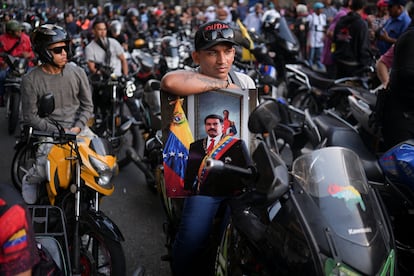
Cubans, historically protected by U.S. immigration policies, were lumped together with other migrants last year: the community of 2.5 million — 68% of whom voted for Trump — was suddenly affected by the elimination of visa programs, family reunification and humanitarian parole. Many Cubans have ended up in the so-called Alligator Alcatraz detention center, built on the outskirts of Miami. And, in recent months, discontent has been growing within the community over the deportations of family members and neighbors. Now, with the possibility that Trump will intervene in Cuba as he did with Venezuela, the president has, once again, strengthened his supporters’ resolve.
Jorge Duany is the director of the Cuban Research Institute (CRI) and professor of Anthropology in the Department of Global & Sociocultural Studies at Florida International University. For him, it’s no surprise that Maduro’s capture has brought so much joy to the Cuban and Venezuelan communities.
“The failure of multiple previous attempts — fraudulent elections, economic sanctions and the search for a negotiated exit from the Chavista leadership — has likely contributed to citizen frustration and support for extreme alternatives, like the one used by the Trump administration,” he describes. “As for Cuba, the long-standing presence of the Castro regime — despite the U.S. embargo, recurring economic crises and widespread reports of human rights violations — has led to a marked erosion of public opinion, both on and off the island.”
“For decades, the Cuban and Venezuelan communities have denounced the crimes of the Castro and Maduro dictatorships before all international institutions and democratic governments, seeking protection under international law, solidarity and aid. Most of the time, we have encountered silence, complicity and inaction,” says Cuban activist Carolina Barrero. “The removal of the dictator Maduro is the dream that many people have given their lives for in Venezuela. How can they not value the administration that finally listened?”
Sign up for our weekly newsletter to get more English-language news coverage from EL PAÍS USA Edition









































