
Julio Ricardo Varela: ‘Latinos are the future of this country’
The renowned Puerto Rican journalist defends bilingual, independent, and community-based journalism in Trump’s America
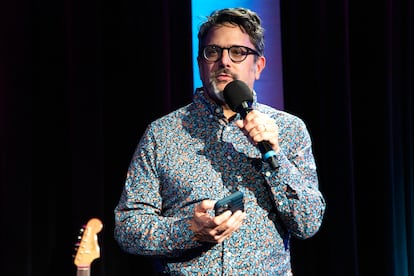

In a tense political climate, with Donald Trump in the White House and an increasingly hostile environment toward the press and the Latino community, journalist Julio Ricardo Varela, 56, believes his work for bilingual, independent, and community-based journalism is more important than ever. He recently received the Bravo Award for Journalist of the Year for this work. In a conversation with EL PAÍS, Varela reflects on his career, his convictions, and the project he now leads from Boston: The Latino Newsletter, a non-profit publication that seeks to train new generations and produce community-focused journalism.
“Unfortunately, the industry has viewed independent journalists through the wrong lens,” he explains. “For years, my colleagues at large corporations would say, ‘You’re just a blogger.’ For me, this award confirms that the wave of independent journalism that emerged from the digital world and blogging is strong, critical, honest, and authentic. I spent 20 years listening to people say I wasn’t a journalist, but I think this recognition makes it clear I am.”
When asked what this award means for Latino journalism, Varela answers without hesitation: “It’s extremely important. Latinos in the United States are the ones who will save, support, and uplift our communities. There is no other solution.”
According to Varela, the problem of Latino representation in U.S. newsrooms is structural and persistent. “There aren’t enough Latinos in this field. And I reached a point in my career where I no longer want to convince companies that they should recruit more Latinos. We are the future of this country.”
For him, the solution lies not in reforming institutions anchored in commercial models that don’t prioritize community coverage, but in creating new newsrooms: “My solution is to build organizations where Latino journalists can work and publish freely, thinking of the community first. We’re no longer asking for permission to do our work: we’re already doing it.”
Varela acknowledges that his identity permeates everything he writes. “I carry Puerto Rico and the Bronx in my heart. And Boston has been my home for 30 years. That combination defines who I am.” Being Puerto Rican in the United States, he says, means inhabiting a dual reality: “We are part of the country, but we aren’t always treated as part of it.”
This perspective, he affirms, broadened by decades of studying and narrating Puerto Rican and Latino history, allows him to see the country differently: “I see parts of the Southwest, the South, or California as extensions of myself. We are united by language, food, and culture.”
Although he recognizes that the Latino community is going through a difficult time, he also observes a deep commitment to American ideals. “Despite the mistreatment, many still believe in the experiment of freedom and equality and democracy. When we criticize this country, we do so from a place of love.”
The Latino Newsletter was born from that conviction. It’s an independent, non-profit publication, created to prioritize journalism above commercial interests. “For me, it’s essential that our work be free, accessible, without paywalls. If someone has internet or a phone, they can read our stories. Information should be accessible to everyone.”
Varela now has his sights set on the future: “I’m building something for the next generation of Latino journalists. I want them to be able to do their work without worrying about how they’re going to pay the rent. Getting there is a marathon, but I’m committed.”
The non-profit structure, he says, is not a technical detail, but a declaration of principles: “It defines the mission. It tells the world that this project belongs to everyone. Within the team, we understand that we have total editorial freedom, with ethics and independence. The quality of the journalism is high, and this is my contribution.”
One of the most serious obstacles, Varela explains, is the lack of editors with experience covering Latino communities. “There’s a lot of young talent, but there aren’t enough editors. Without editors, there’s no growth.” He acknowledges that there are valuable local efforts, but coordination is lacking: “We’re not sharing stories. We’re still stuck on the idea that we’re competing against each other. That doesn’t exist. Independent journalism doesn’t compete with anyone.”
The business model of traditional media, he adds, hinders community coverage: “If you work for a for-profit outlet that has to double its revenue every year, you’re never going to properly cover the community.” The Latino Newsletter, on the other hand, follows a different logic: “We ask for support from those who believe in the project. And if they can’t donate, they can read and share the articles. It’s free.”
In a media ecosystem saturated by artificial intelligence and the race to publish first, Varela believes that audiences are looking for something that cannot be automated: humanity. “People want to know that the people who create these stories are human beings. Nothing more.” After two decades of observing how the pressure for speed, erodes the profession, his conclusion is clear: “The future of Latin American journalism will depend on rebuilding trust from a human and collective perspective.”
Sign up for our weekly newsletter to get more English-language news coverage from EL PAÍS USA Edition









































