
Trump intensifies attacks on the media and freedom of speech following Charlie Kirk’s murder
The government’s push to suspend Jimmy Kimmel’s show comes on top of efforts to single out reporters and crack down on left-wing groups. The president is threatening critical news outlets with the loss of their licenses


One of the biggest sources of pride of the U.S. conservative movement has always been its image of itself as a champion of the sacrosanct freedom of speech, in contrast to the “censorious” spirit of the left. Things seem to have changed with Donald Trump in power for the second time. Since his return to the White House, his attacks on the press and the silencing of his adversaries have intensified, especially after the murder nine days ago of MAGA youth leader Charlie Kirk.
Trump, his vice president J.D. Vance, and other members of the government have since launched a campaign against freedom of speech, riding on the back of a terrible crime for which the president blames the “radical left,” while promising that it — however vague the concept may be — will pay for it.
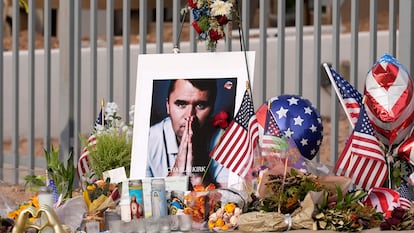
Kirk died after being shot in the neck at a university while exercising his right to free speech — a right guaranteed by the First Amendment, of which he himself was an absolutist defender. His murder was celebrated or excused by certain sectors of the American left and far-left, and that pushed the leaders of the MAGA world — a movement largely united against cancel culture — to adopt their own version of that censorious passion and to publicly single out those who celebrated Kirk’s death, urging their employers to fire them.
The most famous victim of the right’s change of script is comedian Jimmy Kimmel, whose late-night show was suspended “indefinitely” on Wednesday night by ABC, the network that had aired it for 20 years. The decision followed a comment Kimmel made about the reaction of some Trump supporters after learning that the alleged murderer, a 22-year-old man named Tyler Robinson, comes from a Mormon, Republican, gun-loving household.
Kimmel, who went on to joke about the president’s grief after losing one of his closest allies, made that comment before authorities on Tuesday presented evidence linking the acts of the alleged killer — whose mother told investigators he had embraced “leftist” positions — to a weariness, confessed by Robinson himself, with the “hate” that, in his view, Kirk was spreading. The young activist was famous for his commitment to free speech and to the right to bear arms, but also for his anti-immigrant and anti-LGBTQ+ rhetoric, opposition to affirmative action policies, and defense of male and Western cultural supremacy.
Kimmel’s comment was fiercely rebuked in a podcast by a Trump administration official, Brendan Carr, the head of the communications regulator (FCC). Carr suggested to ABC that they should fire the host and warned that if they didn’t, the government would step in. “We can do this the easy way or the hard way,” he said. A few hours later, ABC’s local affiliate group, Nexstar — which is in the middle of a major business deal requiring FCC approval — announced that it would stop airing Kimmel’s late-night show. Within minutes, ABC formalized the suspension of the program.
Revoking licenses from critics
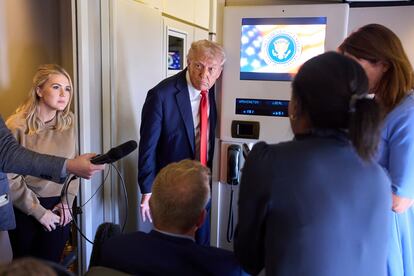
Trump, returning from his state visit to the United Kingdom, told reporters aboard the presidential plane on Thursday that he believes the FCC should revoke the licenses of networks whose late-night hosts speak negatively about him. The night before, he celebrated Kimmel’s removal on his social network, Truth Social, as “great news for America.”
It wasn’t the first time: in July, when the comedian Stephen Colbert revealed that his employer, CBS, would not be renewing his contract at the end of the new season, Trump celebrated the news and predicted that Kimmel would be next. This Wednesday, he also said that two other late-night hosts, Seth Meyers and Jimmy Fallon, should suffer the same fate.
Democrats in Congress have called for Carr’s resignation. In an interview on Fox News, Carr defended his decision, arguing that TV comedians have gone from being “court jesters that would make fun of everybody in power to being court clerics and enforcing a very narrow political ideology.” Carr also believes that local broadcasters, which reach every corner of so-called Middle America and relay content from the major networks, have said “enough” to propaganda from Hollywood and New York.
Katie Fallow, a free speech lawyer and deputy director of Columbia University’s Knight Institute, said in a phone conversation on Thursday that “Kimmel’s suspension following Carr’s threat is the most serious and recent example of a sustained attack on the First Amendment by the Trump administration.”
She added: “I find it extremely hypocritical that those who complained about being banned from social media or public discourse for their views want to cancel what they disagree with now that they are in power. Freedom of speech should not be censored or suppressed, regardless of whether you are right-wing or left-wing. But it’s even more serious when the government threatens its critics with financial penalties or even prison.”
In a post on X, former president Barack Obama accused the government of taking things “to a new and dangerous level by routinely threatening regulatory action against media companies unless they muzzle or fire reporters and commentators it doesn’t like.” Obama cited as an example of “government coercion” of the First Amendment the firing of Karen Attiah from The Washington Post over a Bluesky post that echoed a comment by Kirk.
Criticism from Tucker Carlson
In a rare moment of agreement with Obama, MAGA opinion leader Tucker Carlson accused Trump of using Kirk’s murder to trample on the First Amendment and called for “civil disobedience” if the project, advanced by Attorney General Pam Bondi, to create a legal category — nonexistent in the United States — for prosecuting “hate speech” goes ahead.
Bondi’s remarks triggered an intense debate within her own ranks, and she later had to backtrack. According to Fallow, when Bondi spoke of hate speech she was referring only to “speech that the right considers offensive,” when “it is legally defined as the use of slurs based on race, nationality, religion, or sex.” “And all of that is fully protected in our system to preserve freedom of thought and expression, and to protect us from the government.” The same protections apply to demonstrating in favor of the Ku Klux Klan or marching with Nazi flags.
Trump’s direct attacks on the press — which he has branded “the enemy of the people” and sought to discredit — include lawsuits against an Iowa newspaper for a poll that failed to predict his decisive win in the state, against The New York Times for running negative stories about him, and against The Wall Street Journal for disclosing the existence of a lewd drawing that Trump claims is fake, allegedly sent by him to congratulate the pedophile millionaire Jeffrey Epstein on his 50th birthday.
He has also banned the Associated Press from accessing the Oval Office for refusing to use the name “Gulf of America,” and has fueled the financial strangulation of public radio and television (NPR and PBS) and the closure of almost all foreign news services formerly provided by Voice of America.
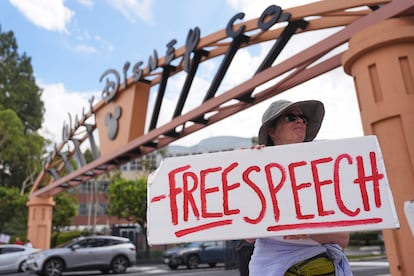
But ABC and CBS are surely the most high-profile cases. The two networks share more than just having dropped their late-night stars. Both paid $15 and $16 million, respectively, to halt separate defamation lawsuits brought by Trump. And both did so to avoid antagonizing the FCC, whose approval they needed for two major business deals in progress.
In ABC’s case, the settlement came after a news anchor said on air that the then-Republican candidate had been ordered to pay columnist E. Jean Carroll damages for “rape,” when in fact the jury had found him liable for “sexual abuse.” In CBS’s case, Trump accused its flagship program of editing an interview with his Democratic rival, Kamala Harris, in a way that, in his view, favored her.
Kimmel’s suspension comes in the same week that Trump filed a defamation and libel lawsuit against The New York Times, accusing the paper of “lying” and harming him “for years,” and of acting as “a virtual mouthpiece for the Radical Left Democratic Party.” Trump is seeking $15 billion from the paper and four of its reporters — two White House correspondents and two investigative journalists who published a book challenging his narrative of being a successful, self-made businessman. The publishing house behind the book is also named in the suit.
On the same day news broke of the lawsuit, the U.S. president clashed with two reporters. The first was Jonathan Karl of ABC News, who asked Trump what he thought of Bondi’s plans to curtail freedom of speech. Trump replied: “She’d probably go after people like you because you treat me so unfairly.”
The second journalist targeted for intimidation was the White House correspondent for Australia’s public broadcaster, who asked about the apparent conflicts of interest stemming from Trump’s dual role as president and businessman. Before cutting him off, Trump warned that by asking such a question he was “hurting Australia,” arguing the country’s leaders “want to get along with me.”
That correspondent was barred from attending Trump’s Thursday press conference with U.K. Prime Minister Keir Starmer. According to the British government, the exclusion was due to “logistical reasons.” Trump’s administration has also threatened to revoke the visa of a German journalist who criticized Stephen Miller, one of Trump’s close allies.
At that meeting with the press at Chequers, Starmer’s country residence, Trump insisted that the Kimmel case had nothing to do with free speech but with the host’s “bad ratings” and “lack of talent.” The reporter’s question had pointed to the apparent contradiction in MAGA’s stance: turning alleged persecution of extremist speech in Europe into an ideological crusade. Vance himself had placed that battle at the center of his agenda, using harsh language at the Munich Security Conference in February.
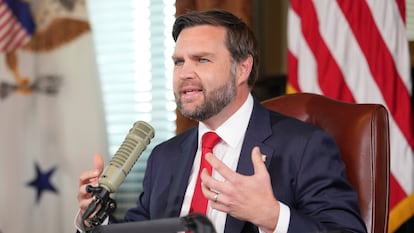
Vance seemed to have changed his tune on Monday, when he hosted his late friend Kirk’s podcast. He railed against “the incredibly destructive movement of left-wing extremism,” encouraged the public shaming of those who celebrated Kirk’s murder, and announced that certain organizations would be targeted by stripping them of their tax-exempt status.
He cited two in particular: George Soros’s Open Society and the Ford Foundation, which he accused of funding a “disgusting article” in the leftist magazine The Nation (titled Charlie Kirk’s Legacy Deserves No Mourning by Elizabeth Spiers). According to Vance, that piece was used to justify Kirk’s assassination. In it, Spiers criticized Kirk’s message and argued one could mourn his death, without celebrating his life.
The link between those foundations and The Nation has not been proven. Bhaskar Sunkara, president of the historic magazine, stated on X that the publication has never received funding from Open Society. As for the Ford Foundation, its last contribution to the magazine was in 2019.
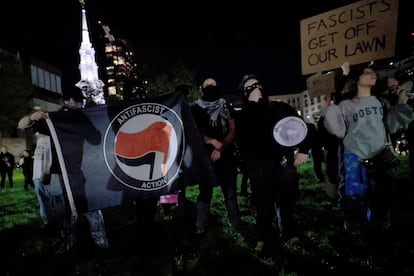
In another message on Truth Social, Trump announced his plan to designate Antifa, an amorphous constellation of antifascist and far-left groups with no clear leader or structure, as a “terrorist organization.” The U.S. president also said he would be “strongly recommending” that those who fund such groups “be thoroughly investigated in accordance with the highest legal standards and practices.” He had already tried to go after the nebulous movement known as Antifa during his first administration, when the killing of George Floyd by a white Minneapolis police officer triggered a wave of anti-racist protests across the country at the height of the pandemic.
Christopher Wray, who was then his FBI director, stated earlier this year that Antifa is an “idea,” not an organization. With that late-night post on Truth Social, written from Windsor Castle, it remained unclear how Trump’s administration intends to pursue an idea.
Sign up for our weekly newsletter to get more English-language news coverage from EL PAÍS USA Edition









































