
Young socialist Zohran Mamdani wins over New York with his promise of change in the face of Trump
The 34-year-old Democratic candidate defeated his main rival, Andrew Cuomo, after a dazzling campaign that will make him the city’s first Muslim mayor and the youngest in a century


Zohran Mamdani, the Democratic candidate for New York City mayor who has managed to embody in record time both the hope for change in Donald Trump’s America and a sense of rebellion against the establishment of his own party, made history this Tuesday at the age of 34 by becoming the first socialist to govern the world capital of capitalism and the first Muslim mayor of the city of 9/11. He is also the youngest mayor in a century.
His victory is almost unprecedented in a city that had elected 110 mayors before him — a handful of whom were immigrants — and where almost no one knew him just a year ago. Back then, he was just another state assemblyman in Albany. From that unassuming position, Mamdani has raced to global fame on the back of a left-leaning platform — sensible or populist, depending on your perspective — centered on a commitment to affordability, which this Tuesday proved irresistible to the residents of the country’s most populous city, and one of the most expensive in the world, who are increasingly struggling against the rising cost of living.
The new mayor, who is also the first person of South Asian descent to win the mayoral office in New York City, did so thanks to a dazzling campaign, bolstered by an extraordinary command of social media, which he demonstrated once again at the moment of his victory. It took only about 45 minutes after the polls closed at 9:00 p.m. for major U.S. media outlets, including the AP, to declare him the winner, and then his X account posted a simple 10-second video. In it, from inside one of the city’s unmistakable subway cars, the City Hall station sign is visible, and a voice announces to passengers: “The next and last stop is City Hall.”
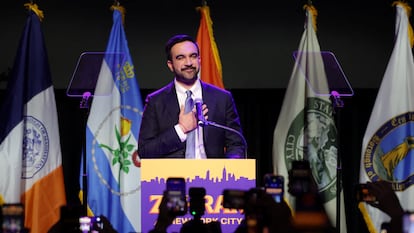
These attention-grabbing tactics, which Mamdani, or his campaign, deliver with apparent ease, are complemented by a classic charisma reminiscent of the politicians in the movies, comfortable taking selfies, shaking hands, and kissing babies. With this combination, Mamdani managed to inspire an army of some 100,000 volunteers, a movement that emerged in just a few months, who knocked on more than three million doors to rally support for Mamdani and repeat a simple three-point platform that stood out above the rest: free buses, a freeze on rent-stabilized leases until 2030, and free childcare for children under five.
These straightforward ideas earned him a decisive and surprising victory in the Democratic primaries in June. They also prevailed this Tuesday in a record-turnout election of two million voters — the highest since 1969 — winning over voters despite his opponents’ objections. Those opponents, led by U.S. President Donald Trump, tried to portray him as a antisemitic (due to his support for Palestine and his condemnation of the “genocide” in Gaza), as an apologist for Islamist terrorism, and, above all, as a dangerous communist ready to bankrupt the city and return it to its worst nightmares — the decades-long era of rampant crime.
Mamdani comfortably defeated his rivals with 50.4% of the vote, though it must be acknowledged that these opponents were not the best-equipped. The main challenger was former New York governor Andrew Cuomo (41.6%), who had pinned his political comeback on these elections after his ignominious resignation in 2021 following a decades-long career, plagued by multiple sexual harassment scandals. Neither Cuomo — with his pedigree (he is the son of former Governor Mario Cuomo), his old-school aura, and his close ties to economic powers and the Democratic Party establishment — nor Curtis Sliwa (7.1%) — the Republican candidate who never had real chances in a traditionally progressive city — could overcome Mamdani, even though Trump endorsed Cuomo on Monday. Or perhaps it was precisely because of that.
Starting in January
It will be from January 1, the day the new mayor is sworn in, that we will be able to see whether those fears are well-founded or merely the ghosts stirred up by the city’s established powers — from big business owners to landlords, and from Wall Street sharks to pro-Israel activists and cultural elites — to stop a candidate who proved unstoppable, especially, though not only, among young voters.
Born in Kampala, Uganda, in 1991 to intellectual parents — the Indian filmmaker Mira Nair and Columbia University scholar Mahmoud Mamdani — the victory of New York’s new mayor also represents the consolidation of an alternative, to the left of the Democratic Party, in the form of the Democratic Socialists of America (DSA). This is a movement born out of opposition to runaway inequality and capitalism, and from the disappointment following Hillary Clinton’s defeat to Donald Trump in 2016, and in the wake of Vermont Senator Bernie Sanders’s unsuccessful race to win the Democratic Party presidential nomination.
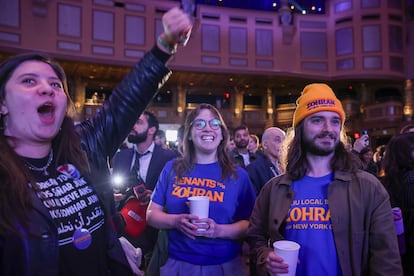
Its first national impact came in 2018, the year Mamdani obtained U.S. citizenship, with the emergence of Alexandria Ocasio-Cortez. Like the new mayor, she is heir to a tradition rooted in the 1920s with socialist presidential candidate Eugene Debs. It draws on the principles of Franklin D. Roosevelt’s New Deal and has a direct antecedent in those who took to Manhattan’s streets after the 2008 crisis to occupy Wall Street.
For a party adrift, mired in an existential crisis since Kamala Harris’s defeat last November, Mamdani’s unexpected rise represents a jolt that forces its leadership to debate the future. This debate must also take into account the lessons from other victories this Tuesday in the gubernatorial elections in Virginia and New Jersey. Does Mamdani’s triumph indicate that voters are eager for generational change and more progressive policies? Or is it a mistake to assume that what a major Democratic city has to say can be extrapolated to the rest of the country, where caution has for decades led candidates to move toward the center to win over undecided voters?
What the example of New York’s mayor-elect seems to confirm is that it is no longer possible — if it ever was — to win elections in the United States entirely within the confines of the traditional parties. And in the age of social media, only those who master the various tones of populism, left or right, will have a chance at the polls.
In this regard, he bears a resemblance to Trump — a comparison Mamdani has never shied away from. He often points out that what propelled him was the same force that drove the Republican back to the White House just a year ago: the recognition that the cost of living had become unbearable for ordinary Americans.
One of the big questions in New York is how Trump will respond to Mamdani’s victory. First, he rushed to distance himself on his social network from Republican defeats. Then he posted a cryptic message saying: “And so it begins.” The Republican has threatened to cut federal funding to the city to a minimum, and no one can rule out that he might deploy the National Guard, as he has done in Los Angeles or Washington, among other cities.
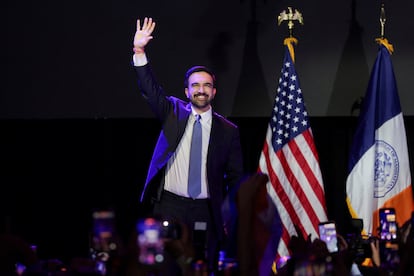
Early on the day he was elected mayor, Mamdani again promised in a public park in Queens that he would stand up to Trump. Mamdani — who was once a little-known rapper going by the name Señor Cardamon, in a nod to his roots — made the promise at the start of a splendid autumn day in New York when he went to vote with his wife, illustrator Rama Duwaji, at a polling station in his neighborhood of Astoria.
This time, he went without the narrow tie that had become an indispensable part of his outfit in recent months, completed with a black suit and a broad, unshakable smile. Knowing his mastery of messaging, that detail could only mean one thing: after an exhausting year-long campaign, Mamdani was ready to stop courting his neighbors and to wait for them to give him the support he needed to make New York history. And indeed, before the day was over, he did just that.
Sign up for our weekly newsletter to get more English-language news coverage from EL PAÍS USA Edition









































