
Zohran Mamdani, a political response to Donald Trump’s country
If New York City elects the winner of the Democratic primary as mayor in November, it will do something even more necessary than choosing a politician with progressive credentials. It will demonstrate that another time still exists for the rest of us
The cultural question
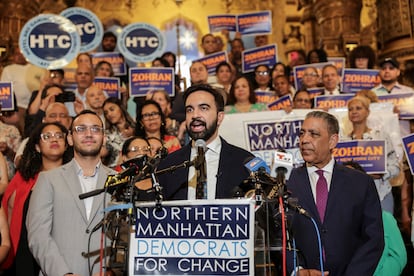
Zohran Mamdani, the 33-year-old who swept the Democratic primaries for mayor of New York on June 24, symbolizes the multicultural subject that the mainstream media system would have readily defended if he had accepted, within his party’s policy set or that of any other important institution, the position that to central power serves as a showpiece of diversity quota and inclusive makeup. His parents are Indian, Punjabi Muslims, and he, also a Muslim, was born in Kampala, Uganda, and lived there until he was seven, when his family decided to move to Queens, the most diverse and bustling borough of the city he now aspires to govern.
“Do you like capitalism?” Erin Burnett asked him two weeks ago during an interview on CNN, shortly after his victory. “No,” Mamdani replied without hesitation and with a somewhat malicious smile, “I have many critiques of capitalism.” A New York kind of cosmopolitanism, which frequently appeals to a kind of multiethnic, local-flavored theater and acts as a promotional souvenir, also carries the political power of a mixed experience, and such an experience would need to rescue the material notion of classes, precisely to articulate subaltern interracial mixing as a force for change somewhat more effective than the current moral economy of the victim and its essentialization of misfortune.
On July 3, The New York Times reported that in 2009, on his Columbia University application form, Mamdani identified himself as Asian, but also as Black or African American, even though he doesn’t consider himself to be one. He responded that, despite the restricted nature of these applications, and the lack of a specific box to check for someone of Indian-Ugandan descent, he tried to check off the boxes that best reflected his background. The article doesn’t seem to have caused any damage to his reputation; rather, the news piece has been the subject of ridicule both for the excessive importance the newspaper gave to the incident and for its clear desire to find some scandalous ethical lapse in Mamdani at any cost.
A few years ago, such a fact would surely have affected his political integrity, launching him into a sort of identity brawl with the African-American community, but today this woke procedure only seems to highlight the racism that resides in the American tendency to classify everyone all the time, and to the irony that underlies the fact that the more boxes they add, the more subgroups are enabled in the name of respect for difference, the more exclusive the identity becomes and the more the subject evades the rules of white normativity. The matter, however, became even more complicated when readers learned that the source who had leaked Mamdani’s application to The New York Times, one Jordan Lasker, is none other than a supremacist hacker with a fondness for eugenics, whose intentions are none other than to eliminate any type of cultural and racial representation in the country’s universities.
Liberal neutrality is always an instrument of reaction, and the intellectual arrogance that an ideology needs to define itself as the equidistant force within the political spectrum is even less harmful than the true repressed desire of the institutions and subjects defined as centrist, since not only is it a place that permanently tries to empty itself of historical responsibility, but that claim is its only constitutive property, and what happens in a limiting world like this, in addition to the evidence that at all times and in all places every political force always has some degree of historical responsibility, is that nobody wants to vote for someone who doesn’t take charge of what happens.
Woke ideology abandoned any attempt to restore justice because it never addressed market capitalism, and the depraved display of the Democratic Party’s good conscience has trapped the party in the following hypocritical situation: just as they try to contain the fascist drift of current domestic politics promoted by their Republican rivals, they appear, due to the isolationist current of Trumpism, to have become the sole owners of the capitalist war machine, of the expansion of production through the administration and the exemplary distribution of death.
The economic question
Bernie Sanders called on Democrats to replicate Mamdani’s political strategy and address the economic concerns of the working class, but his colleagues seem to have paid little attention, tied as they are to corporate PACs and Zionist lobbies, and still clinging to what is truly theirs: the caricature they’ve transformed into identity politics. What Sanders, who still speaks in euphemisms like “Netanyahu’s war,” sadly fails to understand is that Mamdani also won because he was the first American politician to openly condemn the Israeli genocide in Gaza.
No project of social democratization can be carried forward anywhere that evades the question of Palestine, and only the rage and disgust these crimes arouse have the necessary force to generate a political horizon in the West that can oppose the future (or lack thereof) envisioned by Christian Zionism and the accumulation of techno-feudal wealth. There is no other reality that articulates such a universal and transformative popular emotion, hence Mamdani’s pronouncements on the issue morally sustained his electoral campaign and amplified the bold agenda of his public policies.
To date, none of his proposals has caused as much stir as the announcement of an increase in corporate taxes from 7.25% to 11.5%—a rate similar to that of New Jersey, the neighboring state—and from 2% for individuals earning over $1 million in annual earnings. This means that the wealthy would have to pay an additional $2,000 in taxes for every $100,000 of income above that threshold. What would be disturbing is not so much the money to be paid, since the figure wouldn’t seriously hurt any millionaire’s pocketbook, but the nature of the proposal. We are talking about a government that would shape its management based on the needs of the middle and working classes, far removed from the role of bodyguard or, if necessary, lifeline for the financial corporations.
Bill Ackman, who said he agrees with Mamdani that the city is bankrupt while disapproving of his economic policies, advocates a trickle-down theory and has encouraged billionaires to leave New York if the socialist candidate ultimately wins the mayoral race. That’s a suicidal epithet, which Mamdani has chosen to defend.
Beginning in the 1990s, the socialists, and any anti-capitalist in general, had to rely on complements that would lessen or attenuate the shame of historical defeat and the disastrous burden of totalitarian experience and crime. The labels of “democratic socialism” or “really existing socialism” were often used at the time. Controversies over such categories in the political arena today are speculative in nature. Projects of emancipation were subsumed under the segmented logic of the market of cultural identities, and furthermore, as Bifo Berardi notes in his Phenomenology of the End, “the commodities that circulate in economic space are signs, figures, images, projections, and expectations.”
Without getting upset, Mamdani spared himself all this exhausting neurosis in the interview with Burnett and quoted Martin Luther King Jr., who has the status of a national saint: “Call it democracy, or call it democratic socialism, but there must be a better distribution of wealth within this country for all God’s children.” Neoliberal logic makes its political program bear the stigma of demagoguery from the outset, because much of its impossibility lies in the boycott that the city’s billionaires could carry out, and such a boycott is assumed not only to be morally legitimate or politically just, but rather to be the de-ideologized course of events.
This perception rests on the apparent rationality and effective convenience of liberal soft power, and resorts, as a limit to meaning, to the failure of modern political utopias. In any case, Mamdani said he had no problem sitting down with Ackamn and explaining his intentions, since ultimately his project would also benefit him. Data from the Tax Policy Institute indicates that millionaires who have left New York often do so for states with higher taxes, demonstrating that their decisions are primarily driven by other factors, such as the deteriorating quality of life around them.
The political question
Although he continues to operate as an open category of power, where the games of concrete politics have yet to settle, the young Mamdani belongs to a system of ideas that is historically legible, secular, and, more significantly, mutually binding. Donald Trump’s monarchical zeal, on the other hand, reminds us of Ernst Kantorowicz and his discovery of the king’s two bodies. Incredibly, Trump’s two bodies live, separately and within themselves, in a permanent state of tension.
The first—mortal and transitory—is supremacist and nationalist, but also anti-war. When Trump says he’ll turn Gaza into a tourist riviera, he’s not proposing population extermination as a war. And it certainly isn’t one. At the same time, he’s trying to contain Israel and seeks to negotiate with Putin. The second—immortal and institutional—is equally supremacist and nationalist, though warmongering, and all from seemingly antagonistic political tendencies. What the first body reconciles through charisma and despotism, the second body is still seeking to articulate, although perhaps it has already found the way. The two faces of Trump’s second body are the oligarchic technological corporation and post-imperial protectionism. This clash explains, at least until today, the internal contradictions of his mandate, the exclusive positions of Elon Musk and Steve Bannon.
The thing is, the distinctive feature of the new fascism, meant to replace the classic fascism of the Zionist colonial project, is its renunciation of expansion. Nationalist supremacism despises the neoliberal order because it despises the secularism of globalization. If the Nazis exterminated the Jews and subjugated the rest of the peoples to occupy the living space of the entire earth, the new fascism expels the rest of the peoples from the only land that will not be destroyed. If Protestantism is the religion of the rise of capitalism, then a Protestantism deformed to the point of hysteria, the theology of prosperity, is the religion of its end, or of the spiritual acceptance of the end. At any other time, such an idea would have driven the ruling class to despair, since no rich person wants to die, unless the rich have replaced God with accumulation and time with technology.
Seen in this light, the murder of the rest of the classes and the suicide of one’s own class is hardly a natural or inevitable death. Alexander Svyatogor, the Soviet pioneer of biocosmic theory, believed that ensuring the immortality of all men should be the primary goal of the future communist society. Death individualized people, and private property could not be entirely eliminated as long as people still had a private portion of time. On the contrary, the dream of the future capitalist society is simply to eliminate what cannot be privatized, what impairs privatization as an absolute. And if there is a portion of time that resists privatization, a portion of time that prevents the privatization of all property, then all time must be abolished, since one never knows what fragment of time has not been privatized.
The financial oligarchs and technocrats who today build bunkers to survive global overpopulation, material scarcity, and the foreseeable destruction of the species thus run into the eschatological obsession of Pentecostal fundamentalisms. Both make up the surviving community and give life to the sacred kingdom and the body of the law, to Trump’s second body. After deporting anyone they don’t consider White, the Yankee homeland can now become the bunker chosen by the Lord for the righteous who deserve the parousia. This is how Silicon Valley discovers faith, a latter-day doctrine that opens up the posthuman horizon because it allows them to evangelize the machine and invent a messiah made of ones and zeros.
If this seems distant or uncertain, if it seems as if that model of man does not yet exist, it is enough to note that just as Chile was the laboratory of neoliberalism, Argentina is today the laboratory of techno-Christian capitalism, with a widely followed president who, to feed himself, would rather take a synthetic pill than eat and feel taste; a spectral, ataxic, preverbal, and shrill doll, still crudely assembled and produced by the transhuman enterprise; someone who promotes a cryptocurrency scam on social media one day and opens an evangelical mega-temple called Portal del Cielo in the Chaco region, with a capacity for 15,000 people, another day. Both state actions are part of the same fanatical rationality, an extreme project of tribal concentration of wealth.
The above should be enough to explain why, if New York City were to elect Zohran Mamdani as mayor in November, it would do something even more necessary than choosing a politician with progressive credentials. It would demonstrate that the possibility of a mortal and public time still remains for others.
Sign up for our weekly newsletter to get more English-language news coverage from EL PAÍS USA Edition









































