
Hollywood Boulevard, a stroll through the imperfect charm of cinema’s most famous street
With its stars, premieres, legendary theaters and less glamorous corners, this avenue can disappoint and fascinate in equal measure

Just like in a romance—like that lover we fantasize about—places become objects of adoration and, though less poetic but no less real, of disappointment. And disappointment, in love and in travel, is humanizing. If managed well (which is difficult...), it can even put things in perspective. Coming down from the pedestal adds nuance. When you stroll along Hollywood Boulevard, disappointment arrives—inevitable and quick—for the tourist and the traveler, for the seasoned researcher and the most naive passerby. Nothing is what you expected. But is that necessarily bad?
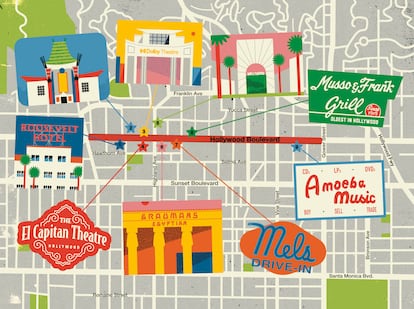
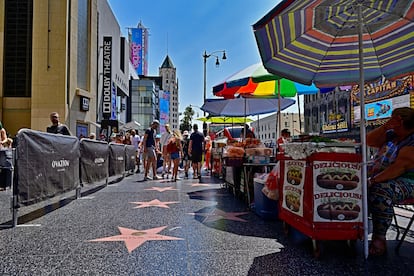
Hollywood Boulevard stretches from the canyons of the West and blends into Sunset Boulevard to the east. But its heart, across roughly 18 blocks from La Brea to Gower streets, is the Walk of Fame. With 3,000 stars peppering the sidewalks on both sides, everything happens on the Walk. It is Hollywood’s foundational street, and its fascination endures. Walking it all at a steady pace takes just over half an hour, but it’s almost inevitable to spend a couple of hours exploring it.
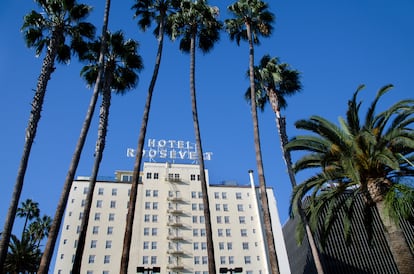
That is, if you’re quick with photos. The boulevard is, logically, one of the most photographed places in the world, by amateurs and professionals alike. As soon as you start walking east past the famed Roosevelt Hotel, where the first Oscars were held back in 1929 and where a young aspiring actress named Marilyn Monroe lived in the pool bungalows for a couple of years, the grandeur of the Walk arrives. If it’s daytime, the phones fly out; at night, the photographers show up. In the short stretch between Orange and Highland streets, three giants of American and global film culture are concentrated: the Chinese Theatre, the Dolby Theatre, and the El Capitán Theatre. And that is even though they aren’t strictly theatres.
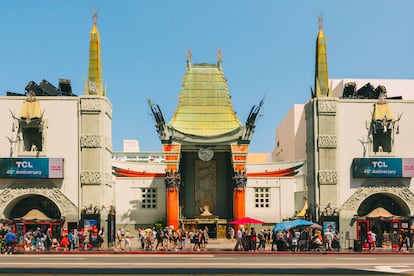
In fact, all three are movie houses. The main auditorium at the Chinese Theatre, which seats a thousand people, is the third largest in North America and it was where classics such as The Wizard of Oz and Star Wars were first shown. Throughout the year, but especially late in the year—the high season for premieres—it’s not hard to catch a star stepping out of a huge black car on their way to a premiere photocall. But if its interior is historic, so too is its forecourt, which competes in Hollywood-ness with the pink-and-gold terrazzo stars of the Walk. There, more than 200 actors, directors and even athletes (like the much-loved and remembered Kobe Bryant) have left their hand and foot prints over the last 100 years. The idea came from its promoter and mastermind, Sid Grauman, who saw that cinema would be a place for dreams but also for the masses. Today the tourists try to fit their giant sneakers into Sophia Loren’s tiny heels.
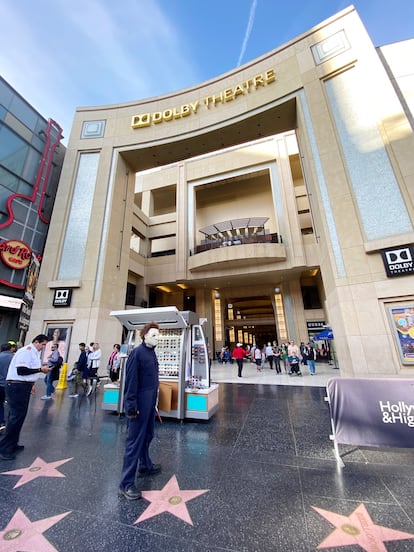
Wall to wall is the Dolby, the grand golden movie house built to host the Academy Awards, which will leave it in 2029 to move to downtown Los Angeles. But in its 25 years the Dolby, which in March causes streets to close and brings chaos to the neighborhood—has grown up with elegance. It hosts premieres, film festivals and galas and is part of the small shopping paradise on the Walk, an open-air mall called Ovation, with exhibitions, shops, restaurants and, best of all, one of the brightest views of the Hollywood sign. After all, it’s in the neighborhood. A visitor only needs to climb a couple of flights of stairs to take the best photos of the nine white letters, though they’ll glimpse the sign from various points along the street. Here you can even sit at a public table (rare in these parts), burger and soda in hand, and eat American-style facing the sign and the hills. As well as the unstoppable traffic that runs up and down Highland, entering and leaving Hollywood and the rest of the city.
When you come down the Ovation steps you’ll come face to face with the handsome El Capitán, six refined Art Déco floors celebrating its centennial this year. Originally owned by Paramount, Disney bought it in the late 1980s and spent $14 million renovating it, with success. If you decide to see The Little Mermaid on an ordinary day, you might first hear the pianist performing the film score live there. And during the week you might run into Jimmy Kimmel and his crew: the late night host’s venue (and his star on the ground) is right next to El Capitan, where each afternoon at around 4 pm he records the show that is broadcast every night.
Disney is not the only company to have taken a piece of the Walk of Fame. Netflix put $70 million into the Egyptian Theatre when it bought it during the Covid pandemic to restore it. The world’s first major movie premiere—with a red carpet and exploding flashes—for Douglas Fairbanks’s 1922 Robin Hood was held there. The mind behind it was Grauman himself.
Near the Egyptian is one of the Walk of Fame’s few gastronomic temples, aside from the street hot dog stands and fun diners like Mel’s, recognizable by its giant dinosaur on the roof. It’s Musso & Frank, an institution for the best martini in town, referenced by Quentin Tarantino (see his Once Upon a Time in... Hollywood) and by Taylor Swift (listen to her Elizabeth Taylor). Come in, eat—and be prepared to pay. You may also spot a celebrity sitting in its dark leather booths.
From there to the end, the street frays. There are hidden gems, like vast wig, costume and toy shops, or Larry Edmunds, a bookstore specializing in film books, with original scripts for sale. There are huge Scientology churches and specialty coffee shops on the corners. A yummy taco truck sometimes shares space with many of the homeless people who inhabit the sidewalks. There is filth, chaos, sometimes shouting, the smell of spilt beer underfoot. On Sundays, orange peels and revelry fill the street market that runs parallel on Selma Street.
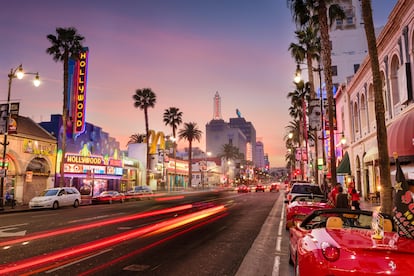
There’s more toward the end. For collectors, there is the music lover’s paradise that is Amoeba Music, self-styled as the largest independent record store in the world. For theatergoers, the Pantages, a beautiful 1920s theater that hosts touring Broadway productions. And for movie obsessives, the Fonda Theatre, named for Henry Fonda. And stars—stars that continue to cover the avenue, with fewer and fewer gaps for new ones.
Hollywood Boulevard is not the prettiest street this side of the Mississippi, nor even in Los Angeles. It is not in the tidiest neighborhood. It is not elegant, refined, restrained or a gourmet paradise. It does not smell good. There is poor lighting and little shade. But it is not lacking in charm—perhaps a little anarchic, a little shabby. For someone who spends only a few hours or days in L.A. it is a must-see, perhaps even the trip’s only stop. It may disappoint. It may enchant. With a little luck, both.
Sign up for our weekly newsletter to get more English-language news coverage from EL PAÍS USA Edition









































