
How the Spain coach spent over a decade recruiting the players who will be at the World Cup final
Luis de la Fuente began his winning streak in 2015 with Unai Simón, Merino and Rodri in the U-19s and has been slowy adding players to build a powerful squad: ‘As a team, it is unstoppable’
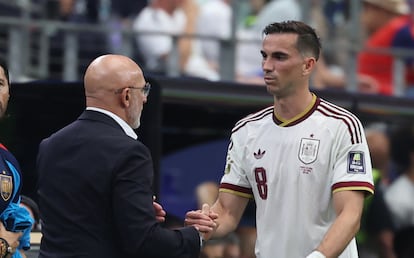

Luis de la Fuente’s international career began badly in a semifinal against France, and he came within a step of reaching the highest summit also in a semifinal against France. And in both matches, separated by 13 years, Aymeric Laporte was there. This Tuesday, after qualifying for the World Cup final with a commanding performance at the Dallas stadium, the Spain coach took a moment to recall where they had come from, the moment he began recruiting the players for this dazzling squad. “We embraced,” he said. “And we told each other: ‘Who would have thought, back in 2015, that 11 years later we would find ourselves in the final of the World Cup after the journey we’ve had?’”
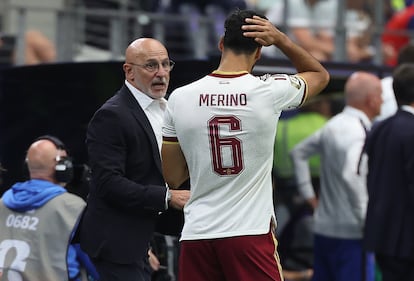
De la Fuente won the U19 European Championship in 2015 with a team that included Unai Simón, Rodri and Mikel Merino, the first with whom he began to win, the genesis of this group that already has a Nations League and a European Championship under its belt.
His early days with the national team were a mix of frustration and anguish, beginning when he came across an ad in a sports newspaper saying the Royal Spanish Football Federation was looking for a coach for the youth categories. It was 2013 and he had been unemployed for more than a year, with no income and growing concern that the calls he was counting on were not coming. On May 1 he signed a three-month contract to take the U-19s to the European Championship in Lithuania. It was an express mission, a trial by fire.
His team reached the semifinals and France eliminated them in extra time (1-2) on July 29. Thirteen years later, at Tuesday’s match in Dallas, no player from that Spanish squad remained. There were, however, two from the French side: Rabiot and Laporte, who now plays for De la Fuente after becoming a Spanish national in 2021. “What a thing! A player who has been one of our pillars in the senior Spanish national team in recent years,” the coach writes in the autobiographical book published shortly before the tournament.
But he did not win right away. In 2014 he missed out on qualifying for the U-19 European Championship. Germany, featuring Kimmich and Sané, stopped them. “Those were hard moments,” he writes; “because we saw we had a good team, but, of course, you were playing against the best squads in the world, against the great players of the future, and I began to understand the difficulty of national-team football.”
This Tuesday, after reaching only the second World Cup semifinal in Spain’s history, and besides celebrating the journey and the place where success was born, De la Fuente reviewed some of the lessons he has learned along the way. “The most important thing is knowing how to choose the companions on the journey. If you make a mistake, you can have problems. We have placed a lot of emphasis on that. It makes the journey much better. We have the best companions.” In the more than three years he has led the senior team, he has repeatedly stressed the importance he places on surrounding himself with good people.
In 2019 he won the U-21 European Championship. Unai Simón and Mikel Merino were still with him. Rodri would also have been there if that summer he had not completed his transfer from Atlético de Madrid to Manchester City. He asked to be excused. At the tournament in Italy, Fabián, Dani Olmo and Mikel Oyarzabal joined De la Fuente’s ranks. In 2021 he continued to add to his record: he won Olympic silver in Tokyo with Eric García, Cucurella, Zubimendi and Pedri.
After knocking off France in Dallas with 10 players he has been winning with for years, De la Fuente revealed what he told them before the semifinal. And in fact it was also a description of what he has been building for more than a decade. “The message was that we were facing one of the best national squads in the world, but that the latter would be facing the best team in the world,” he said. “That is the key: this is a team, and as a team it is unstoppable.”
Several long-serving RFEF employees say the group the coach has assembled not only wins but also captivates with its sensitivity and spirit. Last Friday, minutes before the quarterfinal began, the federation photographer Ángel Martínez learned that his mother had died in Spain. He worked during the match. When it ended, Aitor Karanka learned the news and told De la Fuente, who called the photographer into the locker room, where the players surrounded him in a collective embrace before he left for Spain, a gesture that moved him.
Sign up for our weekly newsletter to get more English-language news coverage from EL PAÍS USA Edition









































