Challenges of Fujimori’s presidency: reinforcing public safety and uniting a fractured country
The president-elect will officially take power on July 28 after winning on her fourth try by a tiny margin. One of her challenges will be to serve out her entire term, something beyond the grasp of the eight elected officials who preceded her
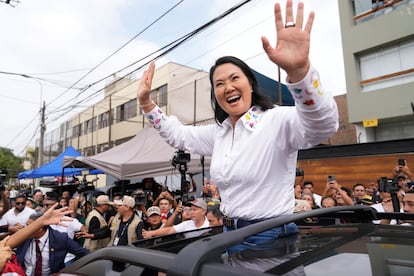
It may not seem like a special achievement, but making it to the end of the five-term presidential term in Peru is something that, in the last decade, has been beyond the grasp of the eight elected officials who preceded the 51-year-old conservative Keiko Fujimori. Longevity will be one of the primary goals of the first woman to arrive to the executive office by votes, after she beat — by a narrow margin of 49,000 ballots, less than 1% of voters — her leftist rival Roberto Sánchez. It was her fourth try after three consecutive defeats, in a country immersed in political instability and fractured by inequality, ideological differences and territorial tensions. The southern part of the country, impoverished and primarily Indigenous, presents a particular challenge to her power.
Fujimori will have to apply all the perseverance she displayed for becoming president towards winning over the half of the electorate that didn’t vote for her — in fact, Sánchez won the vote within the country’s borders, with the votes of Peruvians abroad turning the final count to Fujimori — and convincing them with the new public image she is being to assemble.
On the international stage, she will be surrounded by ideological allies throughout Latin America and the United States, which considers the region part of its area of hegemonic influence. Amid its effusive congratulations to the new president on social media, the U.S. Secretary of State placed an emphasis on security: “The Trump Administration looks forward to deepening collaboration with the Fujimori Administration to advance security cooperation and to strengthen bilateral cooperation on investment and trade in our region.”
Fujimori’s response to the U.S. ambassador in Peru was also enthusiastic, offering “utmost willingness” and saying her team was “ready to work collaboratively starting day one.” From Bukele in El Salvador to Milei in Argentina and De la Espriella in Colombia, Latin America’s right-leaning and far-right presidents also offered their congratulations to Fujimori.
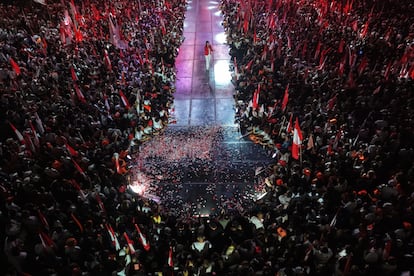
Since the end of her campaign, she has spoken little and when she has, it has been in a measured tone: “beginning a road of order and hope”, “searching for reconciliation and unity” and “governing for all Peruvians.” What all this will translate into is still a question mark. For now, Fujimori has announced a plan to prepare for El Niño, which could start having more intense effects on the country due to climate change, and lead to potential flooding.
Attracting private investment and incentivizing small business is another of Fujimori’s priorities, which is why one of her first acts as president-elect was a trip to the Central Reserve Bank. There, she had a meeting with bank president Julio Velarde, and requested that he lead the institution for five more years, a proposal he accepted immediately. The choice looks to send a signal of continuity when it comes to monetary policy and market stability, which is no minor matter. Velarde has led the bank since 2006 and in under two decades, has seen 10 presidents of the republic come and go. In a country of political crises, Velarde is the most recognizable face of economic stability.
But Fujimori’s primary challenge is related to Peruvians’ top concern: public safety. The latest report from the attorney general’s office paints a picture of the magnitude of crime in Lima, with 152 murders linked to extortion, a prevalent offense that affects public transportation drivers, but also small business owners, since 2024. Fujimori promised during her campaign that she would combat the issue, and connected her father’s legacy of ending terrorism in the 1990s to her plans of fighting organized crime today. She proposed, among other measures, attacking the groups’ financial structures, military patrols on public transit, and imposing work requirements on prisoners to earn their food.
Since election results became official on July 3, she has started an account on social media to portray the transfer of power, in which she strikes an executive and expeditious figure. The account’s content consists of short videos in which Fujimori appears speaking by video call or telephone with political figures — for example, she chats with opposition leaders like Spain’s Alberto Núñez Feijóo, and Venezuela’s Maria Corina Machado; presidents like Javier Milei, to whom she complained about the bureaucracy she was encountering in Peruvian government, telling him she would apply “similar” measures to the ones he has carried out in Argentina — and ambassadors, like the one from China.
Fujimori’s Popular Force party has the greatest number of representatives in both legislative chambers. Even so, there is fierce leftist opposition that has not accepted defeat, filing complaints of electoral fraud with the Inter-American Commission on Human Rights, and convening a protest march that was slated to take place on Wednesday. Opposition leaders are aware that in the past, a section of society united under the banner of anti-Fujimorism, a broad and heterogeneous movement whose primary goal was for years blocking her path to the presidency. The group’s mobilization was not sufficient on this occasion, but it remains, uniting not only the left, but also social movements from human rights to feminism.
Fujimori is aware that part of the population considers her party one of the drivers of the country’s political instability after approving a law in Congress that transfers jurisdiction of crimes committed by police officers and military personnel to the military courts, setting the stage for potential impunity. “What is coming is a bolstering of executive power that threatens the independence of other institutions. [Fujimorism] already controls the Constitutional Court, the Public Defender, the military, the courts,” says political scientist Paula Távara. “The closest thing to institutional opposition is the judicial power.”
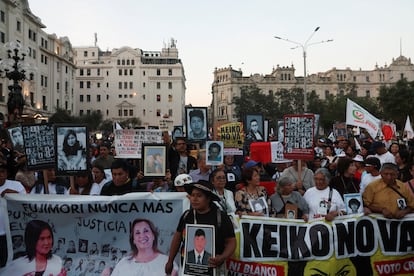
Fujimori also knows that her last name, and the controversial legacy of her father, ignites polarization and arouses fear. Particularly in two areas: historic memory and the defense of human rights. That is not only due to the president-elect’s family history — her father, the autocrat Alberto Fujimori, was convicted of crimes against humanity — but also due to the path followed by Popular Force, including the law to benefit members of the military and law enforcement under investigation for or who have already been convicted of human rights violations during the period of violence that shook Peru between the 1980s and 2000s.
The weight of history
Historian Manuel Burga heads the Place of Memory, Tolerance and Social Inclusion, a building set in front of the Pacific Ocean, where photographs, testimonies and objects reconstruct one of Peru’s most painful eras. He thinks that it is necessary to preserve the memory of the abuses committed by terrorists and by the armed forces. Asked about the future administration of the autocrat’s daughter, he says, “I don’t think that they are interested in memory. They are interested in the memory of those they call the victors over terrorism and the restorers of democracy.”
For Burga, such memorial sites shouldn’t depend on the will of the government, but rather, that of a society that is still trying to understand its own history. “The richness of memory lies in its diversity and the acceptance it has within civil society. What the state shouldn’t do is promote a specific agenda, because that can turn into the manipulation of memories.” He underlines the fact that the country still has around 20,000 disappeared people. For him, memory continues to be unfinished work.
Teresa Carpio, who led Amnesty International from 2000 to 2004, the years during which the Alberto Fujimori regime fell and the country returned to democracy, finds many parallels between that era and the discourse embracing her father’s legacy that Keiko Fujimori’s campaign has employed. “It was a period of our history in which the independence of powers and human rights were not respected. To the contrary, their idea of order was to control society, information and all institutions.”
For Carpio, some of the laws being promoted by Popular Force, such as the one that shields police officers and members of the military from civil liability, foreshadow the direction the new government may take. “They are laws that are in line with everything her father did. We spent years carrying out a campaign against torture and the persecution of journalists. But everything points to a return to the past, which has already begun even before she takes power.” A few weeks away from the presidential inauguration, the future administration is already the subject of suspicions that before looking ahead, it is attempting to rewrite the past.
Sign up for our weekly newsletter to get more English-language news coverage from EL PAÍS USA Edition