
Keiko Fujimori secures victory in Peru’s presidential election after taking an unassailable lead
Her left-wing rival, Roberto Sánchez, alleges fraud and refuses to concede defeat
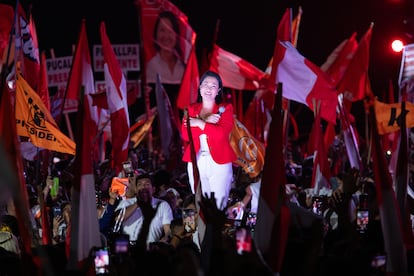

Right-wing politician Keiko Fujimori, 51, is set to become Peru’s new president — the country’s ninth in a decade. Seventeen days after the election, with the slow count 99.8% complete, Fujimori (50.1%) holds a lead of around 43,386 votes that her rival, leftist Roberto Sánchez (49.8%), can no longer overturn, as only 40,213 ballots remain to be counted. Her victory has come slowly and amid Sánchez’s fraud allegations. It was the fourth time that the daughter of autocrat Alberto Fujimori — the figure who has most shaped and divided the country’s politics — ran for the presidency, and she has done so while championing her father’s controversial political legacy.
Fujimori will preside over a deeply divided country with fragile institutions and mired in instability, after suffering three consecutive electoral defeats. This time, her persistence has proved stronger than anti-Fujimorismo, the powerful and diverse movement opposed to her. She proved stronger by exactly 42,000 votes in a country where recent elections have been decided by razor-thin margins, as in this case, of less than 1%.
Overseas voting proved decisive in her victory, especially in the United States, home to the largest Peruvian community abroad. Challenging these votes at every possible level has been the main strategy of her rival, who said this week that he would not recognize Fujimori’s victory and has announced new mobilizations by his supporters. This stance, widely criticized in Peru, mirrors that of Keiko Fujimori herself when she lost in 2021 to Pedro Castillo, who is now in prison for attempting a self-coup.
She will be the country’s first elected female president — Dina Boluarte assumed the presidency through constitutional succession after Castillo’s removal — and will be surrounded by ideological allies in a Latin America governed by right-wing and far-right leaders under the influence of Donald Trump’s United States.
Campaigning under the slogan “Fujimori returns, order returns,” Keiko has focused on the country’s security crisis, the issue that most concerns Peruvians, citing rising homicides and extortion targeting small businesses, shops, and especially urban transport drivers. To tackle this problem, she has promised to organize street patrols involving the military, immediately expel migrants who commit crimes, and require prisoners to work for their food, among other measures.
Throughout the campaign, Fujimori attempted to equate her father’s fight against terrorism in the 1990s with today’s battle against crime. But Alberto Fujimori’s legacy is double-edged: while many credit him with ending hyperinflation and defeating terrorist groups, it is also marked by his authoritarian rule following a self-coup, as well as corruption and human rights abuses, including the Barrios Altos and La Cantuta massacres, along with disappearances and the forced sterilization of thousands of Indigenous women. He served 16 of a 25-year sentence before being pardoned near the end of his life in a move criticized by international bodies, and he died in 2024.
This victory has the potential to deepen the country’s social and political divisions — not only because recent presidents have struggled to complete their terms, but also due to the polarization generated by Fujimori herself, who has wielded considerable power in Congress in recent years.
Her party, Popular Force, is the largest in Parliament, but she will need to negotiate alliances to pass reforms in a highly tense environment. This is set to be her main challenge. She will have to govern for the half of the population that did not vote for her, especially in poorer rural areas. At the same time, she faces a left-wing opposition that insists on alleging fraud and is calling for mobilizations, as well as the broader anti-Fujorismo movement, which includes everyone from feminist groups to a variety of social movements.
Sign up for our weekly newsletter to get more English-language news coverage from EL PAÍS USA Edition









































