
Delays in Peru vote count: a month of speculation, suspicion and doubt
With both presidential contenders neck and neck, supporters of leftist candidate Roberto Sánchez are calling to ‘defend the people’s vote’ against what they see as a risk of interference

Peruvians who went to the polls this past Sunday to vote in the presidential runoff will not know who their president is until July. One month is how long the National Jury of Elections estimates it will take to review the 1,555 tallies that have been challenged, a spokesman confirmed on Tuesday. Two days after voting, uncertainty over a result that will be decided by about 25,000 votes between the leftist candidate Roberto Sánchez and the right-wing Keiko Fujimori is turning into weariness and allegations of fraud on the streets and social media.
The slow count threatens to deepen distrust of politicians and institutions amid the instability of recent years: Peru’s next leader will be the ninth in 10 years. “Something is happening, that’s for sure, because we should already have the results. Although it is also true that in recent elections we’ve had these delays, that they deliberately cause to destabilize, so that Keiko wins. ‘La china’” —(“The Chinesewoman” as her supporters also call her, although she is of Japanese descent— “wants to govern at any cost; she has tried four times and hasn’t managed it,” says Sofía, 60, in her housewares shop in central Lima.
She voted for Sánchez, not because he was her preferred candidate, but to stop Fujimori, whom many see as the instigator of the country’s political instability. Three of the country’s eight last presidents were removed by the powerful Congress where Fujimori’s party, Fuerza Popular, is dominant. It is the fourth consecutive presidential bid for the daughter of the autocrat Alberto Fujimori —who used her father’s anti‑terrorist legacy against the Shining Path to address today’s rising crime, despite the stain of human rights abuses.
Besides the challenged tallies, which come mostly from Lima, where Fujimori has her electoral stronghold, and from some rural areas of Peru, there is the overseas vote, which usually favors Fujimori, particularly in the United States, home to the largest Peruvian community abroad. So far only one third of that overseas vote has been counted, in which she has 64.6% against Sánchez’s 35.3%.
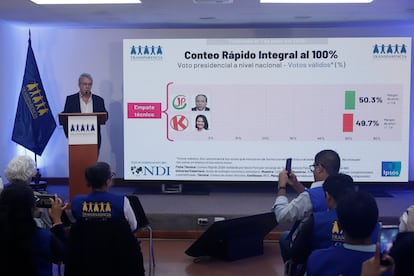
As the official count progresses —they are already at 97%— Fujimori has been narrowing the gap with Sánchez, whom Ipsos’s vote projection on election night gave a slight 0.6 percentage point edge, within what is considered a technical tie with a 1.9% margin of error. Anti‑Fujimori activists, a powerful and diverse movement formed around rejection of Keiko and her father’s authoritarian legacy, have begun to fear an adverse outcome on social media and to question the integrity of the process.
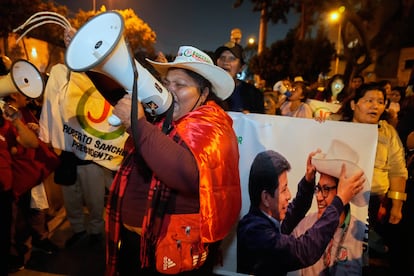
In such a tight contest and a polarized atmosphere, remarks by the president of Ipsos Peru, Alfredo Torres, inflamed tensions. On Monday night he said in an interview: “The truth is that, in the majority of scenarios, Fujimori wins, but narrowly (...) the models that have been developed, in most cases, put Fujimori slightly ahead.” Hours later, supporters of the leftist Sánchez organized a demonstration in front of the National Jury of Elections office to shout slogans such as “The vote must be respected! Not one step back, the struggle continues!” “We have come to safeguard the people’s vote,” said Samuel Breña, 54.
Sánchez supporters fear there could be fraud or that the remaining tallies will be manipulated, not so much because of the Ipsos president’s words but out of sheer distrust of Fujimori. “Peru is polarized and we have doubts. Until the count is finished you cannot say we have won, but there have been many incidents,” said Carlos Lavander, 61, a lawyer for Sánchez’s party Juntos por el Perú, at the rally. “We are afraid valid votes will be annulled.” A couple of hours later Juntos por el Perú called a national march for Friday. “It is evident there is a whole right‑wing plot to preserve political power,” a party spokesman said.
One month is also a long time for economic decision‑makers, as the uncertainty of not knowing the winner when the choice is between two very different models can affect them. “If you already have an investment under way, you are not going to stop it because of this, but for new investments, it may happen that they will wait to see who wins and what is riskier,” argues Jorge Carrillo, a finance expert at Pacífico Business School. “It could also affect those about to take out a mortgage to buy a house; depending on the model, the rules could change, and that creates uncertainty.”
The choice between two widely divergent visions for the country provokes investor fears, and the doubts will take a month to be dispelled. “An investor wants to have clear rules of the game, so a constitutional change like the one Sánchez proposes is the biggest concern. On the other side, there is worry about the social reaction that could follow a Keiko victory, which could generate a lot of animosity,” Carrillo adds.
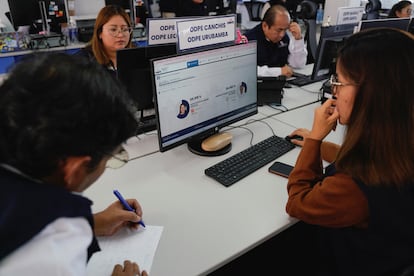
The counting is slow because Peru does not use a digitized system, something that has been noted by the Organization of American States observation mission in its preliminary report on Tuesday. “We have mentioned in previous reports the need for a rapid transmission system of preliminary data that are later confirmed by the physical vote count (...) and that is done through digital means; it is the convenient way,” said the head of the mission. The European Parliament mission, for its part, expressed concern about the slowness in the “announcement of results that, far from guaranteeing the process, creates a climate of greater distrust and unease among the population.”
On the streets the memory of the first round is very present, when there was an agonizing month‑long count, marked by logistical problems and virulent fraud allegations from the far‑right candidate, who had been the favorite among 35 others to face Fujimori. When Sánchez overtook him, boosted by votes from rural southern areas, insults erupted alleging a rigged count for which there is no evidence. Now, many assume there will be such accusations again. One of Fujimori’s voters, José Luis Maldonado, 44, says in a central Lima market that although “fraud is already being talked about, one must accept whatever the result is. They still have to count the votes.”
Sign up for our weekly newsletter to get more English-language news coverage from EL PAÍS USA Edition









































