
Trump administration steps up fight to block undocumented students from attending college
Colorado becomes the 14th state the government sues for refusing to discriminate against students based on immigration status
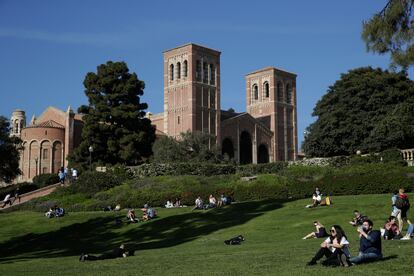

Colorado has become the latest target of the Donald Trump administration’s campaign against students who are not U.S. citizens or lack permanent resident status. The Department of Justice (DOJ) filed a lawsuit on July 23 against the state for allowing undocumented students to access in-state tuition rates, which are lower than those charged to out-of-state students. That brings the total to 14 lawsuits filed against states that do not discriminate against students based on immigration status.
Texas, Kentucky, Oklahoma, Nebraska, Illinois, Minnesota, Virginia, California, New Jersey, Kansas, Massachusetts, Rhode Island and Maryland have received similar complaints in which the DOJ makes a largely consistent argument: state laws violate federal law by offering undocumented students benefits not available to all U.S. citizens.
“An alien who is not lawfully present in the United States shall not be eligible on the basis of residence within a State (or a political subdivision) for any post-secondary education benefit unless a citizen or national of the United States is eligible for such a benefit (in no less an amount, duration, and scope) without regard to whether the citizen or national is such a resident,” reads the complaint filed against Maryland on July 16, citing Section 1623 of the U.S. Code.
The high tuition charged by U.S. colleges and universities has become a major obstacle for many families, who turn to loans and financial aid to pay for higher education. Sometimes students have no choice but to end their studies after high school. In households with undocumented members, financial situations are more likely to be precarious because the jobs available to them typically pay lower wages.
“Today the Department of Justice filed a lawsuit to take away an opportunity from Maryland students who grew up here, graduated here and are working to achieve more for themselves, their families and the communities where they live. We are carefully reviewing the complaint. We will respond in court, as we always do when Maryland laws are challenged, and we will continue fighting for the young people of our state and their future,” Maryland Attorney General Anthony Brown said in a statement.
Eligible for taxes, not for benefits
Under Maryland law, undocumented immigrants who reside in the state, graduated from a state high school, have paid state income taxes for at least two years and apply for permanent resident status within 30 days of meeting the requirements —among other conditions— may qualify for the reduced in-state tuition rate available to resident citizens.
At the public University of Maryland, in the 2025-2026 academic year, in-state tuition was $12,008, while out-of-state tuition was $41,974. To that must be added room, board and course materials. Overall, the university estimates annual expenses for a student living in Maryland at $32,408, compared with $62,374 for a student residing in another state.
The DOJ’s complaint estimates that Maryland’s law saves immigrants about $9 million a year, savings that, in its view, come at the expense of U.S. citizens.
“There’s a false narrative that immigrants are hoarding resources that should go to Americans. That is simply not true. Immigrants pay taxes and fund many programs that benefit Americans, but which they themselves cannot access,” said Corinne Kentor, senior manager for research and policy at the President’s Alliance on Higher Education and Immigration, an alliance of about 600 college and university presidents and chancellors focused on higher education and immigration policy.
The assault on college access for undocumented students is part of the Trump administration’s broader campaign against migrants, which besides deportations has opened other fronts such as removing their work authorization, restricting access to health and food assistance, and limiting educational opportunities.
Since 2001, nearly half of U.S. states, plus the District of Columbia, have adopted some version of an in-state tuition equity policy to expand access to resident tuition—and in some cases to financial aid. Many states do not verify immigration status, while others, such as Georgia and South Carolina, bar noncitizens or non–permanent residents from enrolling in public higher education institutions.
The legal fights in the courts have sometimes favored the states and other times the federal government. Federal courts have already struck down similar policies in Texas and Oklahoma, while Kentucky agreed to end its program after being sued. Earlier this year, a federal judge dismissed a similar suit in Minnesota. Legal challenges, however, continue with appeals of many of the rulings already issued.
“The state policies being challenged are not based on residency; therefore, while the claim may be correct with regard to federal financial aid law, it is not accurate about how those policies are structured at the state level. Criteria can include attending a state public high school or earning a GED or high school diploma in that state. Those are the specific criteria, so this affects not only undocumented students but also many others,” Kentor explained.
In the most recent lawsuit, the one filed against Colorado, the attorney general reiterates the argument that allowing undocumented students to pay the same tuition as U.S. citizens harms the latter and encourages irregular immigration. Opponents of the ban say excluding academically qualified students because of their immigration status would remove their contributions to their communities, deprive crucial labor needs and weaken the economy.
In Florida, where last year Governor Ron DeSantis already excluded undocumented migrants from state student tuition rates, the Board of Education voted on June 30 to restrict their access to public universities starting in the 2027-2028 academic year. “This proposal would prevent thousands of undocumented students from accessing higher education and most of them have no guidance to navigate this process. Students like me will be forced to leave the institutions and communities we consider home, delay our studies or seek completely new routes to obtain a degree,” said Carlie, a Florida student, upon learning the news.
Sign up for our weekly newsletter to get more English-language news coverage from EL PAÍS USA Edition









































