
Jimmy Kimmel returns with an emotional, defiant monologue: ‘Our government cannot be allowed to control what we say on TV’
The comedian, who was suspended a week ago over a remark about the alleged killer of MAGA activist Charlie Kirk, spoke out against Trump’s efforts to silence critics
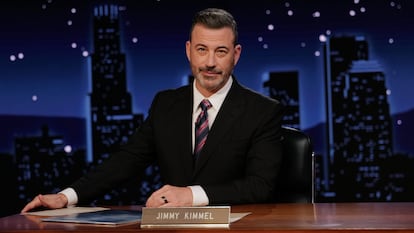
Comedian Jimmy Kimmel has hosted the Oscars four times. The Emmys, three. But perhaps none of his monologues had ever been awaited with such anticipation as the one this Tuesday, seven days after the final broadcast of his late-night show and eight nights since a comment about the identity and motivations of the alleged killer of Trump activist Charlie Kirk sparked a controversy that led to the show to be suspended “indefinitely” — a move ordered by his network, ABC, and upheld by its parent company, Disney.
That decision placed the comedian at the center of a debate over freedom of speech in Donald Trump’s second term, and this Tuesday, at around 11:35 p.m. (East Coast time), he returned — one day after Disney revoked the cancellation — with an emotional and defiant monologue lasting nearly half an hour (instead of the usual 10 minutes). In the monologue, which reached a million views in its first hour on YouTube, he mocked Trump, highlighted the contradictions of his administration regarding the First Amendment, criticized the White House’s attacks on the press, and, through tears, praised Kirk’s widow, who on Sunday, during a massive memorial celebration, said she had forgiven her husband’s killer.
Kimmel opened his monologue with the phrase: “As I was saying before I was interrupted...” Then, he went on the offensive and offered an apology with a trembling voice. “our government cannot be allowed to control what we do and do not say on television,” he declared. “I’ve been hearing a lot about what I need to say and do tonight, and the truth is, I don’t think what I have to say is going to make much of a difference. If you like me, you like me, and if you don’t, you don’t [...] But I do wanna make something clear because it’s important to me as a human, and that is: You understand that it was never my intention to make light of the murder of a young man.”
Holding back emotion, the comedian said that on the day Kirk was killed, he posted a message on his Instagram account sending love to his family and asking for compassion. “I meant it, and I still do. Nor was it my intention to blame any specific group for the actions of what was obviously a deeply disturbed individual. That was really the opposite of the point I was trying to make.”
Kimmel was referring to the comment at the center of the controversy. This one: “We hit some new lows over the weekend with the MAGA gang desperately trying to characterize this kid who murdered Charlie Kirk as anything other than one of them,” Kimmel said the night before authorities, last Tuesday, offered more details about Tyler Robinson’s turn to left-wing politics. Robinson, a young man from a Mormon, Republican family, now faces the death penalty for allegedly shooting the MAGA youth leader in the neck while he was speaking at a university in Utah.
“I understand that (to some) that felt either ill-timed or unclear, or maybe both, and for those who think I did point a finger, I get why you’re upset. If the situation was reversed, there’s a good chance I’d’ve felt the same way,” Kimmel continued in his monologue following the return of his show. He also said he had “many friends and family members on the other side” — making air quotes with his fingers and referring to Republicans — “who I love and remain close to, even though we don’t agree on politics at all. I don’t think the murderer who shot Charlie Kirk represents anyone. This was a sick person who believed violence was a solution and it isn’t — ever."
The comedian thanked his audience, those who had called him in recent days to show support, comedians from countries where censorship is state policy, as well also his rival late-night hosts, who came to his defense on their shows. Kimmel also thanked even his own network executives, for allowing him, over 23 years and more than 4,000 episodes, to criticize them and “stretch the boundaries of what was once traditional for a late-night talk show.” “Most of all,” he continued. “I want the people who don’t support my show and what I believe, but support my right to share those beliefs anyway."
Kimmel then highlighted voices from the right who had spoken up for him in recent days. “I never would have imagined Ben Shapiro, Clay Travis, Candace Owens, Mitch McConnell, Rand Paul, even my old pal Ted Cruz who, believe it or not, said something very beautiful on my behalf. [...] it takes courage for them to speak out against this administration, and they did, and they deserve credit for it.”
At another point, the TV star reinforced that idea, saying he had learned from some of the great comedians of this country, from Lenny Bruce to Howard Stern, that “a government threat to silence a comedian the president doesn’t like is anti-American.”
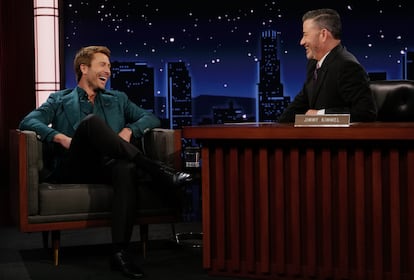
In response to Kimmel’s return to air —when many already considered him finished — Trump posted a message on his social network a couple of hours before the show began, expressing disbelief at the news: “The White House was told by ABC that his Show was cancelled!”
“Why would they want someone back who does so poorly, who’s not funny, and who puts the Network in jeopardy by playing 99% positive Democrat GARBAGE,” he posted on Truth Social. “I think we’re going to test ABC out on this. Let’s see how we do. Last time I went after them, they gave me $16 Million Dollars. This one sounds even more lucrative. A true bunch of losers!
In that post, Trump was alluding to an out-of-court settlement he had reached with ABC. The agreement resolved a lawsuit he had filed after one of the network’s anchors mistakenly reported details about the civil trial launched by columnist E. Jean Carroll in which he was found guilty of sexual abuse — but not rape, as the journalist had reported.
Trump did not temper his words in his fiery post on Truth Social. And yet, Kimmel’s show was not aired at the White House... or anywhere else in Washington. Two groups of ABC-affiliated local stations that together cover around 25% of U.S. territory — Sinclair, whose owner is a well-known Trump supporter, and Nexstar, the most widely spread across the country and the one behind the initial suspension — decided not to broadcast Kimmel’s program.
Among the places where the content was banned was the capital itself (something Kimmel highlighted in his monologue), where Sinclair chose instead to air a rerun of a dull news program. In a city where politics is a drug that has much of the population hooked, the same political junkies who at that hour are usually glued to CNN, MSNBC, or Fox News for the latest twist in the news cycle spent the afternoon figuring out how not to miss Kimmel’s monologue. Looking for a pirate signal? Driving to nearby Baltimore? Or waiting for the delayed broadcast on YouTube?
The monologue also couldn’t be seen on TV by Brendan Carr, chairman of the Federal Communications Commission (FCC), who had pressured ABC into suspending the show — and who also lives in Washington. Carr said last week on a podcast that Kimmel’s comment about Charlie Kirk’s murder was grounds for dismissal. He also said: “We can do this the easy way or the hard way.” That afternoon, Nexstar, which owns 200 stations that carry ABC content and is awaiting FCC approval for a major deal, announced it was pulling Kimmel off the air. Disney-owned ABC soon followed suit.
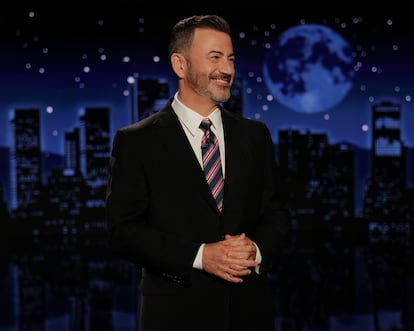
In his monologue on Tuesday, Kimmel made special mention of the FCC chair. Kimmel resurrected a tweet in which Carr had praised political satire as the ultimate expression of free speech, and said “Carr is the most embarrassing car Republicans have embraced since this one," before showing a photo of a Trump-branded Tesla.
At the end of the monologue, Robert De Niro — the quintessential gangster of the movies — pretended to be the FCC chairman in one of the funniest moments of the night. Then, in his usual style, Kimmel shifted to criticizing Trump, specifically his appearance at the U.N. General Assembly. Just another day.
After Colbert
Trump had already set his sights on Kimmel after Stephen Colbert announced in July that his show, on rival CBS, would end at the close of this season by decision of the network — after it had to pay $16 million to the U.S. president to settle a defamation lawsuit. Consequently, Trump said that Kimmel was “next” in the firing line, arguing the comedian had “absolutely no talent” and that his show didn’t get good ratings.
“I do tonight,” Kimmel replied on Tuesday, in his first show since the suspension was lifted. “[Trump] forced millions of people to watch the show. That backfired bigly. He might have to release the Epstein files to distract us from this,” he addded, alluding to the alleged client list of billionaire pedophile Jeffrey Epstein.
In the two days following the show’s cancellation, Trump intensified his attacks: since the networks that air late-night shows are against him, he told reporters at the White House, “I would think maybe their license should be taken away.” “They‘ll take a great story and they‘ll make it bad. See I think it’s really illegal, personally,” he argued on Friday.
The mere idea of canceling a comedian’s show for criticizing the president, by pressuring a private network, set off alarm bells in a country that venerates the freedom of expression guaranteed by the First Amendment — a principle that Kirk himself had embraced as an absolutist. Carr (and Trump) also faced heavy criticism from prominent MAGA figures, including broadcaster Tucker Carlson, Senator Ted Cruz, and influencer Ben Shapiro. Kimmel also noted this in his monologue.
In a more serious tone, Kimmel said: “The president of the United States made it very clear he wants to see me and the hundreds of people who work here fired from our jobs. Our leader celebrates Americans losing their livelihoods because he can’t take a joke.”
He continued: “He was somehow able to squeeze Colbert out of CBS. Then he turned his sights on me, and now he’s openly rooting for NBC to fire Jimmy Fallon and Seth Meyers, and the hundreds of Americans who work for their shows, who don’t make millions of dollars. And I hope that if that happens or if there’s even any hint of that happening, you will be 10 times as loud as you were this week. We have to speak out against this bully. He’s not stopping.”
Kimmel also stressed that Trump was going after journalists as well — “He’s suing them, he’s bullying them.” He acknowledged that highlighting this issue wasn’t as attention-grabbing as canceling a comedian, but insisted it was essential: “it’s so important to have a free press, and it is nuts that we aren’t paying more attention to it.”
On Monday, Disney reversed the decision to suspend Kimmel’s show. “We have spent the last days having thoughtful conversations with Jimmy, and after those conversations, we reached the decision to return the show on Tuesday,” Disney said in a statement.
In his opening monologue, Kimmel, who thanked the company’s owners for that decision, joked about the subscriber exodus the controversy had caused for the platform. He pretended that they had required him to read a corporate statement... which turned out to be instructions on how to reactivate Disney and Hulu accounts.
Sign up for our weekly newsletter to get more English-language news coverage from EL PAÍS USA Edition









































