
Trump honors Charlie Kirk as a martyr in a memorial mixing religion and politics: ‘We want to bring God back’
The MAGA youth leader was honored in a stadium too small for the crowd that attended the event. The activist’s widow said she had forgiven the ‘young man’ accused of killing her husband


Tens of thousands of people from across the United States, thousands of them arriving before sunrise, lined up this Sunday to bid farewell to the MAGA youth leader and Donald Trump ally Charlie Kirk at the Arizona Cardinals’ football stadium in Glendale, on the outskirts of Phoenix. Kirk — who was wurdered on September 10 — was honored as a “martyr for the Christian faith,” in the words of Vice President J. D. Vance, and as a “martyr for America’s freedom” (Trump) at a memorial attended by nearly the entire U.S. administration.
The tribute was an unprecedented event in the nation’s modern history. It served both to demonstrate the extraordinary moment of unity now experienced by the quasi-divine cult that Trump has managed to forge in just a decade — thanks in part to Kirk and largely after surviving two assassination attempts himself — as well as to show the extent of the confusion in the MAGA rhetoric, caught between politics and the most reactionary version of Christianity.
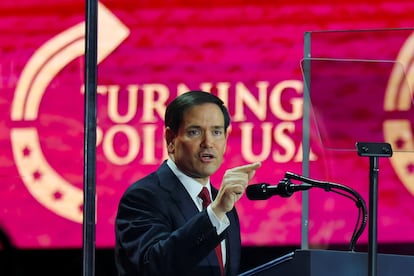
Secretary of State Marco Rubio, head of diplomacy for the world’s leading power, compared Kirk, who professed the evangelical faith, to Jesus. Defense Secretary Pete Hegseth, at the helm of the Pentagon, proclaimed that “only Christ is king.” And Vice President Vance spoke of “the truth that Jesus Christ was the king of kings” that Kirk spread, while Trump waited for his turn, seated in a box next to the world’s richest man, Elon Musk, whom he had not been seen with for months.
For nearly four hours, the event blended religion and politics, before culminating in the arrival of the president of the United States, who turned it into a rally in his trademark fashion.
Trump reviewed Kirk’s life, defended his tariff policy, and attacked Joe Biden, migrants, the “radical left” — whom he blames for the murder — and the mainstream media. He boasted of having turned the country, in the eight months he has been in office, into “the hottest in the world” and could not restrain his obsession with the crowds at his events. He also spoke of his plans to deploy troops in Chicago and of the press conference he plans to hold this Monday at the White House, where he promises to offer “an answer to autism.”
“He was a Christian and patriot,” Trump declared when he returned to the tone of an elegy, though with less familiarity than his predecessors with biblical rhetoric. “We want to bring God back into our beautiful U.S.A. like never before,” Trump continued, adding “without [secure] borders, law and order and religion, you really don’t have a country anymore.” He said that one thing that set him apart from Kirk was that the activist “wanted the best” for his opponents. “That’s where I disagreed with Charlie. I hate my opponents, and I don’t want the best for them. I’m sorry, I am sorry Erika.”
Erika is Erika Kirk, the widow of the controversial activist, who was murdered at the age of 31 by a gunshot to the neck while speaking at an outdoor event before about 3,000 people at a university in Utah. Just minutes before Trump addressed her directly, she had said she was ready to forgive “the young man” who killed her husband, a 22-year-old named Tyler Robinson. “It’s what Jesus did,” she reminded the crowd, recalling his words on the cross: “Father, forgive them, for they not know what they do.”
“I forgive him because it was what Christ did, and it is what Charlie would do,” she continued. “The answer to hate is not hate. The answer, we know from the gospel, is love, and always love. Love for our enemies and love for those who persecute us.”
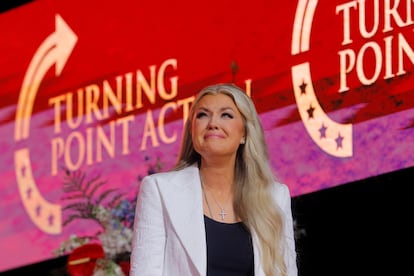
Since Kirk’s death, Trump has been stoking the rhetoric of political confrontation with his opponents. He closed his speech by bringing Erika Kirk on stage for an awkward embrace. A choir’s rendition of the patriotic song America the Beautiful capped a tribute that grew more heated when Stephen Miller, deputy to Trump’s chief of staff, warned that the activist’s adversaries had no idea what “they had awakened.” “You thought you could kill Charlie Kirk? You have made him immortal […] and now millions will carry on his legacy!”
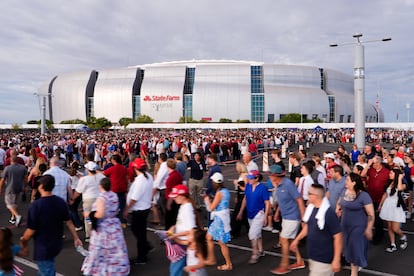
It was a long, intense day. Some attendees arrived as early as 3:00 a.m. One family said they had flown in from the Philippines, and traffic jams stretched for miles before dawn. By around 9:30 a.m., the State Farm Stadium — a vast silver dome with a capacity of 73,000 — was declared full. The overflow crowd rushed to another venue set up to follow the memorial on a giant screen: a nearby hockey arena with 20,000 seats, which also proved too small for the throngs who came.
Almost two hours passed before the first speaker, Rob McCoy, pastor of Kirk’s church, took the stage with a fiery sermon that set the tone for the rest of the proceedings. The lineup of speakers, more fitting for a state funeral than the farewell to a young activist, reflected the shock caused by the murder — whose reverberations have been felt around the world, highlighting the deep divisions in the country and reviving the darkest ghosts of America’s long history of political violence.
The lineup included, in addition to Trump, Vance, Rubio, and Hegseth, White House Chief of Staff Susie Wiles, Health Secretary Robert F. Kennedy Jr., and Director of National Intelligence Tulsi Gabbard. Other speakers included Don Jr., the president’s eldest son, who delivered a rough imitation of his father, and Erika Kirk, who last week assumed leadership of Turning Point USA (TPUSA), the conservative youth organization her husband founded in 2011 at the age of 18, which reported $85 million in revenue in 2024.
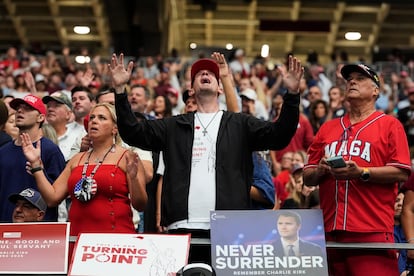
Sebastian Gordon, 22, left Los Angeles on Saturday night. He drove about 370 miles and arrived in Glendale shortly before 5:00 a.m., drawn by the “message Kirk spread” among college students like himself. By then, the line was so long that he wasn’t sure he’d get a place inside the stadium. In the end, he didn’t.
Neither did Carol Cassady and Sonia Fraile, who had come from El Paso, Texas, so that Fraile’s three teenage children wouldn’t miss what they called a “historic moment.” They described Kirk as a “missionary,” a “martyr of common sense,” and an “example of a defender of freedom and love for the country.” “His death marks a before and after. The ultimate proof that 90% of the U.S. population is MAGA,” said Cassady, wearing a cap that read: “Jesus Christ is my savior and Donald Trump, my president.”
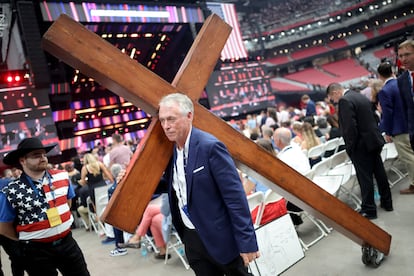
Among the crowd that, just after dawn, wound around and around under an unusually overcast sky were families dressed for church, groups of friends in mourning, every imaginable variation on the patriotic Stars and Stripes, T-shirts declaring “I Am Charlie Kirk” or “Freedom,” Bible verses, and one young woman with her back bare, covered by a tattoo of Christ carrying the cross to Calvary.
Christian rock
For those who made it inside, a lineup of Christian rock bands awaited, leading the crowd in singing “Amen” with arms raised high. Amy, a 56-year-old woman who declined to give her last name, lamented that with Kirk’s death, “the United States has lost its next president.” Soon after, a bagpipe band performed the national anthem, The Star-Spangled Banner, for the first time that day — later repeated by a tenor accompanied by an orchestra and flanked by members of the various branches of the U.S. military.
At the speakers’ podium, shielded behind what looked like bulletproof glass, figures from the far right such as Tucker Carlson, Republican lawmakers, and friends and colleagues of the honoree took the stage, underscoring Kirk’s deep ties to the MAGA movement.
All of them praised his “patriotism,” his “faith in Almighty God,” and his belief in the virtues of marriage and procreation. He was compared to Saint Stephen, Christianity’s first martyr. They railed against the “left.” Again and again, speakers — including Rubio — proclaimed that the United States is “the greatest, most exceptional nation that has ever existed,” while denouncing the current state of higher education, which they portrayed as a hub of “socialist indoctrination,” warning parents against sending their children there lest they return “four years later” transformed.
Benny Johnson, an ally and donor of the activist, shared with the audience the advice he once received from Kirk: “Center your life on Christ. Fall in love, get married, have a million kids, and live out your American Dream — that will be our turning point,” he added, referencing the name of the organization they both shared: Turning Point.
“Are you ready to put on the full armor of God?” shouted MAGA influencer Jack Posobiec, brandishing a rosary at the climax of his speech. “Now is the time!”
The spectacle unfolded with the precision of a television production. TPUSA organized it in just over a week, in collaboration with local, state, and federal authorities, which granted it the highest security rating. Access checks were comparable to those at an airport, though the police presence was discreet.
Born in 1993, Kirk founded TPUSA at the age of 18 in a garage in Lemont, Illinois, the state where he was born and raised. In 2019, he moved to Arizona and set up the organization’s offices on the outskirts of Phoenix. A year earlier, he had met Erika in New York. In 2021, the rising political figure married the former Miss Arizona. In Phoenix, they organized America Fest each year, TPUSA’s annual convention and a true who’s who of the MAGA movement. This year’s edition is scheduled for December.
In addition to producing podcasts, TPUSA organized events on university campuses across the country — though Kirk himself had never attended college. At these events, the youth leader sparred with liberal students on issues aligned with his brand of Christian nationalism, which included fierce opposition to abortion, attacks on LGBTQ+ rights, mockery of affirmative action initiatives, and the defense of both the supremacy of Western society and the institution of marriage.
Kirk’s alleged killer — a 22-year-old from a Mormon, Republican household who, according to his family, had recently embraced “leftist” views — surrendered to police after a 33-hour desperate manhunt in the state of Utah, after being persuaded to do so by his father. Last Tuesday, he learned that the district attorney prosecuting him will seek the death penalty for aggravated murder.
Kirk — a key figure in Trump’s victory in the last election due to his enormous influence among Generation Z voters — died after being shot in the neck from a distance of 180 meters. According to the indictment, the bullet from the hunting rifle could have killed more people.
Nearly two weeks after the attack, conspiracy theories about what happened continue to circulate online. One such theory focused on the fact that the bullet that killed Kirk did not exit his body. On Saturday, a TPUSA spokesperson addressed the claim via X, dismissing the conspiracy and saying that “the fact that there wasn’t an exit wound is probably another miracle.” “I want people to know,” the spokesperson added.
The spokespeson quoted the surgeon who treated Kirk in the hospital. According to the post, the doctor said that the bullet “should have gone through” the victim’s body, which, according to his widow and a friend who accompanied him to the emergency room, killed him instantly. “I’ve seen wounds from this caliber many times and they always just go through everything. This would have taken a moose or two down, an elk, etc.,” the doctor said. He added that the shot likely would also have killed anyone standing behind Kirk.
Sign up for our weekly newsletter to get more English-language news coverage from EL PAÍS USA Edition









































