
Miguel Pita, geneticist: ‘When you fall in love, mechanisms are activated that cause you to suffer when you fall out of love’
In his book, the researcher uncovers the neurological keys behind why we become enamored with someone, who we are drawn to, and what happens when a romance ends
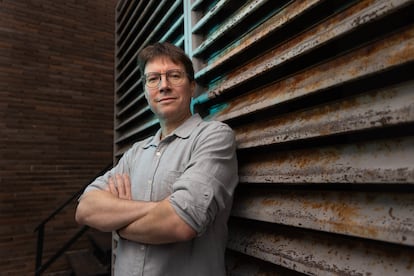

Love is a very sophisticated derivative of sex, says Miguel Pita. This doctor of genetics and cell biology has rolled up his sleeves to try to explain in a book one of the greatest and most beautiful mysteries of the human mind: how and why we fall in and out of love, and why we focus, in particular, on that one person who becomes the object of our obsessive thoughts throughout the process. El cerebro enamorado (In English, The Enamored Brain) is not a self-help book, nor does it pretend to be. It reads like a novel that tells the story of Raquel and Íñigo, the fictional couple Pita uses to illustrate the brain and hormonal changes they experience and the joys and pains they endure — from their instant attraction to their eventual separation.
Pita, 49, is a researcher and professor at the Autonomous University of Madrid, and also the author of two other books: El ADN dictador (The Dictator DNA) and Un día en la vida de un virus (A Day in the Life of a Virus), about the Covid-19 pandemic, on which he has also written for this newspaper.
Question. You start the book in a curious way; you don’t say who it’s for, but who it’s not for: “If you’re desperate because your partner has left you or if you want to win over someone you’re obsessed with, this isn’t your book.” Why?
Answer. I wanted to make it clear that this is a book based on scientific knowledge, very different from those written based on opinions or feelings, and from self-help or personal growth books. I’m not aiming to offer self-help; I don’t include tricks for getting over a breakup, but you can understand what happened to you after yours, and you’ll also realize that you’re not alone in the world. It’s normal; it doesn’t just happen to you, it happens to everyone, even voles. In that sense, I do think it helps.
Q. You aim to explain what scientific knowledge says about love, but you also acknowledge that science still has much to learn. Why is love so hard to study?
A. Because there’s a part of the phenomenon that’s exclusively human, and that makes it very difficult. We share the mechanisms and neural circuits on which love is based with other species. But those species produce emotional bonds with their partners, not a crazy infatuation like ours; this is exclusively human.
Q. You say that being in love is somewhat like turning the other person into a drug you get hooked on. What happens in the brain of a person who is in love?
A. Recreational drugs exploit brain mechanisms that have other functions, one of which is falling in love. In a nutshell, they generate an obsession with the object of desire because many receptors to achieve pleasure are produced in the reward centers. Furthermore, the neurons that produce these receptors undergo modifications. These molecules punish you in the absence of your object of desire. This is very typical of both love and drugs. The difference is that these modifications associated with falling in love can be reversed, whereas with drugs there are many lasting consequences. The body has been tested to fall in and out of love throughout many years of our species’ history.
Q. Are there neurological differences between a one-night stand and the love between a couple who have been together for 20 years?
A. Yes, it’s very different. A one-night stand may not develop into romantic love. But if, after that night, you fall madly in love, it triggers the beginning of those mental changes in the production of dopamine receptors, and later oxytocin, which will eventually diminish and balance out. That’s the beginning of the transition to mature love. A couple who have been together for two years aren’t as madly in love as they were in the first week, but they’re not less in love; they’re in love in a different way. What fades is the madness, which is associated with the greatest peaks of well-being, but also of distress.
Q. Some people fall in love easily, while others have never been in love. If all humans have this predisposition to love, why is this the case?
A. Because we are not identical. We all have the capacity to fall in love, but the number of receptors and neurotransmitters we produce, likely due to genetic and epigenetic factors, varies. And while the exact answer to your question isn’t entirely clear, I speculate that some people are more dopaminergic and others more oxytocinergic. More dopaminergic individuals need the anticipatory pleasure to be constantly active — that pleasure of anticipating something even greater to come, and when that “something greater” arrives, they don’t enjoy it as much. However, there are other people who are more oxytocinergic, and likely also have a greater capacity to produce serotonin, making them more capable of enjoying the present. Some people, when a relationship ceases to be completely euphoric, need to find a new source of euphoria and are unable to make the transition to mature love.
Q. In the book, you say that raising children is the cornerstone of love — the moment when two separate brains come together for that purpose. But what about couples who can stay in love for years without wanting children? What happens in their brains?
A. They work exactly the same way. Thanks to science, the human species can understand why it does things. And some things are taught to us from a young age, like the fact that the purpose of sexual relations is to have offspring. However, none of us think about that when we intend to have sex; it’s completely domesticated. From that instinct, which is evolutionarily based on sexual relations and, subsequently, on raising offspring, we take advantage of the part that interests us. The sexual relations of someone who has sex for pleasure and the sexual relations of someone who has sex to have children are neither better nor worse; they are the same.
Q. Monogamy in humans is also strange, from an evolutionary point of view...
A. Actually, monogamy is very rare in mammals, but in those where it occurs, it’s not a choice. In our species, everything is a choice. We are social monogamists: for a time, when we fall in love, we want to be only with that partner and we’re not interested in others. Some people will argue with this, but when you’re in love with someone, you have little to no interest in others. Humans are transient social monogamists.
Q. We’ve talked about sex and love. But what happens when you fall out of love? Is it also a brain process, do hormones play a role?
A. Yes, of course. The suffering of falling out of love is purely biological, and in that sense, I do believe that understanding it can be helpful. One of the parts that fascinated me most about writing the book was explaining that, when falling in love, certain mechanisms are activated that were already primed to make you suffer when you fall out of love. It’s not a bad idea; your brain designed it so that when you’re not with your partner, you’ll go back to them. When you stop being with them, a series of hormones and neurotransmitters are released that activate receptors that increase in number during the time when you’re completely happy — in a treacherous way.
Love plays two cards: the reward of pleasure and the punishment of pain. When your partner leaves and you’re in love, the anxiety is extremely high, and those molecules of discomfort never subside. And that always happens in the brain: that pathway of discomfort is activated during the breakup, and it’s constantly knocking on the door of those neurons that make you suffer and that were primed for this moment, when you were looking elsewhere. And until they’ve knocked on that door thousands of times, those neurons don’t say, “Come on, let’s start packing up now, this path is getting too overwhelming, let’s think about something else.” Hence the old saying that love heals with time is perfectly valid.
We know what that time is dedicated to: dismantling all that architecture built during the infatuation phase. And that’s a very interesting phenomenon that hasn’t been understood until recently. It’s a kind of self-inflicted blow that wouldn’t serve your immediate interests, but it does serve nature’s purpose, which is to think: “Don’t lose that partner with whom you’re going to produce offspring that will keep the species alive. Go back to her.” And when it’s told you that 100,000 times, it finally says, “Okay, fine, then don’t go back.” And that’s when you recover a little of your clarity.
Q. When you have your heart broken, you try to learn to fall in love less — or better. Can the brain be trained for that?
A. It can be trained very subtly. It’s like thinking you can train to run the 100 meters as fast as Usain Bolt. If you don’t have certain innate qualities, there are certain things you’ll never achieve. We all come with a very powerful capacity for falling in love, and with our conscious mind, we can tame it to some extent. But our stronger, more instinctive parts are harder to train. In the end, what makes you fall in love less is also biological. Your own hormones, due to your own progress in life, decrease, and they probably do so at the same rate as you teach yourself to control them. You have to accept that there are things that happen in the brain that we can’t control, period. Our access to the brain’s black box is minimal.
Q. And if everything depends on a black box that’s so difficult to control, do dating apps work? Can an algorithm determine who you’ll fall in love with?
A. Yes, they can do that perfectly, because ultimately it’s about accumulating data. They won’t do it with total precision, because it’s not entirely clear how you choose the person you fall in love with. However, it is believed that it’s someone you have a mental image of in that black box of the brain. That person has a series of characteristics that tend to repeat themselves, so a machine that works with accumulated information can predict it.
Q. How will AI change all this? There are already people who are falling in love with artificial intelligence chatbots...
A. It’s very interesting. On the one hand, love is such a strong instinct in our species that societal changes have very little impact. The way we fall in love is very similar to how it was in the Middle Ages. Love is such a powerful and profound feeling that it’s stronger than our conscious decisions and social changes. But, on the other hand, human beings have such an abstract capacity to fall in love that they can fall in love with people they don’t know, even with beings that don’t exist.
Q. What question about the brain in love can’t you answer in your book? What remains for you to learn?
A. I’d like to know exactly what the physiology of love at first sight is like; to know in more detail what’s happening, in which parts of the brain and with which molecules, at that moment when your brain realizes that there’s a person who matches that list in the black box. From then on, we know quite well what falling in love and falling out of love consist of. But love at first sight is still the part that intrigues me the most.
Sign up for our weekly newsletter to get more English-language news coverage from EL PAÍS USA Edition









































