
Oke Göttlich, the man shaking up German soccer over Trump: ‘We discussed at length our red lines for boycotting the World Cup’
The vice president of the German Football Association sparked a national debate after opening the door to a boycott of the World Cup
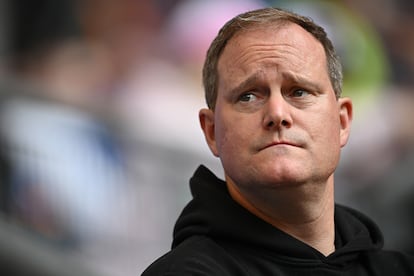

He takes this newspaper’s call on a train bound for Hamburg, home of St. Pauli, continues by car and says goodbye almost an hour later in his office at the headquarters of the modest club, which he has chaired since 2014. Oke Göttlich (Hamburg, Germany; 50) is also one of the 13 vice presidents of the DFB, the German Football Association. And earlier this year, amid threats from Donald Trump’s administration to invade Greenland, Göttlich, a trained journalist, said enough was enough. “What reasons justified the boycotts by certain countries of Olympic Games in the 1980s?” he asked, referring to Moscow 1980 and Los Angeles 1984, in the Hamburger Morgenpost. “In my view, the current threat is greater than back then, so we must have this discussion; a footballer’s life is not worth more than the life of any of the people being directly or indirectly attacked by the host country of the next World Cup.”
Göttlich was referring to the United States, which in just over a month will host the final of the most prestigious tournament in world soccer, as well as 84 of the 104 matches scheduled by FIFA — the remainder will be shared by Mexico and Canada — from June 11 to July 19.
The mere idea of considering a possible boycott of the World Cup set off a national debate in Germany, a country whose men’s team has won the tournament four times, second only to Brazil, which has five titles. Göttlich drew criticism from within his own organization, the DFB, which was quick to distance itself from the hypothetical snub to the global event.
“At no point did I say Germany should boycott the 2026 World Cup,” the German official clarifies to EL PAÍS. “I was asked whether I thought it was right or wrong to go play in a country that had only days earlier threatened to take Greenland by force, and I simply reflected on the issue, opened the debate.”
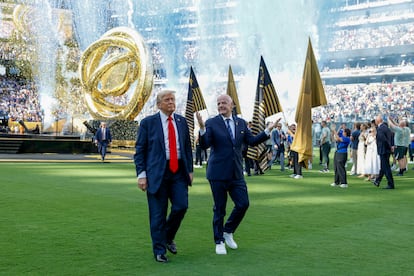
The matter not only made the front pages of the German press but also filtered into the DFB offices. “We discussed at length what our red lines would be for boycotting a tournament of this nature,” Göttlich says. “And I recall that, for example, we concluded that if the United States attacked a NATO country, we would be at a point of no return.”
That line was not crossed, at least not up to the publication of this piece, but so far this year the United States has abducted Nicolás Maduro, threatened to invade Greenland and gone to war with Iran — developments that did not go unnoticed by the vice president of the German Football Association. “What I have been saying for months is that we must open our minds and accept the debate; we have to ask ourselves whether we should go to the World Cup,” he says. “Germany will go and play, but I am worried about the underlying issue.”
“Many of the major sporting events in recent years have been held in countries with authoritarian regimes or that violate human rights: Russia, China, Qatar, now the United States... It is time for us to raise our voices and broaden the debate,” Göttlich proposes. “Is the German national team, which defends diversity, human rights, and opposes racism, going to call out some of the questionable measures of Donald Trump’s administration, an erratic figure who seems intent on plunging the world into chaos? If they play in Texas, where the U.S. government is banning more books in schools than ever, are they going to denounce it?”
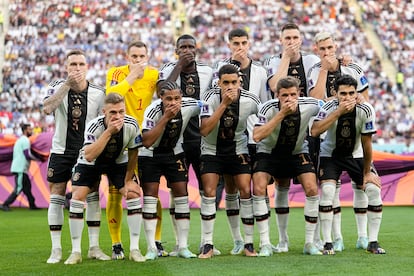
“Football and the World Cup are an unparalleled platform to show our beliefs,” says the official, whose federation was already a protagonist in Qatar 2022 when Germany’s players covered their mouths in protest after FIFA banned the rainbow armband. “I am saddened by people’s growing fear of speaking out, of debating. Social media is tinting everything black or white, good or bad, and as soon as an issue like this is raised everything is polarized and distorted to the point that nobody wants to make a mistake and be assigned to the wrong side. That way the debate dies, and with it, democracy,” he laments.
“When I made those remarks earlier this year, I was told I only spoke that way because I was president of a modest club like St. Pauli and wanted attention for my club. I can only smile at such an accusation,” he says. “First and foremost I am a person, a citizen, and I do not leave my ideals at the door when I leave home. We are immersed in a tremendous geopolitical crisis, and that also affects sport. We cannot fold our arms and accept everything. We cannot be afraid to speak out because of a handful of criticisms. Because those who criticize, in most cases, do so to defend business, to keep the wheel turning.”
“I will not go to the World Cup, I am very clear about that,” Göttlich says as he realizes the call is ending. “I only hope that at least the tournament serves so that thousands of journalists from around the world travel to the United States and can report freely on what happens there, something that, incidentally, FIFA itself includes in its statutes, where it guarantees assistance and protection to those reporting from the regions hosting an event like the World Cup, including those who suffer reprisals for it. I will be pleased to watch from here how they keep their word in the coming weeks.”
Sign up for our weekly newsletter to get more English-language news coverage from EL PAÍS USA Edition









































