
Most Americans oppose ICE’s presence at stadiums during the World Cup, according to poll
A survey by ‘The Washington Post’ and the University of Maryland reveals concerns about the role of immigration authorities in the tournament
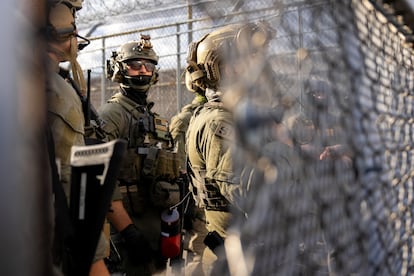

With just a few days to go before the start of the 2026 FIFA World Cup, the world’s largest sporting event faces the question of what role U.S. immigration authorities will play. Now, a new poll by The Washington Post and the University of Maryland has found that most Americans would prefer they play no role at all.
According to the poll — conducted between May 14 and 18, 2026, among 1,030 adults in the United States — 65% of those surveyed oppose the presence of Immigration and Customs Enforcement (ICE) agents in stadiums during tournament matches, compared to 35% who support the measure.
The survey results come after months of uncertainty about how the Trump administration’s immigration policy might affect a tournament expected to draw millions of visitors to the United States, Mexico, and Canada. Although federal officials have insisted that ICE will be part of the overall security operation and that its work will focus on combating crimes such as human trafficking and the smuggling of counterfeit goods, the agency has become one of the most controversial issues in the run-up to the tournament.
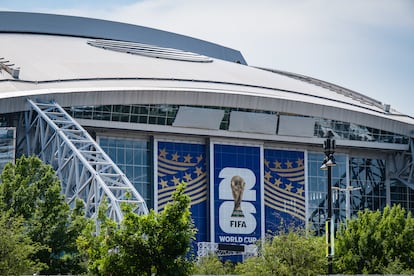
Among Democrats, opposition stands at 92%, while among independents it reaches 74%. Republicans are the exception: 72% support the presence of immigration agents at games. Opposition is also widespread among soccer fans. Sixty-eight percent of those who consider themselves fans of the sport oppose the presence of ICE in stadiums, a proportion nearly identical to that among non-fans.
Opposition also shows marked demographic differences. According to the survey, nearly eight in 10 Black and Hispanic Americans reject the presence of immigration agents in stadiums during the World Cup. Among white Americans, opinion is more divided, although the majority also opposes the measure: 58% oppose it, compared to 42% who support it.
The debate did not come out of nowhere. During the Club World Cup held in the United States in 2025, ICE confirmed that it would assist with security during the tournament and publicly reminded non-citizens that they must carry documentation proving their immigration status. The message drew criticism from immigrant advocacy groups and local authorities, who warned that it could deter thousands of people from attending the matches.
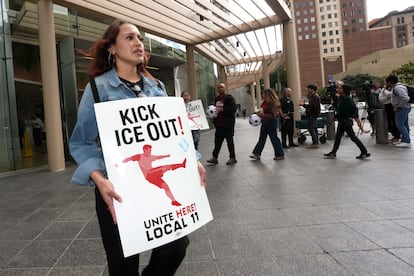
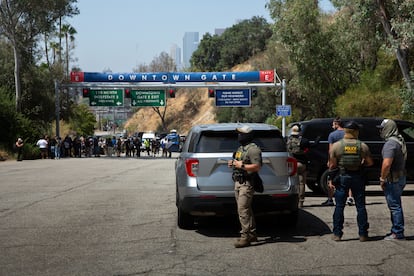
Questions about the role of immigration authorities have multiplied since then. The uncertainty has been fueled by a lack of details on how federal agencies will operate during the tournament and by the tightening of immigration policies pushed by Trump since his return to the White House.
In addition, in recent weeks, the administration has been considering measures that could directly affect the arrival of international visitors. Among them is the possibility of suspending customs processing for international flights at airports located in sanctuary cities, a proposal that would impact some of the major World Cup host cities, including New York, Los Angeles, San Francisco, and Seattle. The discussion has fueled concerns about the experience that the millions of fans expected to travel to the tournament will encounter.
While the presence of ICE is met with opposition, the poll shows a much more open attitude toward another of the most sensitive issues surrounding the tournament: the participation of the Iranian national team. Three out of four Americans — 75% — believe that the Iranian national team should be allowed to play World Cup matches in the United States. This support transcends party lines and extends even to 64% of Republicans.
The issue of Iran has become one of the most sensitive topics in the run-up to the tournament due to diplomatic tensions between Washington and Tehran. In recent months, doubts have arisen about the national team’s participation after Trump sent mixed messages regarding their presence on U.S. soil. While FIFA has maintained that the Asian team will be able to compete, uncertainty has also spread to the situation of players, coaches, and fans who need to obtain visas to travel.
On the other hand, 69% of those surveyed believe that Iranian soccer players should be allowed to remain in the United States if they fear persecution by their country’s government. Even among Republicans, a slight majority supports this possibility. The results suggest that many Americans distinguish between international political conflicts and the sporting participation of athletes and national teams.
The poll also found that there is little enthusiasm regarding the tournament’s international impact. Just 22% of respondents believe that hosting the World Cup will improve the United States’ image abroad. The majority, 68%, believe it will make no difference, while 10% even think it could harm it.
Sign up for our weekly newsletter to get more English-language news coverage from EL PAÍS USA Edition









































