
The US men’s soccer team, between staying quiet and speaking out
Against the backdrop of the Trump administration, the official stance of the host nation’s squad, led by Mauricio Pochettino, stands in stark contrast to the 2019 women’s team, whose players were openly critical of the Republican president
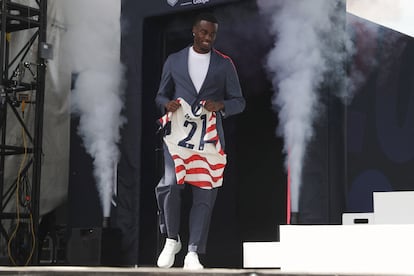

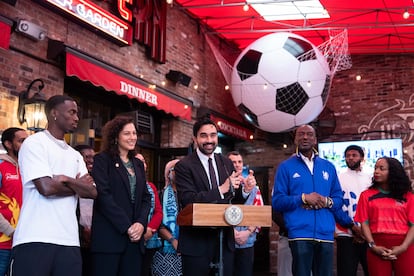
Timothy Weah used his platform as a member of the U.S. men’s national soccer team to speak out about what he sees as an injustice. The Marseille player — son of Ballon d’Or winner and former Liberian president George Weah — joined New York Mayor Zohran Mamdani onstage as he announced he had secured 1,000 tickets priced at $50 for the matches to be played at MetLife Stadium in New Jersey, just across the river from Manhattan. They are a drop in the bucket for this venue — the stadium, expanded to a capacity of 87,000, will host eight matches including the final, meaning 696,000 total tickets — but it’s something.
Weah, a 26‑year‑old fullback and winger, grew up playing soccer in New York before moving to France at age 14 in search of opportunities that didn’t exist in the United States. Standing beside the socialist mayor of his hometown, Weah spoke plainly about ticket affordability for what will be by far the most expensive World Cup in history, a topic that has sparked national and international controversy.
“I think this opportunity is really healthy for the community and for New York in its whole,” he told the crowd. “I think as athletes it’s important to have a voice, because we are the pillars of this community. We are the leaders of the next generation,” he said confidently.
That stance, however, directly clashes with the position of the coach of the U.S. team, Mauricio Pochettino. In late January, Pochettino steered completely away from any political debate, precisely in response to Weah’s initial criticisms of World Cup ticket prices. “I think players need to talk on the pitch, playing football, not outside,” Pochettino said at a virtual press conference. “It is not his duty to evaluate the price of the ticket … We are not politicians. We are sport people that only we can talk about our job.”
The Argentine continued, and showed himself fully aligned with the message promoted by FIFA and its president Gianni Infantino. “I think if FIFA does something or takes some decision, they know why, and it is their responsibility to explain why,” he said. “But it’s not up to us to provide our opinion. […] And I think we have the organization that is over us, that is FIFA, that is doing an amazing job around the world uniting people. I think for sure the media need to ask [these questions] directly to FIFA, and for sure you are going to receive a very good answer. But no, it is not up to us to judge this type of thing. We need to be focused on the sports side, and trust in the organization that is in charge of soccer or football around the world, that they are going to do the right things."
Pochettino’s position, as the team’s top representative, stands in stark contrast to the one taken by the squad before his arrival — and especially to the stance championed by the women’s national team during the 2019 World Cup. That group, which won the tournament for the fourth time, was catapulted to national stardom and used its platform to speak out in favor of civil rights and against the first Trump administration.
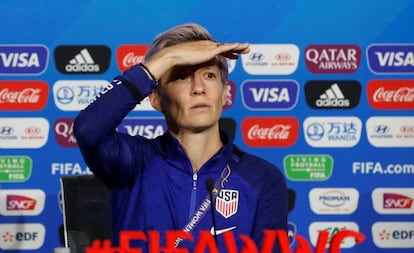
The face and voice of that movement was captain Megan Rapinoe, who confronted the president directly, saying she would not go to the White House if the team were invited after winning the tournament. In the months that followed, she used her platform — earned both through the World Cup victory and her clash with Trump — to continue sharing her message.
“I don’t think anyone on the team has any interest in lending the platform that we’ve worked so hard to build, the things that we fight for and the way that we live our life,” she told CNN’s Anderson Cooper. “I don’t think we want that to be co-opted or corrupted by this administration.”
When asked if she had any message for Trump, she looked into the camera and said: “I think that I would say that your message is excluding people. You’re excluding me. You’re excluding people that look like me. You’re excluding people of color. You’re excluding Americans that maybe support you.”
Building on her teammates’ unequivocal stance — and amid the social upheaval following the killing of George Floyd by a police officer in Minneapolis in 2020 — the men’s national team, then coached by Gregg Berhalter, launched the Be the Change campaign. It aimed to respond to the country’s social tensions through symbolic gestures, such as slogans printed on the backs of the jackets players wore onto the field before several matches. The high point came in 2022, when they sent a letter to Congress calling for stronger measures to address gun violence. Since then, however, the campaign — though still officially active — has been effectively dormant.
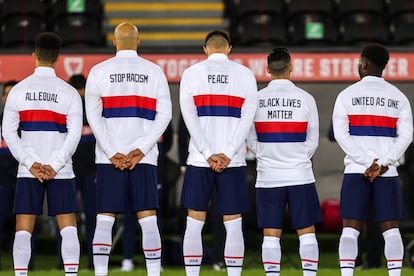
More recently, players have spoken about and celebrated the team’s diversity, promoting it as a reflection of the country itself. That in itself is a political statement when the government projects a white, traditional image of the United States that erases minorities. Still, players are careful about how explicitly political their messages are.
“If I’m going to say something, I’m going to say something because I feel like it can bring people together and bring people closer,” Tim Ream, the team’s oldest player at 37 and one of its captains, told The Guardian. Another team leader, midfielder Tyler Adams, echoed the sentiment when asked about speaking openly on social media. “It’s gonna get misconstrued one way or another so there’s no point,” he said.
Although soccer players are far from being the country’s biggest sports stars — in a nation where football and basketball dominate — U.S. athletes have historically not shied away from political expression. From Muhammad Ali in the 1960s to Serena Williams and Colin Kaepernick in recent decades, athletes, often Black, have championed justice and equality and become icons of social causes.
This year, as the 2026 World Cup shapes up to be one of the most politically charged tournaments in history — alongside Italy 1938 or Argentina 1978 — the U.S. national team appears to be choosing silence.
Sign up for our weekly newsletter to get more English-language news coverage from EL PAÍS USA Edition









































