
Illegal mining advances in the Amazon and corners park rangers in Ecuador
At least seven protected areas in this ecosystem are gold‑extractivism hotspots. Those who safeguard these zones report threats and the presence of armed groups
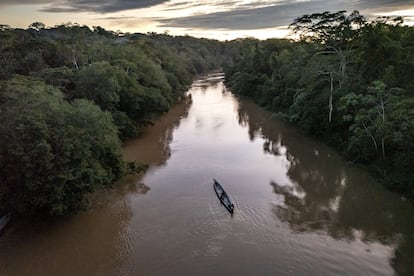
For years the tranquility of Ecuador’s Amazon has ceased to be such. What was once territory guarded by park rangers has turned into a battleground for control of illegal gold mining. Monitoring patrols, conservation work, and species recording are no longer routine. Today, those who guard protected areas face threats, encounters with armed men, and the presence of criminal organizations that have made illegal mining a lucrative business.
That is the case for a group of staff at Sumaco Napo‑Galeras National Park, in the northern Ecuadorian Amazon. Carlos, a park ranger in the area who asked to remain anonymous for security reasons, says his colleagues were intercepted by “heavily armed people” while carrying out one of their patrols.
The men identified themselves as members of a guerrilla group and said they were “providing security to the miners in the area.” They demanded explanations for the rangers’ presence in the jungle. The rangers replied that they were park staff conducting inspections. That made no difference. “They took their cellphones, the GPS devices, and the camera. Imagine how that leaves you,” Carlos says. “We hadn’t had cases like that before. How are you supposed to handle that situation?”
Illegal mining, and the criminal groups behind it, have penetrated Ecuador’s National System of Protected Areas (SNAP), especially those in the Amazon. Ministry of Defense data provided to EL PAÍS reveals hotspots of illegal mining in at least nine of the 71 protected areas. Seven of those are in the Amazon region, although experts warn the figure could be higher.
According to the Ministry of Defense, four criminal groups are behind these activities: Los Lobos, Los Choneros, Los Galarza, and the Sao Box — a dissident faction of Los Lobos. These organizations have diversified their funding sources beyond drug trafficking and have turned to illegal gold extraction as a profitable activity.
“For me, all this blew up with the pandemic,” Carlos says. He explains that the first warnings began to emerge during Covid‑19, when people lost their sources of income and “found gold extraction as an alternative.” Fundación Ecociencia, an organization dedicated to conservation in Ecuador, adds that illegal mining began spreading in remote locations and “many of the protected areas in the Amazon meet those characteristics.”
Although the problem had been brewing for years, Carlos says the situation worsened between 2025 and what has unfolded so far in 2026. “This year there has been a dramatic increase in buffer zones and it won’t be long before it reaches several protected areas,” says the ranger, who has worked for 15 years at Sumaco Napo‑Galeras National Park — one of the protected areas where illegal mining is present.
The expansion of illegal mining has changed the type of threats faced by those who guard these territories. According to Glenda Ortega, former deputy secretary for Natural Heritage, environmental crimes inside protected areas have evolved. They have shifted from wildlife trafficking to activities linked to criminal economies such as illegal mining. “Park rangers can make seizures, for example, in cases of wildlife trafficking and everything related to natural heritage, but on security matters they have no jurisdiction,” Ortega explains.
They also cannot seize machinery — such as backhoes, dredges, or engines — nor confront criminal groups operating inside protected areas. The spread of this activity is evident across more points of the Amazon.
In Podocarpus National Park, an area that hosts more than 4,000 plant species and 600 bird species, illegal mining has already reached deep into the reserve. An Ecociencia monitoring study shows a 125% increase in illegal mining activity between 2023 and 2024. The area rose from 22 hectares in July 2023 to 50 in September 2024.
The expansion of these activities has forced authorities to deploy operations inside the park, often without success or lasting results. In a recent intervention, the Armed Forces destroyed 67 clandestine illegal‑mining camps in the area, located between the provinces of Loja and Zamora Chinchipe, on the border with Peru.
For many park rangers, like Carlos, that increase is no surprise: “There has been mining in Podocarpus for a long time. Many people even live inside the park doing this activity [illegal mining].” Carlos says they have sent official reports to alert the authorities, but the responses do not arrive or get lost in the files of the Ministry of Environment, Energy and Mines.
One of the most alarming cases is Sumaco Napo‑Galeras National Park. In May 2024, mining activity advanced to the park’s boundaries. “Machinery and backhoes are on the Punino river and the Sardinas river. They extract material and large pits form,” Carlos says. But the alarms were raised in May last year after an attack on 11 soldiers in Alto Punino, an area bordering the national park.
The ambush exposed a deeper reality: the presence of criminal groups and dissident factions linked to illegal mining in the Ecuadorian Amazon. The attack was attributed to the Comandos de la Frontera, a dissident faction of the defunct Revolutionary Armed Forces of Colombia (FARC). For Ecociencia, the presence of these structures shows how “armed groups have taken advantage of remote areas to extract minerals.”
Yasuní National Park, regarded as one of the most biodiverse places per square meter, has not escaped this scourge. Javier, a park ranger who has worked there for six years, says the first reports of illegal mining began in 2023 and have increased over the years.
“Two years ago, colleagues were threatened in the Curaray sector — near the border with Peru — when they found people carrying out alluvial mining to extract gold. They were told that if they spoke up they would be killed,” he recounts. But it is not an isolated case. In 2025, during one of their patrols, rangers found backhoes and fuel tanks inside Yasuní. “They warned them to be careful, to protect their lives, that they know who they are and they had even taken their cellphones,” Javier says.
While government attention focuses on the most violent cities and the turf wars between gangs, the expansion of illegal mining has received less institutional attention. “Obviously, by prioritizing the security crisis, protected areas do not have that immediate action or the presence of law enforcement,” says Glenda Ortega. The Association of Park Rangers of Ecuador has repeatedly denounced the presence of armed groups. But there has been no response from the authorities, or they remain limited.
EL PAÍS requested information from the Ministry of Environment, Energy and Mines on measures adopted to protect park rangers and combat mining in the SNAP, but received no reply. Meanwhile, the sense of abandonment grows among those who guard these megadiverse territories.
The lack of protection to which Ecuador’s 598 park rangers are exposed has forced some to request transfers to other protected areas. Others have chosen to resign. Those who remain must constantly assess the risks behind every patrol.
Fear is changing the management of protected areas. Several rangers avoid patrolling certain zones known to host criminal groups dedicated to illegal mining. Others continue to patrol but prefer not to report the presence of mining machinery for fear of reprisals. “The threats cut our level of action as park rangers. We are no longer seen as the authority, but as informants,” Javier says.
Sign up for our weekly newsletter to get more English-language news coverage from EL PAÍS USA Edition









































