
Javier Negre Inc, the hoax multinational
The controversial Spanish communicator has built an international business based on political propaganda and selling access to Donald Trump’s and Javier Milei’s circles
In person, Javier Negre has two modes. Either he doesn’t look you in the eye and answers you in monosyllables, or else he gives you his full attention and energy. If he is interested, he can talk for hours as if someone had pressed a button at the base of his skull, making a torrent of words pour from his mouth. And he is interested in this newspaper story. At 41, this native of Málaga — a former reporter at Spanish national daily El Mundo and now the head of a constellation of outlets accused of spreading hoaxes and far-right demagoguery — is labeled by many people as a charlatan. He wants to prove otherwise. He wants to show that, in Donald Trump’s Washington, they take him seriously.
It’s dinnertime and Washington DC is sweltering. Negre leaves the White House in a suit and tie and walks two blocks to Ned’s, one of the most exclusive venues in the Trump universe. Members pay $5,000 a year and guests are handed a sticker at the entrance to cover their phone cameras. Negre calls this his “office.” Here, in its restaurants, lounges and the terrace overlooking the Washington Monument, he mixes with government workers, members of Congress and businesspeople. Waiting for him on the 12th floor for dinner are a couple of midlevel Trump administration staffers, but before sitting down with them he wants to show us the club’s different spaces. With eyes that seem permanently half-closed, he scrutinizes a room. A man chatting with other patrons on a sofa stands up and comes over. “Javier, save the end of June so we can go to Argentina together,” he says in English. Negre replies that he can count on it. A little later he spots another familiar face and pauses in a hallway to engineer an encounter. A politician with the build of a football player strides toward him, talking to a colleague. His name is Byron Donalds; he is a Republican and one of the candidates backed by Trump in the campaign for the November midterms. Negre extends his hand and exclaims: “The next governor of Florida!”
“This city is full of fakers,” he complains later.
A young Trump administration employee with whom he is friendly and whom he met at an ambassador’s party nods in agreement. A singer and a guitarist enliven the evening at Ned’s around midnight as guests sip cocktails. The two of them drink mineral water. The doctor has told Negre to take care of his health.
“A large Spanish company contacted me to ask my opinion about a lobbyist they thought was deceiving them,” he continues. “I warned them he might be a con man.”
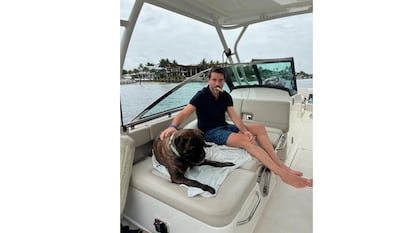
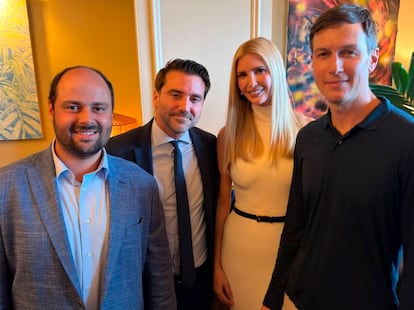
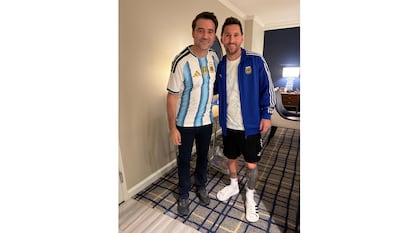
He links one story to another, mixing English and Spanish in his inexhaustible chatter. Since he moved to the U.S. capital in September, his comings and goings, which he posts in detail on social media, have prompted reactions in Spain that range from envy to ridicule, depending on who’s looking. We’ve seen him receive special treatment from the White House press secretary at a press briefing, host a party at the president’s club in Florida, travel on private jets, smoke cigars on yachts and pose with Trump’s children. He claims he has become the main Spanish interlocutor with the Trump administration. His detractors see him differently: as an international "Pequeño Nicolás" (a young fraudster who was arrested in 2014 for passing himself off as an envoy of the Spanish king, among other charges) who seeks photos with the powerful to project an influence he does not have.
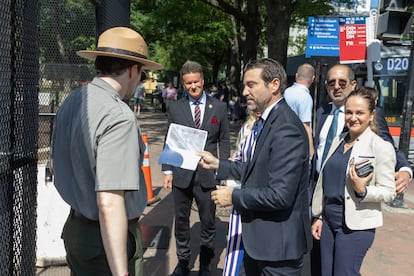
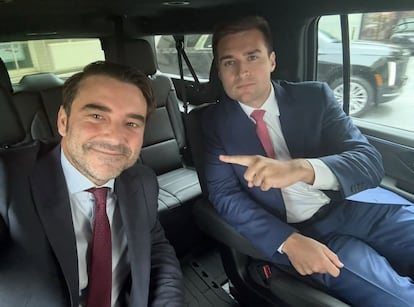
To prove he has a good sponsor, he arranges to meet us at 8:00 the next morning, a Wednesday in late May, at the Waldorf Astoria hotel, where the man who introduced him to the MAGA movement awaits him for breakfast. Alex Bruesewitz, 29, became known in the 2024 campaign as a Trump adviser because he is credited with the podcaster outreach strategy that positioned the now-president among voters under 30. He continues to orbit the president as an external adviser. Time magazine named him last year one of the 100 rising stars worldwide. Negre listens, looking pleased, to the man he considers “the king” of social media. “Javier works incredibly hard and is great at meeting people. For some reason people like him. I don’t understand why,” says the young Wisconsinite, who does not smile when he is joking. “He definitely has a future.”
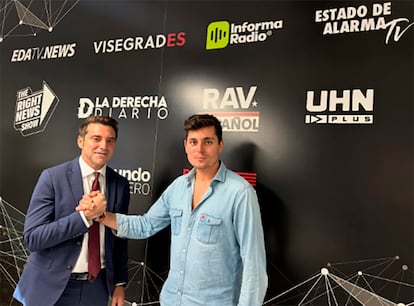
The truth is Negre is disliked by many people. There is even a WhatsApp group, Todos contra Negre (Everyone Against Negre), with members from different Latin American countries. Its members are not leftists, but people who feel cheated by his services or oppose his disinformation campaigns. They are activists and political operators who have dealt with the Spaniard over the past two years, since he crossed the Atlantic to expand his “low-cost media empire” that includes brands such as EdaTV, La Derecha Diario and UHN Plus. They describe him as an unscrupulous fixer eager to get rich. “He’s a mercenary who charges for everything,” says Mexican political consultant Alberto Rosas, aka Tumbaburros. “Want to be at Mar-a-Lago and talk to important U.S. government people? For $10,000, Negre can make it happen.”
He boasts of having gotten rich “telling the truth.” In just two years he has leapt from the Spanish far-right sphere to the international one, thanks to his nose for opportunity and a well-oiled machine of hate and lies run by his right-wing allies, often under opaque deals. He is paid by administrations run by Spain’s conservative People’s Party (PP), by the Argentine government, by large advertisers and by ideologically driven businesspeople, but he does not disclose the names of all his partners and funders. This investigative story, based on interviews with 83 people and five meetings with Negre, tells the story of a man who has made access to power, political agitation and disinformation a commodity. It is also the story of a booming global business sheltered by the new far right.
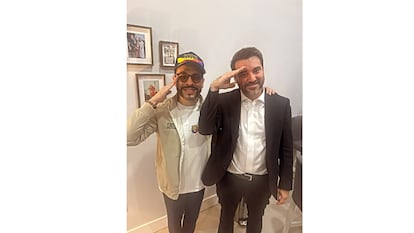
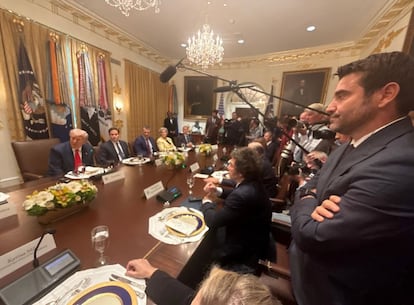
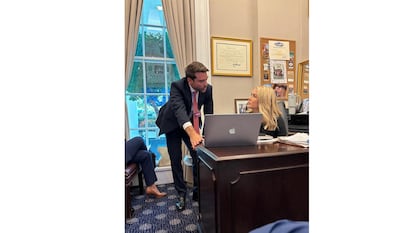

1. The young journalist who ‘went over to the dark side’
To understand how Javier García Negre slipped into Washington’s power circles, you have to go back to his days at El Mundo. Eleven of the 12 former colleagues consulted for this story agree that his career veered into sensationalism and unethical tactics. Lucía Méndez, a veteran who worked with him when he was an intern on the national desk in 2009, says the Negre of today is a “buffoon” and a “madman,” but that the 24-year-old Negre she knew was pleasant, hardworking and “clearly had a journalistic calling.”
He had completed the newspaper’s master’s degree program, where the editor at the time, Justino Sinova, remembers him as “one of the best students.” He was an extroverted kid, the son of a PP councilor in Marbella and well connected with the PP youth group Nuevas Generaciones, where he had been active during his time at the private university CEU San Pablo and had crossed paths with future party leaders like Pablo Casado and Isabel Díaz Ayuso, who is the current premier of the Madrid region. He won over colleagues at the paper by offering them tickets to the Madrid nightclub Gabana, an influence hub frequented by politicians and footballers where he was close to the owner.
He soon befriended a boss, Aurelio Fernández, the deputy general director of Coordination at Unedisa, El Mundo’s publishing group. Fernández recommended him for the Bilbao newsroom at a time when the Basque terrorist organization ETA had already stopped killing, and he spent two years there. He returned to the capital to cover light fare for the La Otra Crónica supplement. Even those who hate him the most acknowledge that he had a nose for uncovering good stories and an astonishing ability to get any phone number.
Méndez identifies the moment Negre lost his way as October 2014, when he began his career as a talk-show pundit. TV offers came his way after the Pequeño Nicolás scandal. He had published several pieces about the young con man’s girlfriend, La Pechotes, and other details of a case that dominated the TV schedule for weeks. “With TV, Negre ends and the character begins,” says Méndez, a seasoned TV talk show guest herself who has watched fame change other reporters. “For some, it’s like a drug.”

Within months he had moved to the Sunday Crónica section, one of the paper’s most coveted showcases. Reporters had a week to develop a news story that might end up on the front page. He chased the most viral topics: crime and politics. He competed to publish the most-read article and bragged on Twitter when he succeeded. In July 2015, he changed his byline. Javier G. Negre became Javier Negre.
He broke the industry’s codes. Newsrooms are territorial and colleagues usually respect each other’s beats or at least warn before encroaching, but he didn’t care. “I told him a thousand times: ‘You’re going to get into trouble. Talk to so-and-so reporter first,’” says a former boss. Suspicions also grew regarding his methods, a picaresque pushed to extremes, such as when he entered the house of football manager Pep Guardiola’s parents, allegedly making them believe he worked for the sports supplement El Mundo Deportivo.
During that period he wrote the story that would mark his career and earn him a nickname that would haunt him for years: Condenas (Convictions). In February 2016, he reported on the surviving ex-partner of the double murderer Sergio Morate. He traveled to Cuenca to speak with the victim, but she refused to authorize publication of her testimony. Despite that, the paper headlined: “The first woman tortured by the Cuenca killer speaks out,” alongside a pixelated photo downloaded from the victim’s Facebook profile.
The court ruling, issued on November 10, 2019, reproached Negre for “bordering on coercion” by trying to “force” the woman via WhatsApp to have a private meeting with him. The decision ordered both Negre and the newspaper to pay €30,000 ($34,000) for breaching the victim’s privacy, honor and image. The judge emphasized that the young woman “did not consent at any time to be interviewed,” a finding that fueled accusations that the encounter had been invented.
To contain the crisis, El Mundo published a clarification two weeks later saying there was a recording and admitting that “the journalist could have acted in a manner more aligned with El Mundo’s founding principles and good journalistic practices.”
By then he wanted to leave El Mundo. He had become a pariah inside the newsroom and had discovered the advantages of building a personal brand outside it. Although the paper maintained a very critical line toward Prime Minister Pedro Sánchez, a socialist, he was convinced that much of the newsroom was in fact “super pro-Sánchez” because of the space they gave the LGBTI+ community and “far-left filmmakers.” He was also frustrated by the hard, often anonymous work of a newsroom. “I saw newsstands disappearing,” he recalls today. “And my TV appearances gave me more income, and my tweets got me stopped on the street.” He had long entertained launching his own project. He told close associates that there was room for a TV channel to the right of the right — a Spanish Fox News.
By that point he no longer concealed his political preferences. On social media he urged votes against the left and called Sánchez “the most cowardly prime minister in our democratic history.” He also supported his friend Pablo Casado, then the PP leader, who before the April 2019 elections summoned him to the seventh floor of PP headquarters to offer him the top spot on the list of candidates running for office in Málaga, with the promise of making him the national PP spokesman, according to Negre and confirmed by a close Casado source. But he turned it down because he thought the PP would “kill” an outsider like him. He said: “I think as a journalist I can help your ideals more.” The trail of that commitment remains on X, where for years he lavished praise on Casado.
At a lunch, a former boss who had been responsible for him and whom he had asked for advice presented him with a crossroads, the journalist says, speaking anonymously. Negre could take the long road of doing good journalism, working for years and building a name for himself. Or he could take a shortcut, go it alone, sacrifice professional standards and reach fame and money sooner. The veteran watched Negre fall silent and left the conversation convinced he had appealed to the latter’s better self. He was wrong.
On the eve of the Covid pandemic, Negre made his move. Without yet leaving El Mundo, on March 10, 2020, he founded Fack News Consulting SL, a company formally dedicated to producing TV programs and advertising. Fifteen days later, on Wednesday, March 25 at 8.30 pm, he broadcast from home the first live show of his new YouTube channel conceived as a political roundtable, Estado de Alarma (State of Alarm). Among the three guests was Macarena Olona, then deputy spokeswoman in Congress for the far-right party Vox. The broadcast began with Negre accusing Sánchez’s government of lying about the pandemic. Watching it, his former boss felt remorse about their earlier conversation. “He had concluded that the hard work of a reporter had no reward,” he reflects today. “I think he made a conscious decision to go over to the dark side.” His newspaper fired him in June for unfair competition.
2. Emotion-triggering content funded with public money
Lockdown proved a bonanza for the new wave of right-wing influencers broadcasting from home. Negre, however, aspired to something more ambitious: to build a TV substitute. He recruited staff to produce programs, many of them people in their twenties who were often paid below minimum wage and, according to several of them, were sometimes not even reimbursed for taxi fares. It was a product based on confrontation that often spread insults and lies. Estado de Alarma, later renamed EdaTV, has been funded with money from PP administrations, as well as money from politicized businessmen and private advertisers. Negre had found his place in the far-right news market, where fratricidal fights for audience and money can be more ruthless than the fight against the leftist leader Sánchez.
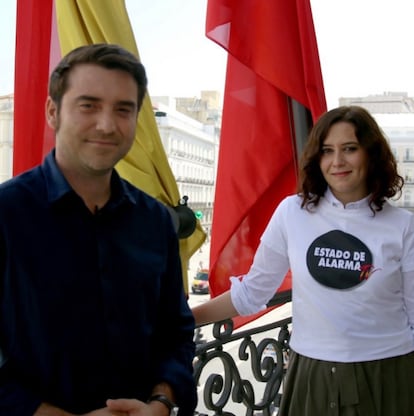
At first, revenue came from rudimentary channels like donations to a bank account or T-shirt sales. Madrid regional leader Isabel Díaz Ayuso, also of the PP, posed with one of those shirts in June 2020 after an interview. He praised her as “the bravest regional premier.” Another income source was YouTube views. By September 2020 he already had 300,000 subscribers and, according to Negre, made about €180,000 ($206,000) in his first year thanks to the platform.
In 2021, several heavyweight businessmen joined the shareholder base. The owner of the multinational cleaning and security company Eulen, María José Álvarez Mezquíriz, daughter of the businessman who funded the ultra-Catholic organization Hazte Oír, contributed €455,000 ($520,700). Former Coca-Cola global vice president Marcos de Quinto put in €227,000 ($260,000).
With a fortune of €47 million ($54 million), De Quinto has been involved in various right-wing initiatives since leaving politics, where he was a lawmaker for the center party Ciudadanos. He says he seeks ideological influence, not profitability, in media. After several failed attempts to buy into the project, Negre met him at a mutual friend’s party in Marbella and convinced him. De Quinto saw in him a “guerrilla fighter” with “lots of drive and very few resources,” capable of producing a “different product.” In his view, not all media need an investigative team. “It’s like an independent music artist competing with the majors.”
Municipalities, provincial councils and regions governed by the PP became a source of funds. Negre attended party congresses and events seeking institutional advertising, usually in the form of interviews or promotional videos. “To mayors I’d say ‘do it for Spain,’” recalls Josué Cárdenas, a former employee who witnessed some of those conversations. To another former worker, Borja Jiménez, Negre asked him to become “friend of the PP mayors” to extract “15,000 bucks a year” from them.
Jiménez was actually an infiltrator from another outlet, Okdiario. For two months he recorded all his conversations and, when he left the company, published several audios, including the one about the mayors. Negre spoke of tactics that sounded like extortion, according to a recording about dealing with political parties: “If they don’t support us we will build platforms against them. And let them suck our d**k.”
The OKdiario journalist says he has some 400 hours of recordings. To protect his cover, he had renamed his boss Eduardo Inda in his phone agenda. He called him Tito Miguel instead.
Tracking how much Negre received from Spanish public administrations is a devilish task because there is no central website that compiles that information. An analysis by the newspaper El Salto revealed that PP administrations paid EdaTV at least €680,000 ($778,000) between 2020 and 2025. Negre calls those amounts “ridiculous” compared with “what other left-leaning outlets receive.”
The money has not stopped flowing despite the hoaxes and the bad practices. Cárdenas, who worked for Negre for a year, says he was ordered to search for “juicy material” on left-wing politicians—approaching them on the street to ask about a personal controversy. If the question infuriated the politician and they shot back with a “fascist,” even better, Cárdenas says. “Negre only congratulated you when they hit you.”
Viral potential was the priority, even at the expense of verification, several former collaborators say. Sometimes crimes whose perpetrators had not even been identified were attributed to Muslims without any evidence to support it. “We had a WhatsApp group where sometimes someone would post a tweet and he ordered us to publish it quickly without checking,” Jiménez recounts. He recalls another episode: “Once he called me to ask me to sign an article about a soccer star who’d slept with a barmaid at a Marbella club. Later I learned he was super close to the owner.” Jiménez says he refused.
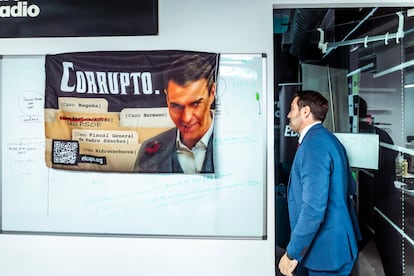
Revenue mostly comes from private advertising and follower contributions, Negre says. The website, which records very limited traffic, contains numerous articles promoting products from Spanish banks, electricity companies and supermarkets that are not labeled as advertorials. Negre denies these are covert ads and says those pieces aim to boost traffic and search rankings. Nonetheless, large companies such as Spanish nutrition company Naturhouse have been advertisers—advertising he says he personally secured. “In that Phoenician task of wheedling people he’s a phenomenon,” Cárdenas admits. “He ends up convincing you his crap is super tasty and you have to try it.”
EdaTV keeps growing. In 2021 it billed €346,000 ($396,000) and in 2024, the latest available accounts, it had quadrupled its revenue to €1.3 million ($1.5 million). Paradoxically, growth is not reflected on YouTube, its main megaphone. It has gained only 100,000 subscribers since September 2020, to reach the current 400,000.
3. Leap into Latin America with Milei
His American adventure began in Argentina in July 2024. The far-right president Javier Milei had been in power for seven months and had already become a reference point for the radical Hispanic right. Milei had visited Spain twice, in May and June, but Negre says he had not been able to speak with him. According to his account, he asked a friend for Milei’s phone number after the Argentine president showed solidarity on X with Negre’s employee Vito Quiles, whom Spain’s Transportation Minister Óscar Puente had called a “sack of s**t.” He says the leader invited him to Buenos Aires.
Days later, the Spaniard was already a familiar face in the South American country. He took part in talk shows and drew attention at Casa Rosada press briefings, where he used his speeches to attack “the lefties” and pick fights with other journalists.
In August, he announced the purchase, for an undisclosed sum, of half of La Derecha Diario, a website that operates “with a structure of only four people” and which during Argentina’s presidential campaign had spread pro-Milei disinformation. Its owner, the political consultant Fernando Cerimedo, admitted he used 50,000 fake social media accounts. As in EdaTV, Negre hired staff on pittance wages. A former employee who beat hundreds of applicants in a casting says she earned 240,000 Argentine pesos ($272). The instructions, she says, were to provoke. They were looking for the “Argentine Vito Quiles.”
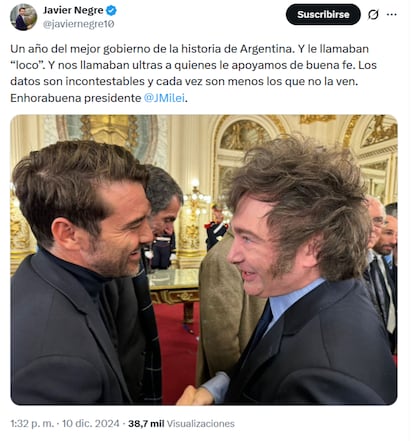
Negre’s website was cosseted by Milei, an X addict who in five months of 2025 retweeted content from La Derecha Diario 1,539 times, according to Argentine paper La Nación. The semi-public oil company YPF financed Negre with advertising, as he has admitted. YPF has not reported how it allocated the €30 million ($34 million) it spent on advertising in 2024, violating the order of a public transparency agency that backed a request by the civic organization Chequeado.
Negre settled in Buenos Aires, though he spent much of his time traveling the continent. He attended CPAC conferences, the major international gatherings of the radical right. On those stages he built a narrative of personal redemption. He presented himself as a businessman fired “like Steve Jobs” and crucified “like Jesus Christ,” but resurrected, vindicated and ultimately triumphant.
He showed up wherever elections were held to open a La Derecha Diario branch with help from local partners. He sought money indiscriminately. Shortly after meeting conservative academic Miklos Lukacs at a CPAC he asked him for $10,000 to open a branch in Peru. Lukacs declined: “Desperate people chasing money make me distrustful.” In Mexico, sources close to the magnate Ricardo Salinas say they reached an agreement to fund the Mexican branch for $6,000 a month for six months, but the billionaire was left dissatisfied with the “limited” impact and with Negre’s behavior, which, they say, disappointed him. Negre denies being funded by Salinas, despite Salinas taking the stage at CPAC Argentina 2024 to say “you need to put money into” the media fighting the cultural battle, echoing something Negre had said in his own speech.
In February 2025, Negre attended a CPAC event in Maryland, a euphoric summit just one month after Trump’s return to power, where Milei, Nigel Farage, Nayib Bukele and Santiago Abascal also took part. Washington had become the new capital of the international radical right and he concluded he needed to be there. A month later, at the Hungarian edition, he befriended Bruesewitz, the young Trump adviser highlighted by Time. Negre took him to bullfights in Madrid and to meet Milei in Argentina.
In June the Spanish businessman registered Right News Inc. in Florida and in September he debuted as a White House correspondent with a short video interview — in English, with a strong Spanish accent — of White House press secretary Karoline Leavitt, whom he called “the most influential woman in the world” and to whom he gave a rosary he bought in Jerusalem during a trip with the Argentine president. Negre, who for years barely spoke publicly about God, now presents himself in the U.S. as a devout Christian. He says that as a teenager he considered the priesthood and has always been a man of deep faith. Some who know him interpret this religious turn as yet another invention by a chameleon-like storyteller keen to blend in with the pious American right.
4. Merchant of influence
One late May afternoon, Negre was part of a small pool of 11 media outlets selected by the White House to share content with others when space is limited, as in the Oval Office. He now represents Real America’s Voice, the Trump-aligned TV network that stars Steve Bannon, Trump’s former strategist, and where he hosts a weekly program in Spanish. On this particular day, the president was in the building and no events were scheduled. Eight reporters worked silently in the press room at their computers or waited to go live on TV. Negre, by contrast, carried only his phone.
Suddenly more reporters began to arrive. “Hey, something is happening here,” he said. Rumors began circulating of a possible peace deal with Iran. Despite the commotion, he did not appear especially worried. He greeted Kaitlan Collins, one of CNN’s big stars. She returned the greeting with a smile. “I know her from Ned’s. Very nice,” he said. Pedro Rojas, Univision’s correspondent, also showed and shook his hand.
Negre has attacked Univision, Telemundo and CNN en Español relentlessly, accusing them of spreading false news among U.S. Hispanics. He also lashed out on X at Weijia Jiang, a CBS reporter and president of the White House Correspondents’ Association. After the assassination attempt on Trump at the annual journalists’ dinner in April, he went so far as to demand she be investigated. In Spain and Argentina, much of the profession repudiates him for his outbursts. At the White House, where a thousand accredited reporters are barely aware of him, he does not carry that stigma. “You can say Kaitlan and I would hate each other in Spain,” he suggests.
He obtained his permanent press pass in a matter of weeks while others wait months or years, and he has interviewed senior administration figures such as Treasury Secretary Scott Bessent. “They treat me like an ally,” he boasts. He says his privileges stem from Trumpism’s need for a Hispanic influencer who can help Republicans with Latino voters. However, he rarely addresses the issues that most affect that community. He spends much of his time outside the U.S., and tweets about political battles in Spain and Latin America.

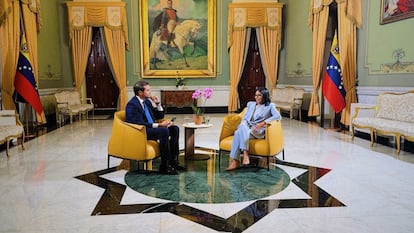
After meeting with this newspaper, he traveled to Colombia, where he took a selfie from the stage at a rally for the far-right presidential candidate Abelardo de la Espriella. He then went to Argentina, where he says he dined with Milei at the Olivos presidential residence. Later he interviewed Venezuela’s acting president, Delcy Rodríguez.
In reality, Negre seems more interested in shifting Latin America to the right, a goal aligned with Trump’s interests, as the U.S. president has revived the old Monroe doctrine famous for the slogan “America for Americans.” Other agents associated with Trumpism also operate in the region. One is Brad Parscale, Trump’s former campaign manager, who has business ties with Cerimedo, the founder of La Derecha Diario.
Fernando Monzón, a Spanish consultant specializing in digital guerrilla tactics who has worked in Latin America, says politicians are interested in Negre and other influencers for their ability to amplify messages: “It’s like hiring a billboard, but with much more impact.” Negre has more than 423,000 followers on X; La Derecha Diario more than 603,000; and UHN Plus over 1.2 million. The latter is a small outlet flagged for hoaxes and created in 2023 in Miami. In November, he bought 50% of it for a “confidential” amount.
Negre is like “the captain of digital troops” aligned with other armies serving these politicians, says Julián Macías, former social media coordinator for Spain’s left-wing party Podemos who directs the Pandemia Digital observatory. Macías acknowledges that Negre and his platforms are influential on X, an important political battleground, in part thanks to bots and provocation with false and extreme content. After the January death of Alex Pretti at the hands of ICE agents in Minneapolis, La Derecha Diario described him as a “deranged leftist” who “pulled his gun to try to shoot the agents” and was “sent deservedly to hell.”
For Negre, it is a battle “between good and evil.” “The left should be declared a terrorist organization,” reads a La Derecha Diario post illustrated with his image. Ayuso “is a star,” Milei “a genius,” and Sánchez “a son-of-a-bitch.” That modern kind of dirty politics has fueled his rise. Macías agrees with other observers when he says: “It seems like a good time for people like this with zero rigor, zero empathy and a willingness to do anything.”
It is also a battle paid for by right-wing leaders to whom he sells his propaganda machinery. To Colombian conservative activist Camila Rojas, 35, he made his intentions clear when they met in October 2025, and he proposed a business deal. Negre asked her to introduce him to prominent politicians in exchange for a commission. “He told me I could earn a margin of what they paid,” she says. That day, several people advised her to steer clear of Negre. She kept her distance thereafter.
One politician who did hire his services was the Bolivian José Carlos Sánchez, who paid him $2,000 a month between November 2024 and January 2025 in exchange for promotion, according to his adviser Anelin Suárez. Sánchez eventually stopped paying, deeming the exposure insufficient and suspecting Negre was also working for another candidate. Negre has denied to this newspaper that he took money from politicians, but in late June he told The Economist that “sometimes” he does.
Opacity surrounds his business in the Americas. He conceals the total number of employees and how much he paid to partner with La Derecha Diario or UHN Plus. He also conceals his web traffic, a metric he considers irrelevant because “people get their news from social media” and “most are incapable of reading beyond the headline.”
Another revenue source would be third parties’ access to Negre’s political contacts. The Mexican consultant Tumbaburros says he paid a $5,000 monthly fee for a time to get introductions to high-level figures in Argentina and the United States, such as Trump’s club in Florida. Negre denies being a lobbyist—a profession that requires registration. “I’ve never charged for facilitating meetings. My business is different,” he insists.
However, other sources have contradicted the Spaniard. Argentine deputy Marcela Pagano, who split from Milei’s bloc, included Negre last month in a complaint to Argentine justice authorities — shared with EL PAÍS — alongside two other alleged facilitators of access to the president’s circle. Aside from that accusation, this newspaper spoke to three people who asked to remain anonymous and whose testimony indicates Negre sought payment from businessmen interested in accessing politicians in Spain and Argentina.
Before meeting us in Washington, he had received EL PAÍS at EdaTV headquarters in Madrid’s upscale Salamanca neighborhood, where he improvised a speech for nine editors he called “apostles of the truth.” He urged them to verify harmful information about anyone because “they have families and rights” and warned: “My house doesn’t publish fake news.” He finished and they all returned to their screens. One TV screen showed a video of Vito Quiles on a morning show. The day before, he had had an altercation with people close to Begoña Gómez, the Spanish prime minister’s wife, whom he accosted with a defamatory question about the judicial investigation affecting her.

Quiles, absent that day from the newsroom, is 25 and is seen by the PP as a “courageous and daring journalist;” PP lawmakers defended him even after Congress expelled him in May for three months for recording in a prohibited area. He has more than 2.7 million followers across X, Instagram and TikTok, far above Negre’s roughly 837,000.
The master claims to have “created” the protégé who now eclipses him. He also says he “invented the system of asking uncomfortable questions.” The FAPE, an association that represents more than 17,000 Spanish journalists, does not dispute asking awkward questions, but supported Quiles’ expulsion and labeled him an “agitator” who violates “minimum standards of conduct” and deliberately confuses “the roles of activist and reporter.”
Both Negre and Quiles will be tried for an alleged hate crime against a disabled woman who was protesting Ayuso. The public prosecutor seeks prison sentences for both. Quiles also faces five other legal proceedings for offenses against honor, disclosure of secrets and fraud.
At the end of June, Quiles announced Combativos, his own media project “to finish off Sánchez.” “That’s how the ‘free market’ works,” replies Negre, who hopes the young man will continue collaborating with EdaTV.
In April, Negre agreed to meet EL PAÍS for the first time at the Feria de Abril, Seville’s famous fair, where he went “to prepare the Andalusian campaign.” He was accompanied by his partner, the Mexican-American citizen Astrid Macías, 35, whom he had married days earlier. The marriage opens the door to pursuing U.S. citizenship.

That afternoon, at the fair, he caught up with the radio journalist Carlos Herrera, with whom he once shared the Informe Negre segment on Herrera’s program on the COPE station. It was after lunch, a time for cigars and drinks inside Herrera’s caseta, a small private tent where judges, politicians and businessmen mixed — one of the spaces with the highest concentration of real power. Negre emphasized that he had learned from Herrera “the importance of public relations.” They embraced.
Asked about Negre’s American experience, Herrera chose three adjectives to describe his friend. He pronounced them theatrically while moving his hands in front of Negre as if firing ninja stars: “Javier is… unsettling… scheming… and always irritating.”
Sign up for our weekly newsletter to get more English-language news coverage from EL PAÍS USA Edition