
Kimi K3, the Chinese AI that has put Silicon Valley on alert
The new model, the world’s largest open-source model, puts China back in the race to lead advances in this technology
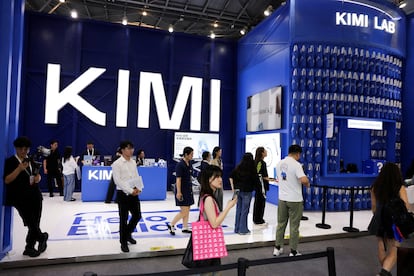

The frantic race to dominate the generative artificial intelligence (AI) industry has a new frontrunner. It’s called Kimi K3 and it has emerged from the labs of Chinese start-up Moonshot AI. The model has stirred considerable attention in the sector after the company published public performance test results placing it ahead of Anthropic’s most powerful model, Claude Fable 5, and of ChatGPT’s best, GPT5.6 Sol. Its open-source nature — meaning its inner workings can be inspected and modified by any user — makes it a formidable rival to proprietary models from the likes of Google (Gemini), OpenAI (ChatGPT), Anthropic (Claude) and Microsoft (Copilot).
The launch of Kimi K3, which will be available from July 27, once again puts China back in the race. The Asian giant made a forceful entrance in January 2025 with DeepSeek, a model that adapted to the U.S. chip export restrictions and challenged the biggest companies in the sector. Although the generative AI industry sees near-weekly developments, nothing from China had caused this much noise since then — until the early hours of July 16, when Moonshot AI, a company founded in 2023, unveiled its new toy.
The Kimi K3 model was developed with 2.8 trillion parameters — the variables adjusted during training. That makes it the largest open-source model in the world (the largest DeepSeek model has 1.6 trillion). The weights for those parameters will be made public from that day: any researcher, institution, or company will be able to take Kimi K3’s code and adapt it to their own needs to build bespoke tools, just as they can with DeepSeek models or Meta’s Llama models.
Kimi K3 has proven especially strong at programming. It ranked first in the LLM Arena leaderboard for creating online interfaces. It also scored highly on other software development tasks, at levels comparable to those achieved by OpenAI and Anthropic. For example, it can generate an interactive, playable 3D environment from a single photograph. The K3 model processes one million tokens — the basic units of text — in a single task, allowing it to work with very large datasets without losing accuracy.
Moonshot AI says, however, that all that computing power is not used to answer every prompt or request. The model includes a system that activates only the appropriate parameter subsets needed to answer each query. Experts recommend exploring this approach to improve AI model efficiency: just as you do not need to read the entire Encyclopaedia Britannica to answer when Pablo Picasso was born, you do not need to compute everything every time a specific task is requested. The more parameters involved in each operation, the greater the energy consumption; avoiding full activation every time would yield significant savings.
Economic and geopolitical implications
The emergence of Kimi K3 not only means China is again taking the lead in the industry. It could also have deep implications for the AI business itself. The open-source K3 model delivers better performance than the top proprietary (closed-source) models, such as Claude Fable. “When the best open weight model exceeds the best closed-source model, how does Anthropic justify its Fable pricing? Why would anyone pay for that?” Xiaowin Qu, a former product director at Meta and an entrepreneur in the AI sector, asked on X.
What Kimi K3 means for USA AI:
— Xiaoyin Qu (@quxiaoyin) July 17, 2026
1. FYI Kimi K3 is open weight and will be released on July 27, 2026.
2. When the best open weight model exceeds the best closed-source model, how does @AnthropicAI justify its Fable pricing? Why would anyone pay for that? Not to mention the Mythos…
From a geopolitical perspective, Kimi K3’s high performance also shows that the U.S. ban on selling Nvidia chips to China — widely regarded as the best in the world — has not been enough to halt the Asian giant’s progress in this industry. It would be “a nightmare,” Qu believes, if Huawei became the new benchmark for manufacturing cutting-edge chips.
The unveiling of the K3 model coincided with the launch of an international AI governance organization led by China. The World Artificial Intelligence Cooperation Organization (WAICO) includes about 30 countries, among them Russia, Pakistan, Indonesia, Brazil, Cuba and Venezuela. “It is an important initiative by China to respond to the call from the Global South and unite the international community to vigorously promote AI development and governance,” Chinese President Xi Jinping said last Friday.
Sign up for our weekly newsletter to get more English-language news coverage from EL PAÍS USA Edition









































