From being unemployed to hunting migrants in South Africa: The movement that has turned foreigners into scapegoats
A xenophobic wave, emerging in townships and working-class neighborhoods, has placed immigration at the center of political debate
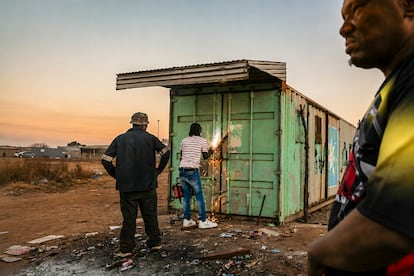

In the township of Katlehong — an area with a reputation for being dangerous, located south-east of Johannesburg — a worker leans a heavy iron bar against the door of an old, rusty Maersk container. Meanwhile, his colleague welds it to another bar, using a machine that sends a shower of sparks flying.
Arms crossed and in silence, Biranu Hajiso watches. A 36-year-old Ethiopian merchant, he’s the owner of the metal box that, until just a few days ago, operated as a spaza shop — one of the small corner stores selling basic goods, which abound in South Africa’s urban settlements.
Illuminated by the last rays of a pink winter sunset, Hajiso isn’t merely having a door sealed: he’s also closing a chapter in his life, as he has decided to shut down the business. He doesn’t know for how long.
“It’s the third time my shop has been looted,” he laments. “At least, this way, they won’t be able to get back inside.” He still doesn’t know if he will return to Ethiopia, or if he will hold out until the wave of xenophobic violence passes. Anti-immigrant sentiment has gripped South Africa in recent months… and, for now, it shows no signs of abating.
Around the container, there’s hardly any sign of activity left. In front of Hajiso’s shop, trash, scraps of merchandise and broken bottles are piled up. On the parallel street, a barbershop bears the marks of another riot: the interior is in disarray, empty, with only a hairstyling sign hanging crookedly from a single thumbtack. A few feet away, another vandalized shop still reeks of burnt rubber.
The scene in Katlehong encapsulates the climate that has taken hold in numerous working-class neighborhoods across South Africa since the anti-immigration movement — March & March — launched a campaign to expel African foreigners from the country. Their main targets are citizens of Zimbabwe, Lesotho, Mozambique, and Malawi — the neighboring countries from which most migrant laborers come — but their reach has also expanded to include refugees and asylum seekers, such as Congolese, Ethiopians, and Somalis, who have been in South Africa for years, even decades. In some cases, those being targeted have already obtained citizenship.
According to Loren Landau, a professor at Oxford University and one of the leading experts on migration in southern Africa, this isn’t simply a movement against immigration. In his view, the phenomenon reflects the accumulated frustration of a segment of the population that feels that the state has failed to deliver on the promises made after the end of apartheid. The protestors have been projecting their discontent on immigrants, who have become a visible target. “[There’s] enormous frustration with a state that has spent years failing to address very real problems. Immigration has become the vehicle through which that frustration [is channeled],” he explains.
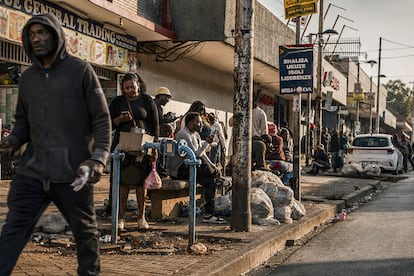
South Africa is the most unequal country in the world, according to the World Bank. It has an official unemployment rate exceeding 30%, an economy that has been virtually stagnant for a decade, high crime rates, as well as deteriorating public services. This cocktail has fueled deep social discontent, which movements like March & March have channeled against immigration.
This dissatisfaction erupted on June 30, the deadline that March & March had given the government to expel undocumented immigrants. That day, thousands of people demonstrated in cities across the country. Since then, the protests have evolved into door-to-door campaigns: groups of residents go through neighborhoods looking for people whom they consider to be foreigners, demanding that they prove their immigration status, or ordering them to get out of South Africa.
At the forefront of the movement is Jacinta Ngobese-Zuma, a former radio presenter who was virtually unknown just a year ago. She has now become the public face of March & March. The organization, which originated in Durban, has spread thanks to intense activity on social media and a constellation of groups that share a common message: closing borders, accelerating deportations, reserving jobs and priority access to public services for South Africans, and demanding that the government enforce immigration laws more strictly. In any case, the migrant population in South Africa constitutes barely 4% of the country’s 63 million inhabitants.
Ngobese-Zuma — who has not responded to this newspaper’s interview requests — denies that her movement is xenophobic. She maintains that its actions are directed against undocumented immigrants… but the victims of the attacks also include refugees, asylum seekers, permanent residents and even naturalized South African citizens. “Very few people can distinguish who has papers and who doesn’t. Suspicion ends up being based on language, accent, or physical appearance,” Landau explains.
The impact of these marches has been so serious that the government itself has been forced to intervene on several occasions. President Cyril Ramaphosa has promised to reinforce the borders, but insists that only the state can enforce immigration law. His message, however, has not stopped neighborhood patrols or door-to-door campaigns.
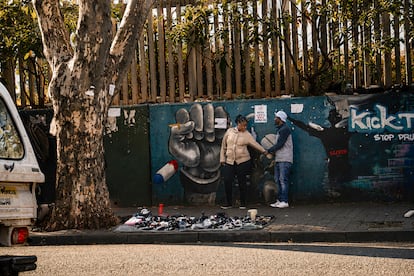
Fear, aggression and threats are the visible consequences of this xenophobic campaign, about which many questions remain unanswered. One such question is the relationship between March & March and uMkhonto weSizwe (MKP), a political party founded by former president Jacob Zuma. Although MKP leaders and members have participated in several demonstrations — and even though the party has publicly supported some of its demands — there is no evidence that the political organization controls or finances the citizen movement.
“There are many suspicions, but there’s very little evidence,” Landau summarizes. It remains unclear how March & March is financed. Ngobese-Zuma denies receiving financial support from political parties or businesses. And, for now, there’s no publicly available information that reveals the movement’s financial structure. What is clear, however, is that both groups share spheres of influence.
Yeshelen Govender is a lawyer and spokesperson for Siyafana Sonke, a coalition of more than 100 civil society organizations fighting xenophobia. He points out that many of the protests are concentrated in the province of KwaZulu-Natal and in townships in the province of Gauteng. These are areas where, during the apartheid era, Zulu workers arrived to work in Johannesburg’s mines. Many of the housing compounds — originally designed for Black migrant laborers — remain important spaces for community organizing. And some of them are within Jacob Zuma’s former strongholds, areas where MKP achieved some of its best results in the 2024 elections. “This doesn’t mean that MKP created March & March,” Govender clarifies, “but it does mean that some of the social and territorial networks that the movement is mobilizing today already existed in the past.”
For Landau, perhaps the most important question is not who funds March & March, but rather why it has found such a strong following. “If this organization were to disappear tomorrow, another would emerge,” he laments.
“I’d rather lose money than my life”
While politicians, analysts and activists debate the causes of the phenomenon, those living in the eye of the storm are beginning to make much more immediate decisions. They’re closing their businesses, fleeing, or going into hiding.
Biranu Hajiso opted for the first choice in Katlehong, welding shut the door of his shop. And so has Kwame (who doesn’t give his last name), a Ghanaian shopkeeper who has lived in the Johannesburg neighborhood of Yeoville for 10 years. He has decided to close his tailoring shop.
“I don’t want to wait until the same thing that happened to others happens to me,” he explains. “I’d rather lose money than lose my life.”
George, a Zimbabwean from the same neighborhood, admits that he has never experienced anything like this. “Until now, I had always considered Johannesburg a tough city… but it was open to anyone who wanted to work,” he sighs. Today, he avoids certain streets and tries to get home before nightfall.
Fear no longer distinguishes between undocumented immigrants and those with papers. On Monday, July 14, six hairdressers with refugee status were attacked in a Durban market. Two of them had to be hospitalized, according to Bishop Raphael Bahebwa.
Landau believes that this fear will persist until the state regains control of the situation. “Once people start thinking that certain groups can be blamed for all the problems, it becomes very difficult to reverse course,” he explains. “And, when that idea takes hold, the difference between having papers and not having them ceases to matter.”
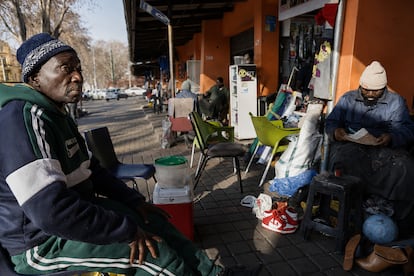
No one knows how long a movement like March & March can last. Government promises haven’t stopped neighborhood patrols or door-to-door harassment. For Govender, the campaign has opened a political space that will be difficult to close in the short term, as various political actors will try to capitalize on this discontent in the lead-up to the municipal elections in November. And it’s still impossible to gauge to what extent March & March will eventually become a political force in its own right, or whether it will continue functioning as a social pressure movement.
While this debate continues, Hajisu gets back into his old pickup truck. The two workers pack up the welding machine and tools. The container door has been sealed with two thick iron bars. “I don’t know how much longer I can last here,” the Ethiopian shrugs, before leaving. In theory, the March & March campaign is directed against undocumented immigrants. But the door that has just been welded shut belongs to a man who has all his papers in order.
Translated by Avik Jain Chatlani
Sign up for our weekly newsletter to get more English-language news coverage from EL PAÍS USA Edition