
Spain has granted an average of €36,000 to each recognized victim of Francoism since 1976
Over 600,000 people have received around €22.2 billion over the past 50 years in pensions and compensation, according to a report by the government’s technical commission
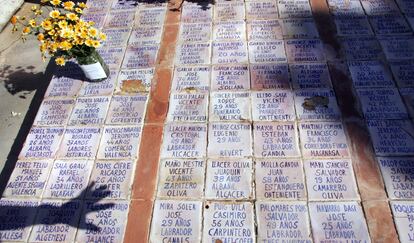

Spain’s Democratic Memory Law provided, in its 15th additional provision, for the creation of a technical commission to evaluate “the set of economic measures and reparations directed to the victims of the Civil War and the dictatorship” in order to analyze the degree of coverage achieved and identify “rectifiable shortfalls.” The final figure produced by that commission’s study shows a cumulative total from 1976 through December 2024 of €22.16 billion ($25.4 billion) and 611,828 beneficiaries. These are victims and those persecuted on the Republican side, since those from the Nationalist side that won the Civil War were already compensated during the dictatorship.
The number of beneficiaries of pensions for death or disappearance — one per family — totals 113,095, a figure very close to the 114,266 included in the first census of victims compiled by then-High Court judge Baltasar Garzón in his aborted investigation into Franco-era crimes. The amount paid under that concept through December 2024 exceeds €4.059 billion. At the end of that year only 3,582 people still received that pension because most beneficiaries have died. A similar pattern appears in another major payment category, aimed at non-professional military personnel and their relatives: 150,293 since the start of the transition to democracy, of whom only 2,548 relatives and 11 survivors were still receiving that payment until two years ago. As for former political prisoners, the total number of beneficiaries is 60,683 and the amounts paid total €397 million.
The government tried to obtain information from all of the country’s autonomous regions to detail those figures by territory, but most governed by the main opposition conservative Popular Party (PP) did not cooperate. The table with the information provided shows a highly uneven regime of reparations from one region to another and far below the state program. Thus, the total number of beneficiaries in the six regions for which there is information is 26,231, with 61 in the Canary Islands; 983 in Asturias; 22,152 in Catalonia; and 2,522 in Andalusia. Regarding amounts, Catalan authorities have granted €52.7 million; Andalusian authorities €9.4 million; Asturias €3.4 million; Castilla–La Mancha €3.2 million; Navarre slightly more than €495,000; and the Canary Islands about €325,000. The total for the six regions exceeds €69.7 million.
The commission urges “promoting new lines of study to determine possible corrections or, at least, to increase the level of knowledge” about the following groups: “women interned in the Franco-era reformatories run by the Patronato de Protección de la Mujer; victims of repression for reasons of religious belief; military personnel repressed in late Francoism for their proximity to democratic positions; people persecuted for their sexual orientation; and people persecuted through Francoist psychiatry.” In addition, the Ministry for Equality identified as “possible groups to be compensated,” among others, women who were victims of sexual violence during the Civil War and postwar period; Republican schoolteachers who were repressed; and women who were victims of child theft during Francoism and part of the dictatorship.
Repression of the Roma people
The government will also publish on Thursday the final report of the “working commission on memory and reconciliation with the Roma people,” who have just marked six centuries of presence in Spain. The document traces the history of persecution and discrimination against the community, including the so-called “great roundup” of 1749, devised by the Marqués de la Ensenada (Zenón de Somodevilla) and described in the text as “an attempt at bureaucratic extermination.” The Marqués de la Ensenada still has streets named after him in the country, something the government, according to sources in the State Secretariat for Democratic Memory, intends to reverse.
Franco’s victory in the Civil War ushered in, the study says, “one of the harshest periods of cultural repression,” since the regime viewed diversity as a threat to “Catholic national unity.” Police archives from the period contain “hundreds of files opened on entire Roma families,” often described in records as “nomadic bands” or “subversive elements” without specific accusations. The Civil Guard had explicit orders to “monitor Roma.” Sources at the State Secretariat for Democratic Memory say, after the commission’s report was completed, that it has been demonstrated that “anti-gypsyism is structural” and that its consequences persist today, which is evident in data such as that 85.9% live at risk of poverty and that more than 60% of Roma students do not finish compulsory secondary education (ESO).
The commission recommends extending the use of anti-discrimination protocols, promoting Roma participation in public institutions and incorporating Roma history and culture into the education system. There are European funds, according to sources at the Ministry for Equality, that depend on such measures. The government also proposes holding “a major state ceremony” in the Spanish parliament with the presence of King Felipe VI to symbolically compensate Roma people discriminated against for decades.
Sign up for our weekly newsletter to get more English-language news coverage from EL PAÍS USA Edition









































