
Jorge Pérez Gallego, astrophysicist: ‘A total eclipse creates an energy similar to a big concert, to the feeling of celebrating a goal’
For the Spaniard who directs communications at the U.S. National Solar Observatory, the unique sensations produced by the astronomical phenomenon go beyond what science can explain
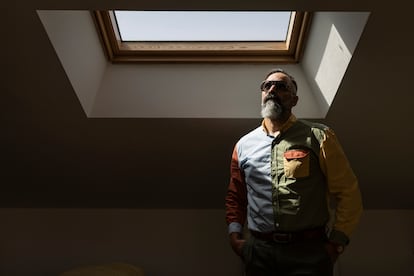

From producing the official live broadcast of the 2024 total solar eclipse for all of the United States to being able to experience the next one in his home country — the only place in the world where it can be seen with certainty — Spanish astrophysicist Jorge Pérez Gallego believes that, with barely two weeks to go, it is crucial to emphasize the feelings and emotions that “this natural event, of an unimaginable magnitude if you haven’t seen it before,” provokes. Looking ahead to August 12, he feels obliged to share key information and his personal experience with top-tier eclipses.
He stresses the need to move into the path of totality. Being nearby isn’t enough. A few tenths or hundredths short of 100% means missing what makes the phenomenon extraordinary, he tells EL PAÍS by video call. Pérez Gallego (Terrassa, Barcelona, 45) is the director of Education, Outreach, and Communications at the U.S. National Solar Observatory. With a Ph.D. in astronomy and a Master’s degree in fine arts, he combines two perspectives that lead him to champion art as a complementary way to communicate how Spain will experience this total eclipse — in 31 of the country’s provinces, another one won’t be seen until the year 2180.
Question. Three weeks after winning the World Cup, Spain will again experience a mass celebration with this eclipse. Can we expect it to leave a comparable mark?
Answer. Yes. It turns out we’ve now won the World Cup twice in 16 years. A total eclipse, if you don’t travel from where you live, on average you would have to wait between 300 and 400 years for it to happen again. In other words, it’s normally, with luck, a once-in-a-lifetime event for a person. People will remember where they were and who they were with during the eclipse, similar to how we remember the day of the September 11 attacks, a tragedy that also marked us. This time, though, the memory will be positive. It will raise a lot of questions, especially among many children. How those questions are answered will also shape their lives. It can plant a seed that sprouts in many directions, generating vocations in science, but also in art, the humanities, and philosophy.
I’d bet money that it will also turn adults who aren’t astronomy fans into new eclipse chasers — true addicts who travel the world to experience those feelings again.
Q. To what extent does seeing a total eclipse make us feel things we haven’t felt before?
A. Well, rather than “see,” I prefer the word “experience,” because what happens involves more senses than sight alone. There’s not just the visual factor. When the sky darkens, you’ll notice a sharp drop in temperature that can, in turn, create air currents. And if you’re out in nature, you’ll hear animals fall silent. All of that will happen even if clouds or a mountain prevent you from directly seeing the phenomenon where you are.
And if nothing blocks your view, you will see the strangest Sun of your life: it will have grown dark and a white corona will have appeared around it. You’ll also be able to see stars or planets very close to it — things we can’t normally see because the blinding brightness of the solar disk hides them.
Q. You’re giving us a massive spoiler about the eclipse. What if, in the end, the experience doesn’t live up to the expectations you’re setting for us?
A. It doesn’t matter if I spoil it. Even so, I think most people won’t be prepared to experience it. I wasn’t prepared — and I’m an astrophysicist. I knew what was going to happen and understood its scientific significance. I knew the theory inside and out, but suddenly, the moment it happens, there’s a very personal element to it. It’s something that goes beyond what science can explain and depends on your background: your education, cultural influences, and everything you’ve experienced up to that point.
Some people will shout, some will cry, some will start thinking of relatives they can no longer share it with, some will feel hopeful about the future. The spectrum of emotions an eclipse can sow in humans is as broad as the number of people on earth.
Q. What do you say to those who think it won’t be that big a deal?
A. Look, the first thing I tell them is: “Maybe, maybe, but give yourself a chance because it’s the only one you’ll ever have in your life.” Then I tell them about my personal experience and share the information I think is most relevant, and I hope that helps them make a decision about what they want to do. If they don’t want to watch it, well, there will always be people with different interests — like those who preferred to go for a walk during the World Cup final — and that’s perfectly fine with me.
Q. What information do you give to those who are unsure?
A. The first thing I tell them is that a 99.99% eclipse has nothing to do with a total eclipse. That remaining 0.01% may seem small, but it’s the difference between day and night. Literally. It’s not a metaphor — it’s just that the Sun is so bright that, if the eclipse is partial, even if it’s very deep — the small portion that remains still shines very brightly, enough for it to still be daytime. Even though an instrument might measure a decrease in brightness, we can’t perceive it with the naked eye. Only during a 100% eclipse does it truly get dark, even if it’s brief and strange. Only at that moment can you take off your protective glasses and see what’s always hidden.
So, if someone is in a place that will experience a 99.9% partial eclipse and asks me, “Is it worth driving half an hour to get into the path of totality?” the answer is yes.
Q. And about your personal experience of the 2017 and 2024 eclipses in the U.S., what would you highlight, for better and worse?
A. The best was being able to see the 2017 eclipse with my two best friends in the middle of the state of Oregon. The three of us being astronomers, and knowing the phenomenon, made us feel very different things; I remember we talked about it at length. The worst was the several-hour traffic jam when, after the eclipse, we began the return trip.
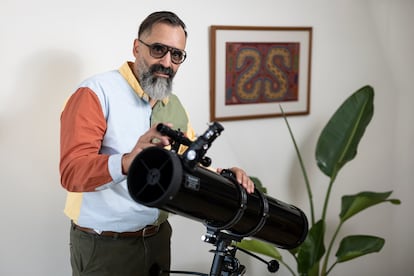
Q. Three astronomers, enjoying that unique experience in the midst of a natural setting. You must have got some spectacular photos of the eclipse...
A. Well, no. We’re there to experience it, which is what I recommend to people, especially if it’s their first total eclipse. If you’re not an expert in astrophotography, don’t try to take pictures of it: just enjoy how it makes you feel, without anything getting in the way. It’s just like how many people go to a Bad Bunny concert and feel the need to document it.
Q. In that case, how is a total eclipse similar to a concert?
A. They can be compared — as long as you experience the eclipse in company, of course. Then an energy is created similar to that at a concert by your favorite artist, or to the feeling of celebrating a goal. You feel part of a group experiencing something; you pick up the energy of those who are sharing it with you. And I, without judging those who want to record it, prefer to be present there without a camera stealing part of my experience. With a cellphone it won’t look good; it won’t resemble those professional photos that fascinate us of a total eclipse, with the solar corona and Baily’s beads.
One thing I can recommend is leaving a camera recording your reactions and forgetting about it. My favorite video from the 2017 eclipse is of a child, captured on camera at a public viewing, who has an incredible reaction. Whenever I show it in a talk, someone says: “I want to see it, I want to feel something like that.”
Q. That child is like the Keyne Yamal of eclipses.
A. Uh, yes, it’s a bit like seeing Lamine Yamal’s brother. The child’s reaction motivates people more to want to see a total eclipse than the astronomical photo of the phenomenon itself.
Q. How will you spend eclipse day?
A. After so many years in the U.S., I will finally be able to see a total eclipse in the country where I was born, with many of the people I love and with whom I became myself. Professionally, I’m also fortunate that the Institute of Astrophysics of the Canary Islands has recruited me for the NATE project, which will study the solar corona — taking advantage of the unique conditions of a total eclipse — and will do outreach about this phenomenon in depopulated areas of Spain. We’ll be in Palencia and several villages in the province during those days. When an eclipse approaches, everyone pays attention to the Sun and listens to us. For solar physicists, it’s like Christmas Day.
Q. Will you feel like a child on Christmas Day on August 12?
A. More like Santa Claus. Because on eclipse day, it’s the astronomers who bring the gifts.
Sign up for our weekly newsletter to get more English-language news coverage from EL PAÍS USA Edition









































