
Spain’s Supreme Court bars chief prosecutor for two years for leaking confidential information
Álvaro García Ortiz has also been ordered to pay a fine to Alberto González Amador, who is the partner of the conservative premier of Madrid
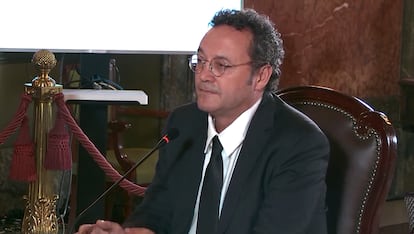

The Spanish Supreme Court has sentenced Spain’s chief prosecutor Álvaro García Ortiz to be barred from public office for two years for the crime of leaking confidential information. He has also been ordered to pay fines totalling €7,200 ($8,300) and ordered to pay €10,000 ($11,530) in compensation to businessman Alberto González Amador, who has been prosecuted for tax fraud. Ortiz is the partner of Isabel Díaz Ayuso, the premier of the Madrid region, from the conservative Popular Party (PP).
The ruling was not unanimous but passed by a majority of five of the seven judges on the panel. The other two, Ana Ferrer and Susana Polo, have announced they will issue a dissenting opinion. Polo was originally assigned to write the court’s opinion and had proposed acquitting the defendant. As a result, the task will now be assumed by the president of the Criminal Chamber, Andrés Martínez Arrieta. The Spanish Supreme Court only announced the ruling on Thursday, but the full written judgment has not yet been completed.
The decision comes less than a week after the trial of Álvaro García Ortiz concluded last Thursday afternoon. García Ortiz was accused of leaking an email sent to the Attorney General’s Office by González Amador’s lawyer. The dissemination of that email — in which the lawyer proposed a settlement with the Attorney General’s Office and admitted that his client had committed two tax crimes — occurred on March 13, 2024. This happened after the Spanish newspaper El Mundo published a report containing a false version circulated by Ayuso’s circle about her partner’s negotiations with the Attorney General’s Office. According to that version, it was the chief prosecutor offering a settlement to the businessman, rather than the other way around, as was the case.
The speed with which the Supreme Court resolved this case is unusual, as is the early announcement of the verdict before the full judgment has been drafted. Almost every aspect of this process has been exceptional, as was the case itself — the first ever opened against a chief prosecutor. By announcing the verdict in advance, the court has not yet revealed the reasoning behind the conviction or whether it directly holds García Ortiz responsible for the leak, for which there is no conclusive proof — only indications.
The preliminary ruling announced by the Supreme Court reads: “We hereby convict Mr. Álvaro García Ortiz, State Attorney General, as the perpetrator of the crime of revealing confidential data, Art. 417.1 of the Penal Code, and sentence him to a fine of 12 months with a daily rate of €20 and bar him from serving as chief prosecutor for a period of two years, and to pay the corresponding legal costs, including those of the private prosecution. As civil liability, it is declared that the convicted party must compensate Mr. Alberto González Amador with €10,000 for moral damages. He is acquitted of the other crimes under accusation [referring to other charges, such as malfeasance and mishandling of documents].”
The dissenting opinions by judges Ferrer and Polo will be incorporated into the final judgment. These two judges were the only clearly progressive members of the panel. The five judges who agreed on the conviction are the president of the Criminal Chamber, Andrés Martínez Arrieta; his predecessor, Manuel Marchena; and magistrates Antonio del Moral, Juan Ramón Berdugo, and Carmen Lamena.
García Ortiz has maintained his innocence from the beginning and denied leaking the email central to the investigation. During his testimony as the accused, García Ortiz stated that neither he nor anyone in his circle had leaked the email. “The truth is not leaked; the truth is defended,” he said. The attorney general had refused to resign throughout the process, but will now have to leave office following the Supreme Court’s two-year ban. The sentence will take effect upon notification of the judgment, not from the preliminary decision announced on Thursday.
The penalty imposed by the Supreme Court is lower than that requested by the private prosecutions, which sought four to six years in prison and up to 12 years barred from office. The crime for which García Ortiz has been convicted, Article 417.1 of the Penal Code, punishes a public authority or official “who reveals secrets or information obtained by reason of their office or position and which should not be disclosed.” The prescribed penalty for this crime is a fine of 12 to 18 months and disqualification from public office for one to three years, but if treated as an aggravated offense, can carry one to three years imprisonment and three to five years disqualification. The court chose a mid-range penalty: two years barred from office.
During the trial, held at the Supreme Court between November 3 and 13, 40 witnesses testified, including Alberto González Amador; the chief of staff of the Madrid premier, Miguel Ángel Rodríguez; former Secretary of State for Communication Francesc Vallés; former high-ranking Moncloa official Pilar Sánchez Acera; former Madrid PSOE leader Juan Lobato; and 12 journalists, including three from EL PAÍS.
Several testified that they knew González Amador had acknowledged his crimes to attempt a settlement before the attorney general received the email at the center of the investigation — some even provided WhatsApp messages as evidence. Three stated that they had access to the email and that it was not García Ortiz who forwarded it. All invoked professional secrecy, a right recognized in the Spanish Constitution, to protect their sources. Among them was Miguel Ángel Campos, the journalist from Spain’s Cadena SER radio network who first reported the leaked email (dated February 2). He stated he accessed its content at noon on March 13, but his source forbade publication until El Mundo had already released a distorted version that Miguel Ángel Rodríguez had been spreading for hours.
Sign up for our weekly newsletter to get more English-language news coverage from EL PAÍS USA Edition









































