
The vast cocaine trade from Latin America to Spain’s Galicia region: Record seizures and more narco-submarines than ever
International cooperation is one of the most successful methods in the fight against drug trafficking, with detection of ships by the US and UK proving fundamental

Drug traffickers are giving police no respite in Galicia. Although cocaine seizures haven’t yet reached the levels of 20 years ago, when they hit record highs, this Spanish northwestern region facing the Atlantic Ocean is experiencing a surge in shipments: 11.5 tons worth €800 million ($918 million) have been seized so far in 2025, compared with 10.5 tons in all of 2024. This surge has been compounded by the arrival of more narco-submarines, intercepted thanks to effective collaboration between international anti-drug agencies. In this relentless battle against drug traffickers, this exchange of information prioritizes stemming the flow of shipments across the Atlantic.
With two months left in the year — and with the expectation that increased consumption during the Christmas season will further boost drug shipments — the rate of seizures has risen to an average of almost a ton of cocaine per month, both at sea and on land or in commercial ports such as the one in the city of Vigo. The Vigo container terminal has become a major headache and a constant source of concern for the officers responsible for monitoring goods and detecting drugs that are concealed within tons of legal products shipped primarily from Latin America.
With narco-submarines as the most undetectable means of transportation, every drug trafficker’s venture now has a greater chance of success. The arrival of these crudely constructed vessels in Europe coincides with a cocaine production boom in Colombia, the main supplier, and the number of seizures represents a tiny fraction of the total shipments estimated to be circulating in the ocean, according to the police. Two of these narco-boats reached the Galician coast in 2025, and evidence suggests that many of the shipments seized at sea or on land have been sent in these vessels, which are then sunk without leaving any trace of their voyage.
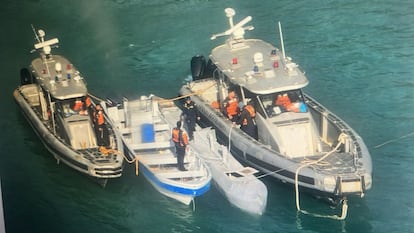
“We are seeing a lot of narco-submarine activity because it is the most profitable system for the organizations. The investment is lower and the chances of the drugs reaching their destination are higher, which is why the battle is constant,” states Emilio Rodríguez Ramos, head of the GRECO organized crime response unit of the Spanish National Police in Pontevedra. In this globalized process of drug trafficking, the inspector highlights international cooperation through liaison agencies as a key advance, in which the detection of ships by the U.S. and the U.K. is proving fundamental. However, technological resources are still insufficient. “We need much more technology to access encrypted systems, and that also requires the involvement of every country,” adds Rodríguez.
The first submersible carrying cocaine was seized in November 2019. Police recovered the vessel with three tons of cocaine on board and arrested its three crew members. Since then, three more have been intercepted, although it is believed that many more may remain at the bottom of the sea. Two of them were found empty and afloat after the drugs had already been unloaded. The most recent one showed up on January 22 in the waters off the Costa da Morte (Coast of Death), and the previous one was located in March 2023 near the port of Vilagarcía, in Pontevedra province.
But international cooperation allowed the police to deal a decisive blow to drug traffickers after intercepting a fourth submersible on September 13 in A Pobra do Caramiñal (A Coruña), north of the Arousa estuary. For the first time, drugs transported by a narco-submarine were seized on land: 3,650 kilos of cocaine that had been carried by several speedboats onto a beach where officers even witnessed the unloading. Twelve people involved in the operation were arrested in the raid, including the three crew members of the submersible.
Three weeks later, another international operation on the high seas led to the boarding of a speedboat carrying 2.4 tons of cocaine off the coast of Lisbon. The shipment, destined for distribution to Europe through Galicia, was intercepted by a French Navy patrol boat as the crew was preparing to jettison it after being surprised by warning shots fired prior to the boarding.
Almost simultaneously, another four-ton cocaine shipment was seized by the Spanish National Police in an operation at sea involving GEO (Special Operations Group) agents aboard a Spanish Navy vessel. The Tanzanian-flagged merchant ship carrying the hidden cargo, which had sailed from Panama, was headed to the port of Vigo to unload part of its legal cargo. This cargo served as a front for a powerful organization that had been under investigation for months. All nine crew members of the merchant ship were arrested.
This past weekend, the Portuguese Navy seized another narco-submarine near the Azores with 1.7 tons of cocaine, a small amount compared to the usual cargo these vessels carry, leading authorities to believe that some of it had already been unloaded. It is still unknown whether its destination was Galicia, and they are waiting for the four detained crew members to reveal some details of the operation. In this context, another factor contributing to this surge in narcotics is the overproduction and stockpiling of cocaine, which, according to investigators, is being stored awaiting a recovery in prices, which have fallen by half in the last four years.
Vigo, a trade route for drug traffickers
A year and a half after the Vigo port container terminal inaugurated a new trade route to South America for the transport of frozen fruit and fish, which has yielded significant economic benefits, cocaine trafficking organizations have seen this maritime route as an opportunity to open up new markets. In fact, seizures have multiplied in this dock area, where there is a presence of Albanian and Belgian groups, members of the Balkan Clan, which controls the cocaine market in Europe and Latin America through major ports.
Operated by the German company Hapag-Lloyd, the weekly shipping line calls at ports such as Guayaquil in Ecuador, where the loading of cocaine makes it a key hub for the drug trade. The route also includes stops in Colombia, Peru, Panama, and Costa Rica. In addition to Vigo, the line connects with the Spanish cities of Málaga, Valencia and Barcelona, as well as three Italian ports, representing a significant volume of traffic with an estimated average of 300 cargo movements per vessel.
Increased police pressure at the port of Vigo has forced Customs to intensify controls using AI methods for drug detection, particularly in containers. This surveillance has diverted some shipments to Portugal, mainly Porto, where hauls destined for Galicia have been seized. The latest report from the State Attorney General’s Office, published last October, analyzes the drug trafficking situation in the Galician region and identifies the port of Vigo as a key hub on the smuggling route from South America.
The Pontevedra Prosecutor’s Office refers to the “significant cocaine seizures at the port of Vigo” that took place in 2024 and emphasizes the impossibility of “linking the substance to its senders or recipients.” It also points out that drug trafficking organizations operating in Galicia have “the capacity to detect and disable tracking devices and channel all their communications through instant messaging applications, encrypted or not, to avoid any surveillance or eavesdropping.” Therefore, it calls for “a review of the regulations governing the range of technological investigative measures and for better allocation of already available Artificial Intelligence resources.”
International cooperation is one of the methods proving most successful in the fight against drug trafficking, according to the Pontevedra Prosecutor’s Office, which highlights the increased cooperation between Portuguese and Spanish authorities. The exchange of information led to the discovery of a new method for concealing cocaine: wrapping it in cowhide. Although the drugs arrived in containers in Portugal last September, the epicenter of the operation was the Rías Baixas region of Galicia, where 19 individuals involved in this network were arrested. The group had moved at least 2,332 kilos of cocaine in two successive shipments using this novel method.
Sign up for our weekly newsletter to get more English-language news coverage from EL PAÍS USA Edition









































