
Torrential rain in eastern Spain revives memories of last year’s deadly floods
In most of the towns affected by the flash flooding, no major incidents occurred overnight, although certain Catalan towns saw rainfall totals reach 246 mm
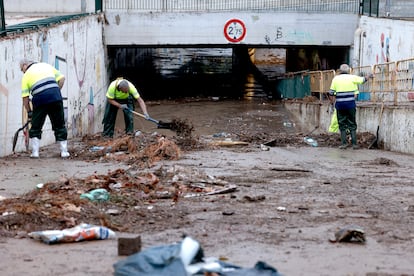

Residents of ground zero of the October 2024 flash floods in Spain, which killed 229 people, went to bed on Sunday night with the feeling that history might repeat itself. In the afternoon, they had received a cell phone alert from the regional government of Valencia warning of heavy rains expected as a storm system passed over the region, with totals potentially reaching 180 mm of rain. In Catalonia, where cell phone alerts were also issued advising caution, the rainfall so far has been the heaviest, with up to 246 mm of rain in areas such as Amposta, Tarragona.
For residents in Valencia, the night passed without major incidents, but fear is stronger than ever, as Spain’s weather agency Aemet reports that alerts at different levels remain in place across the entire eastern peninsula and the situation is expected to worsen throughout Monday. In Catalonia, Lleida is at yellow alert and Tarragona at red; in Valencia, the Ebro basin in Castellón and the capital remain at red; in Aragón, the level is yellow, and in Teruel, orange.
29/09 11:12 Avisos activos hoy y mañana en España por lluvias y tormentas. Nivel máximo de aviso: rojo.
— AEMET (@AEMET_Esp) September 29, 2025
Actualizaciones en https://t.co/BLdoSsO2Qv pic.twitter.com/v4IC7DLUdP
In the La Safor region, by midday Monday, up to 126 mm of rain had already fallen in the Parpalló-Borrell area, within the municipality of Gandía. According to the Valencian Meteorological Agency (Avamet), several municipalities in the area recorded totals above 100 mm, including Barx, Simat de la Valldigna, Camí de Mar de Gandía, and Rafelcofer. The heavy rainfall caused two road closures, a fallen tree, and flooding in several garages on Monday morning.
The mayor of Aldaia, Guillermo Luján, told this newspaper that the town’s residents — where six people died in last year’s flash flood — were “in panic” on Sunday night. There, the rains caused the La Saleta ravine to overflow near the Bonaire dam, flooding streets in the town center. In just 35 minutes, according to Avamet, the town recorded 57 mm of rain.
The Júcar River Basin Authority (CHJ) reported that all reservoirs under its jurisdiction remain at normal levels, with no significant increases despite the heavy rainfall.
The Poyo ravine in Paiporta — one of the area’s hardest hit by the October 2024 floods — also experienced a “short-term surge.” Overnight, rainfall in the town reached 22 mm, causing the ravine to rise at one point to about half a meter deep in its channel, which had receded by Monday morning, much to the relief of residents.
“Everything has worked well. The ravine isn’t carrying water, and although the worst is expected after 12:00 pm today, we’ve learned from experience. Yesterday, we used loudspeakers to warn the population,” said Vicent Císcar, mayor of Paiporta. “At least yesterday, they sent the Es Alert,” he added, referring to the mass cell phone alert warning residents of the severity of the storm.
In Alfafar, the first step by local authorities was to close the commercial area and industrial park, sites that suffered heavy damage during last year’s storm. “The commercial zone is key,” said the town’s mayor, Juan Ramón Adsuara, noting that on Monday morning the Local Operational Coordination Center (Cecopal) met to assess the situation and plan actions for the day.
The highest rainfall in the province overnight was recorded in Manises, specifically in the La Presa area, with 74 mm by 8:30 am, according to Avamet. Other towns, such as Buñol, only experienced minor rockslides along a road, though the Advanced Command Post (PMA) met Monday morning to report updates. In Catarroja, Massanassa, and Cullera, there were hardly any incidents.
In the province of Castellón, rainfall was even more intense. Eslida recorded 173.8 mm overnight. Seven other municipalities recorded totals above 100 mm — l’Alcúdia de Veo, Alfondeguilla, Aín, Tales, Chócar, Cabanes, and Vall d’Uixó — while four additional towns exceeded 80 mm.
A total of 112 incidents were reported overnight due to the storm, though none were significant, according to the Valencian Emergency Minister, Juan Carlos Valderrama, after a meeting at the Emergency Coordination Center. Incidents included rescuing a driver crossing a tunnel — a reminder of the importance of avoiding riverbeds or ravines, even if they appear dry.
The premier of Valencia, Carlos Mazón, chaired an extraordinary Consell meeting due to the active weather alerts. Pilar Bernabé, the government delegate in the Valencia, issued “a message of reassurance” to residents: “Valencians can be certain that the authorities have been working in a coordinated manner with all emergency agencies from day one,” she said, adding that “citizens have been warned and are therefore prepared to respond in the coming hours, which will be challenging.” Given forecasts of heavy rains along the coast, the delegate urged vigilance in areas such as campsites or similar locations.
Torrential rains in Tarragona
In Catalonia, residents also received cell phone alerts on Sunday afternoon urging extreme caution due to the rain, which poured down heavily overnight. Precipitation in the region has been the strongest so far. In southern Tarragona, in the Terres de l’Ebre area, Amposta recorded 246 mm, Mas Barberans 168 mm, and Els Alfacs 155 mm, according to early morning data from the Catalan Meteorological Service (Meteocat).
The most affected areas in Tarragona are the Baix Ebre and Montsià regions, where the Catalan regional government has suspend school activities. The Rovira i Virgili University (URV) also canceled classes at its Terres de l’Ebre campus in Tortosa and asked students to avoid traveling to and from the area.
So far, four roads have been closed in Terres de l’Ebre, according to the Catalan Traffic Service (SCT): the TP-3311 between Santa Bàrbara and La Sénia, the TV-3314 between Godall and Ulldecona, the N-340 between La Ràpita and Alcanar, and the TV-3408 between Amposta and La Ràpita.
The premier of Catalonia, Salvador Illa, met virtually Monday morning with the Centre for Operational Coordination of Catalonia (CECAT) to learn about “the evolution of torrential rain forecasts in various regions of Catalonia and their consequences,” according to Europa Press.
Evacuations and flooding south of Zaragoza
In Zaragoza, the Huerva River reached red alert due to rising waters, hitting 2.6 meters overnight. By 9:30 am on Monday, the alert had been lowered to yellow as water levels decreased to 1.4 meters, according to the Ebro Hydrographic Confederation (CHE). The Huerva riverbank was among the areas most affected by heavy rainfall in Aragón, including the municipalities of Cuarte and María de Huerva, just south of Zaragoza.
The storm left these towns with flooded streets, evacuated homes, and dozens of industrial facilities forced to halt production. In Zaragoza city, heavy rains disrupted the tram and bus services, closed the Z-30 ring road, and prompted over 100 calls to firefighters, who rescued some people trapped in vehicles. The water also affected hospitals, including Royo Villanova and Miguel Servet, and caused power outages in nursing homes such as Santa Fé, where residents were assisted overnight by firefighters and Civil Protection. On Monday, with water levels down, residents can be transferred to other facilities.
Monday is cleanup day in all affected municipalities. “We’ll focus on clearing streets, removing debris and damaged vehicles, but we remain alert in case another storm hits this afternoon,” said Miguel Ángel Clavero, Director General of Emergencies, who is highly experienced in coordinating these operations.
Since early morning, the 112 emergency service and the Aragón Infoar team have deployed six ground brigades, six fire trucks, and two technicians/supervisors to clear mud and reopen roads, along with heavy machinery.
High-ranking officials were present, including Aragón Premier Jorge Azcón. In previous storms, the opposition criticized him for being absent or delayed — once during a wedding in Galicia, and during the last flood in Aragón, while on a family trip in Menorca. This time, officials made a visible presence. The regional government has also announced that it will approve an urgent decree this week to provide aid for damages caused by the rains.
With reporting by Cristina Vázquez, Joaquín Gil, Ana Pantaleoni, Eva Pérez Sorribes.
Sign up for our weekly newsletter to get more English-language news coverage from EL PAÍS USA Edition









































