
How thousands of sperm squeeze into a space 10 times smaller without getting tangled
Fruit flies’ giant cells rely on collective motion, pushing against each other to prevent their flagella from tangling


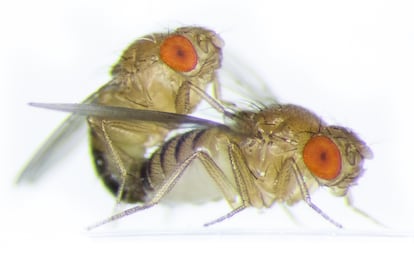
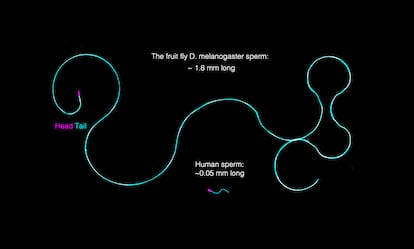
The sperm of the fruit fly are enormous—the largest in nature relative to body size. The male Drosophila melanogaster rarely exceeds 1.8 millimeters in length. Its sperm measure the same — 1,800 microns. And it doesn’t produce just one, but thousands, which cluster in the seminal vesicle while they wait to encounter a female. After mating, the problem falls to her. These thousands of sperm cells end up in the spermathecae and the seminal receptacle. There they remain for up to two weeks before reaching the uterus and completing this delayed fertilization. Both organs are shorter than a single sperm cell. So how do flies keep them from getting tangled up? A theory first proposed in the 1970s — one that helped underpin the plastic age — has provided the answer.
A group of researchers has taken an in-depth look at how flies manage this. D. melanogaster is no ordinary insect: it is the most studied in science. Like mice among mammals, it is a key model organism and underpins much scientific and medical research (many human diseases have parallels in these flies). A team of physicists, biologists and mathematicians set out to understand how so many sperm — each 1,800 microns long — can fit into a space measuring just 200 × 150 × 150 microns, the volume of the seminal vesicle. Their findings, published in Nature Physics, show that the sperm are able to self-organize and generate movement through a physical mechanism.
Under the microscope, a human sperm cell looks like a tadpole: it moves on its own, beating its tail in a fluid medium, propelling itself forward as if swimming. It is programmed to do so. The sperm of the male fruit fly also moves under the microscope — it waves its tail — but it does not advance. What researchers discovered (see video above) is that its flagellum oscillates, but always in the same place. It only moves forward when it does so collectively: observed in the seminal vesicle, the sperm never stop moving in sync. What is striking is that, unlike in mammals, there is nothing in these sperm cells that makes them move autonomously.
“We found that two adjacent sperm in the male’s sperm-storage organ often swim in opposite directions rather than moving in the same direction,” says Jasmin Imran Alsous, from the Flatiron Institute in the United States. “This happens in any region of the seminal vesicle.”
It is as if they were gears: the oscillation of one in one direction forces, through contact, the movement of the other. “In one area of the vesicle, sperm can be aligned in a particular direction [even if they swim in opposite directions relative to each other], while in another area they can be aligned in a different direction [also maintaining opposite motion],” she continues. This dynamic allows the sperm to move without their flagella becoming tangled.
They appear to move like flocks of birds or schools of fish. But there are radical differences. “In those cases, the emergence of collective behaviors is often tied to sensory and behavioral cues such as vision, predator avoidance or a tendency to keep a fixed distance from others,” says Michael J. Shelley, also of the Flatiron Institute and senior author of the study. “That is possible because fish and birds are highly evolved organisms.”
He continues: “Individual sperm, as far as we know, have no communication system beyond mechanical interactions arising from their extremely dense packing. Therefore, the appearance of large-scale collective flows in these sperm aggregates is a mechanical consequence of their density and activity.”
In other words, a giant sperm cell that cannot move forward on its own — despite constantly beating its tail — manages to stay untangled and in motion only thanks to its interactions with its neighbors when packed in large numbers.
In nature, there are many examples of dense packing to make the most of space or of collective movement to gain efficiency. The DNA packed inside a tiny human cell can stretch to two meters. If the sperm whale, at nearly 20 meters long, is enormous, consider the length of its intestines — about 150 meters. And as for self-organized collective motion, in addition to bird flocks and fish schools, certain insect species — such as the black sawfly (Perreyia flavipes) — also move in coordinated groups.
“An isolated sperm differs from an isolated fish or bird in an important way. A fish can swim by itself, a bird can fly alone, and a mammalian sperm can also move individually,” Shelley notes. But the giant sperm of the fruit fly generate the typical bending waves seen in any sperm cell, yet remain motionless when isolated. “Hence both the large-scale flows and the rapid directional mobility observed in the seminal vesicle are the result of collective interactions,” the researcher concludes.
For the authors, this dynamic can be explained by the theory of polymer reptation. It was proposed by the French physicist Pierre-Gilles de Gennes in 1971. Developed in the years that followed, “it explains the most important phenomena in the use and recycling of plastics,” says Juan Francisco Vega, a researcher with the BIOPHYM Group at the Institute of Structure of Matter at Spain’s research center CSIC. Plastic is made of macromolecules that tangle and untangle during processing. “They move through an imaginary tube formed by adjacent polymers,” adds Vega, who did not participate in this study. Two decades later, Gennes would receive the Nobel Prize in Physics for his ideas on reptation and the physics of soft matter.
“But in this biological context reptation is active,” says Vega, who applies Gennes’s theory to ocular fluids and the design of eye drops: “Tears are made of highly confined macromolecules,” he notes. In plastics, molecules are passive; they move due to heat or an external force applied during processing. “By contrast, fruit fly sperm use their tails to writhe forcefully.” This self-organized movement — each one pushing against its neighbor — is, in Vega’s words, “the most efficient and fastest traffic jam in nature, where extreme density itself allows the system to function and not stall.”
Sign up for our weekly newsletter to get more English-language news coverage from EL PAÍS USA Edition









































