
A living drug that fits on a spoon saves the lives of eight young people with the most common childhood cancer
The experimental treatment, developed using cells at La Paz public hospital, achieves a preliminary survival rate of 70% in patients who had exhausted all other options
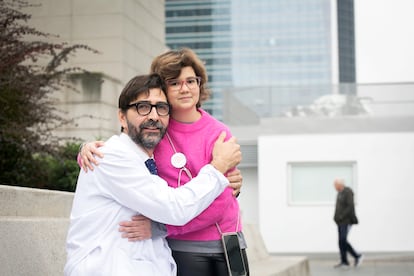

A new living drug, made up of cells small enough to fit on a spoon and produced at a public hospital in Madrid, has so far saved the lives of eight young people suffering from an extremely aggressive form of the most common childhood cancer — B-cell acute lymphoblastic leukemia. The patients, all under the age of 24, had been declared terminal after multiple relapses and the failure of all conventional treatments.
The sophisticated experimental treatment involves extracting a sample of immune cells, re-engineering them in the laboratory to increase their ability to destroy cancer cells, and then reintroducing them into the body to kill the tumor. The lead researcher, pediatrician Antonio Pérez, presented the results on Thursday at La Paz University Hospital: a 70% survival rate after more than a year and a half of follow-up.
A delighted patient, 15-year-old Lucía Álvarez from the Spanish city of Cádiz, joined doctors, politicians, and donors at the event. Her name is the latest to be added to a hopeful list of young people who are at the forefront of this medical revolution. The first was Emily Whitehead, a six-year-old U.S. girl with seemingly fatal leukemia who, in desperation, became the first child patient treated with this experimental therapy, called CAR-T, in 2012. It worked perfectly, and her doctors now consider her cured.
Thousands of people have survived since then thanks to their own modified cells. The father of the treatment, U.S. immunologist Carl June, speaks of resurrections “like that of Lazarus,” the biblical figure miraculously revived by Jesus Christ. However, the results are still insufficient. CAR-T cell therapies don’t always work. They only manage to save half of the children with the most aggressive, otherwise untreatable tumors
Lucía Álvarez and a dozen other patients received the new therapy when they were, on average, 12 years old. It’s a state-of-the-art CAR-T cell therapy. Typically, the treatment involves implanting a kind of radar in the patients’ white blood cells: a synthetic molecule capable of detecting the CD19 protein present in cancer cells of leukemia and lymphoma. The problem is that the tumor often manages to camouflage itself. The new therapy, in the words of Antonio Pérez, is like “a tandem,” capable of binding to tumor cells at two points, CD19 and CD22, minimizing the risk of escape.
Thanks to this sophisticated strategy developed in La Paz University Hospital, eight of the 11 patients saw their cancer disappear and become undetectable in just one month.
“The treatment doesn’t take long; it’s a bridging therapy and must be consolidated with a bone marrow transplant,” explained Pérez.
Five of the young patients were able to receive this life-saving transplant. After 20 months of follow-up, eight are still alive, representing a survival rate of over 70% for patients who had no other options for survival. The results, which should be interpreted with caution pending further trials, were published in August in the specialized journal eBioMedicine.
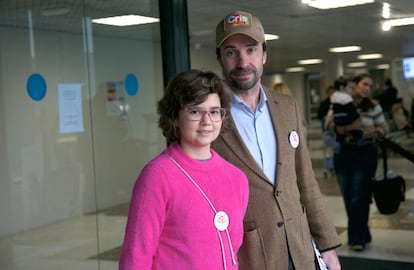
“I’m so happy to be here,” the 15-year-old said, her words carrying a double meaning that drew a standing ovation at the press conference.
Lucía Álvarez’s case illustrates the suffering of these patients and their families. She was diagnosed with B-cell acute lymphoblastic leukemia when she was 17 months old. Chemotherapy worked very well, but at age seven she had her first relapse, which was controlled with more chemotherapy. In the midst of the COVID-19 pandemic, she had a second relapse, with the tumor spreading throughout her nervous system. A first conventional CAR-T therapy and a bone marrow transplant achieved remission, but successive treatments failed until, with no options left, she received the experimental tandem CAR-T therapy and a second transplant. Today, she leads a normal life, has returned to school, and dreams of studying biology.
There are currently only eight CAR-T products approved in the European Union: seven commercial and one academic, ARI-0001, developed at Hospital Clínic in Barcelona. The treatment is named after Ariana Benedé, an 18-year-old who helped advance the research before she died of acute lymphoblastic leukemia in 2016. The examples from Madrid and Barcelona demonstrate that these revolutionary therapies can be developed in public hospitals at a fraction of the cost. The Swiss pharmaceutical company Novartis set a price of over €300,000 ($347,000) per patient for its Kymriah CAR-T against leukemias and lymphomas, while the Barcelona therapy cost only €90,000 ($104,000).
Pediatrician Antonio Pérez directs the CRIS Unit for Advanced Therapies for Childhood Cancer, located on the eighth floor of the iconic polygonal tower of La Paz Hospital, where more than 700,000 Spaniards have been born. Over the past year, however, Pérez has been working and learning at London’s Great Ormond Street Hospital, funded by the royalties of Peter Pan, which the Scottish novelist James Matthew Barrie donated in 1929. There, Pérez met one of the hospital’s most legendary patients: Alyssa, a teenager with incurable leukemia who in 2022 became the first patient to receive cells from another person, modified with a kind of genetic pencil to prevent rejection.
Pérez’s team is now also working with this genetic pencil, the so-called DNA base editors, the so-called DNA base editors, to adapt donor white blood cells — an excellent option when patients’ own cells are too damaged or there is no time to lose. The CRIS Unit at La Paz does not receive funding from Peter Pan royalties but does receive support from the CRIS Against Cancer Foundation, a nonprofit that has contributed over €10 million ($12 million). In February 2024, the foundation shared the story of another patient, Mathías, a seven-year-old treated with the tandem CAR-T therapy for his aggressive leukemia, which had kept him hospitalized for much of his life. In less than a month, his tumor entered complete remission.
Around 400,000 children and adolescents are diagnosed with cancer each year worldwide, according to the World Health Organization. These are very rare diseases — Spain sees only about 1,500 cases annually — and survival exceeds 80% in wealthy countries. But precisely for that reason, Antonio Pérez emphasizes in every talk that public hospitals must take the lead in developing new treatments, given the lack of financial incentive for the pharmaceutical industry. There are still two out of 10 children that no one is able to cure.
“I am very happy to be here helping so that other children can receive treatment,” Lucía Álvarez continued.
Sign up for our weekly newsletter to get more English-language news coverage from EL PAÍS USA Edition









































