
Guided missiles targeting tumor cells open a new route to combat cancer
A major European clinical research event in oncology gives a boost to antibody–drug conjugates, treatments that work like a Trojan horse, delivering chemotherapy to the interior of malignant cells
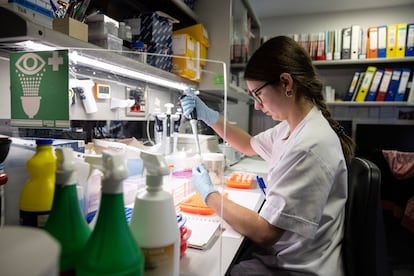

If more than half a century ago, science looked expectantly at the potential of chemotherapy to combat cancer; or 15 years ago, oncologists did the same with immunotherapy, which energized the immune system’s own defenses to attack tumor cells; now the spotlight has turned to an innovative treatment that is reaping promising results: antibody–drug conjugates (ADCs), treatments that function like a Trojan horse, delivering chemotherapy to the interior of tumor cells to destroy them. The European Society for Medical Oncology (ESMO) Congress, Europe’s main meeting for clinical cancer research, was held last week in Berlin, and it has given a boost to a new generation of these precision missiles. At the event, there were study presentations that demonstrated ADCs’ potential in several types of breast cancer and at various stages, not just metastatic.
These Trojan horses are formed by an antibody that targets a kind of antenna on the surface of tumor cells. These molecules carry a hidden chemotherapy payload, and when they reach their target, they bind to those receptors and release the entire drug into the tumor cells to selectively kill them. “ADCs are here to stay. It’s a validated line of research and it is like a highway along which we can continue to advance,” noted Aleix Prat, director of the Clinic Barcelona Comprehensive Cancer Center. Other studies presented at the event showed that this therapeutic approach also has potential for other tumors, such as ovarian, endometrial, and pancreatic cancers.
In breast cancer, these precision missiles have shaken up the prognosis of the most aggressive tumors. They entered the therapeutic arsenal more than a decade ago, but new generations of these drugs are gaining more ground. Three years ago, for example, research demonstrated that one of the new ADCs, trastuzumab-deruxtecan, increased the survival rate of women with HER2+ tumors (this subgroup accounts for 20% of all breast cancers) in metastatic stages. And a new study presented this year at ESMO and published simultaneously in the prestigious New England Journal of Medicine (NEJM) has also shown that another of these new precision missiles, sacituzumab govitecan, is more effective than conventional chemotherapy in treating triple-negative breast cancer (the most aggressive type, affecting 15% of patients) in advanced stages: median progression-free survival was almost 10 months in those treated with this Trojan horse (in those treated with chemotherapy alone it was seven months).
Javier Cortés, director of the International Breast Cancer Center in Barcelona and author of this research, asserts that, with this study, science confirms that when breast cancer metastasis appear; that is, when malignant cells have spread to other parts of the body, these drugs are positioned as the first treatment option. “This study adds another twist and improves the prognosis for these patients. Little by little, we are making slow but steady progress. At this congress, immunoconjugates have positioned themselves as the most innovative, the hottest, and the most spectacular,” notes the doctor, who is also scientific director of the IOB Institute of Oncology Madrid.
But this therapeutic strategy isn’t just suitable for the most advanced stages of cancer. Another study presented at the conference and published in the Annals of Oncology showed that in patients with high-risk, HER2-positive early breast cancer — who are more likely to have the disease recur — administering the ADC trastuzumab-deruxtecan followed by standard therapy before surgery improves the pathological complete response. This means that there are no tumor cells in the breast or lymph nodes at the time of surgery after this treatment, a key parameter for reducing the risk of relapse.
Santiago Escrivá de Romaní, an oncologist at the Breast Cancer Group at the Vall d’Hebron Institute of Oncology, participated in this research: “We found an 11% higher rate of complete pathological response [when incorporating ADCs into treatment].” The doctor asserts that the development of Trojan horses is “a turning point” in oncology: “ADCs are gaining significant traction. They don’t allow us to rule out chemotherapy, but they greatly help us target it more precisely to tumor cells,” he adds.
Regarding this research, Prat asserts that in these early contexts, the therapeutic potential they anticipate from these Trojan horses means that “they can cure more patients.”
A “new chapter” in oncology
In a statement, the European scientific society stated that, with the potential shown by ADCs, oncology is “on the threshold of a new chapter,” focused on “smarter targeting, earlier intervention, and a deeper biological understanding of tumors.” The research presented at the congress, it stated, “marks the official entry of a new generation of drugs into the curative field.” “This is a therapeutic strategy with enormous potential, which we are only just beginning to discover, and which promises to reduce recurrence rates and improve survival in multiple cancer types in the coming years,” Paolo Tarantino of the Dana-Farber Cancer Institute and Harvard Medical School said in the same statement.
The doctor did warn, however, that the use of these drugs also presents new challenges, such as toxicity and defining the patient profile that will benefit most. In Cortés’ study, for example, 66% of those receiving the ADC experienced side effects (62% of the control group also experienced side effects), primarily diarrhea and decreased immune defenses. “In general, Trojan horses produce a toxicity that, compared to traditional chemotherapy, tends to be somewhat better,” Cortés notes.
Another open area is refining the profile of patients who will benefit. In the study led by this Spanish doctor, around 50% of the patients in the trial saw their tumor shrink; 45% maintained their tumors unchanged (neither growing nor shrinking), and 5%, during the first follow-up, had experienced growth, explains Cortés. “Research is now focusing on studying the mechanisms of Trojan horse resistance. It could be due to alterations in the receptors where the antibodies must attach, or there could also be resistance in the mechanisms of cleavage and release of the chemotherapy load they carry. Ultimately, these treatments are an elegant way of administering chemotherapy, and it could also be that the tumor is resistant to chemotherapy,” the oncologist ponders.
Pending challenges
Cortés also argues that there are many other issues still to be investigated: for example, how to combine different Trojan horses with each other; or how to fit one of these precision missiles with other treatments, such as immunotherapy. “We need to see how to optimize these Trojan horses: there are studies on antibodies that can attach to various receptors [on tumor cells], or how to carry a load of two different chemotherapies,” he says.
Pilar Barretina, head of Medical Oncology at the Catalan Institute of Oncology (ICO) in Girona, points out that there is “a boom in [this type of] drugs under investigation that opens up many avenues.” “It’s one of the major promises we have today. There’s a tsunami of ADCs coming our way, but we’ll have to see the results of their efficacy, tolerance, and which patients can benefit most,” she adds.
This oncologist, who presented a study on immunotherapy for advanced endometrial cancer at the congress, says that ADCs have been used “in almost all tumors,” but admits that the most advanced research is in breast and lung cancer. “But very promising phase I trials have also been presented in ovarian and endometrial cancer,” she adds.
The “highway” that, according to Prat, ADCs have opened to combat cancer is expected to be long, especially with the new generations of Trojan horses being tested, which are increasingly precise. Along these lines, the oncologist from the Clínic assures: “Technologically, [this precision missile] will be able to release anything. So far, it’s been chemotherapy, but we are already starting to see combination designs with immunotherapy or others.” For example, Cortés adds, research with radioligands is beginning to gain traction. These are a kind of Trojan horse that, instead of chemotherapy, carries radioactive isotopes in its payload to create selective radiation. “It’s extremely powerful. There’s already good data on some tumors, such as prostate cancer,” he adds.
Sign up for our weekly newsletter to get more English-language news coverage from EL PAÍS USA Edition









































