
Insecure men make for big business: The testosterone craze that is exploiting the masculinity crisis
Hormone therapies promise to increase muscle mass and sex drive, while bringing down depression. But because of advertising claims and ideological elements, this means that only a minority of men who inject themselves do so for medical reasons

“You have to hack your body. I think that people from my generation will live to be 100.” This was a comment made by 50-year-old businessman José Elías, on a Spanish-language podcast titled The Formula for Success.
While discussing erections, biohacking, and immortality, the owner of a frozen food chain in Spain explained the reasons that led him to start testosterone replacement therapy (TRT). “I just started… and it’s amazing. In terms of vigor, you can’t go wrong. In terms of vitality, too. It feels like being 30 again.” The conversation was relaxed and, one might think, merely anecdotal. But it perfectly illustrates a growing trend that has arrived in other countries, imported from the United States.
TRT promises to boost muscle mass, mood, and libido. It promises to rejuvenate the elderly and lift the spirits of those suffering from depression, while making men younger, more masculine, and more sexual. But this isn’t so much a medical list as it is an advertising claim.
The overall concept has become a marketing strategy, one which is especially prevalent on social media and podcasts. Masculinity is being medicalized: its attributes are exaggerated with aggressive treatments that respond less to a medical need than to an underlying ideology.
Three months ago, an academic study conducted in Australia concluded that some social media posts portray low testosterone as “a crisis of masculinity.” And not only that: the advertisers promote testosterone tests, trying to convince healthy young men that they have some kind of problem.
This could explain the incredible increase in TRT prescriptions in recent years. In the United States, prescriptions have increased by 154% since 2020. Approximately 5.6% of men between the ages of 30 and 79 have low testosterone, a condition called hypogonadism. But only one in five of these men ultimately receives treatment. The availability of this medication should solve the problem; however, paradoxically, it doesn’t.
“There are no guarantees that the patients who actually need it are being treated,” says Maria Papaleontiou, an endocrinologist at the University of Michigan Medical School. Her recent study — highlighted by The Endocrine Society — quantifies this paradox: only 12% of the men treated met all the diagnostic criteria. The sample size is small (around 200 cases) and focuses on a single institution, but Papaleontiou points out that the results are consistent with other similar studies.
Of course, this doesn’t even take into account the numerous private clinics that perform tests and prescribe treatments online. In these centers, testosterone levels are measured beyond traditional clinical protocols.
In his podcast appearance — after discussing the benefits of TRT — José Elías announced that he wanted to open a men’s health clinic to perform testosterone tests. There are already many in Miami and in Dubai, he noted, but not in Spain. And this is the other side of the trend that cannot be ignored: the economic aspect. The testosterone-testing market continues to grow: it’s estimated to increase from $122.2 million in 2026 to $222.7 million by 2035, according to a report by Future Market Insights.
“This industry has become a multi-billion dollar market,” says Dr. Sophia Sinha, co-author of the study from the University of Michigan. “It’s driven in part by subscription-based business models and aggressive social media advertising strategies. Furthermore, while low testosterone can be associated with fatigue, lack of energy, and decreased muscle mass, these commonly cited symptoms aren’t specific and can also be due to other conditions.”
More and more healthy men are turning to testosterone supplementation. Levels of this hormone decline with age, especially after 45. It’s a natural aging process that can now be addressed with a synthetic approach. The promise is as tempting as it is unsettling, depending on how you look at it: to create a generation of elderly people who are toned, energetic… and as sexually active as teenagers.
For younger users, the benefits are more dispersed and can only be understood from an ideological and cosmetic perspective. But the side effects are clear: if a healthy young man injects himself with testosterone, his body detects it and shuts down its natural production. This can cause testicular damage and infertility. However, in some corners of the internet, influencers like 20-year-old Clavicular (whose real name is Braden Peters) claim to be using these products like steroids, in order to achieve a more masculine and muscular appearance.

“All of this has a clear ideological component,” sociologist Olmo Morales explains. He believes that the rise of TRT is a reaction to the questioning of male power. “One of the responses to the advancement of women, instead of reinventing masculinities, has been to reinforce them, with the hegemonic form and esthetic,” he explains. Essentially, TRT is a form of gender affirmation therapy: men are told that, if they don’t fit into a caricature of masculinity, they can achieve it through treatment. This approach resonates strongly with the so-called “manosphere” — a network of online communities that spread regressive ideas about gender and push the notion of male superiority.
Thus, testosterone has become the priapic elixir of the MAGA movement. Just as a few years ago, in certain sectors of the left, there was talk of “feminizing politics.” Now, in the most extreme corners of the right, there’s an attempt to masculinize it. Literally.
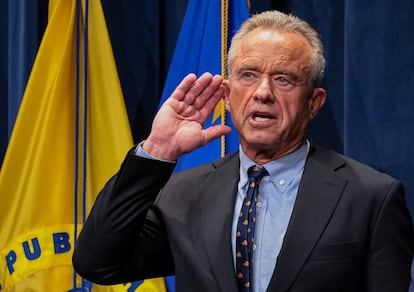
Robert F. Kennedy Jr., the U.S. secretary of Health and Human Services, is the biggest proponent of this treatment. His shirtless photos and videos of him working out in jeans are a draw for many of his contemporaries. At 72, Kennedy has a toned, veiny, slightly puffy torso. One might think he’s the antithesis of the much rounder Donald Trump… but that’s not the case. According to Kennedy, his boss has “the constitution of a deity.” And back in January, on a podcast, he explained the key to the president’s health: “Dr. Oz looked at his medical records and said he’s got the highest testosterone level that he’s ever seen for an individual over 70 years old.”
The MAGA obsession with this hormone goes beyond words. Kennedy has begun taking the first steps to deregulate testosterone prescriptions, which could open the drug to a much wider market, detaching it from the medical context and turning it into a cosmetic product.
The reasons for doing so are debatable. Various studies have shown that, in recent decades, average testosterone levels have declined among men in Western countries. This is partly explained by the aging population. The obesity pandemic also plays a role, as being overweight and having diabetes interfere with testosterone production. However, a segment of the American right argues — without evidence — that environmental factors, chemicals, or even public policies are reducing testosterone levels in men, which is having profound social implications. Therefore, they want to “liberalize” its use.
Testosterone has proven not to be as dangerous as previously thought. A 2023 study of 5,200 men between the ages of 45 and 80 debunked the then-widespread belief that testosterone replacement therapy was linked to an increased risk of heart attacks and strokes. The trial also found that testosterone improved sex drive (although it didn’t treat erectile dysfunction) and was associated with a modest reduction in depression after two years.
However, the benefits of supplementation for people with healthy levels of testosterone are debatable. A recent study from the University of Gothenburg warns that “the connection between testosterone and well-being is weaker than many people think.”
Endocrinologist Amar Osmancevic, one of the study’s authors, tells EL PAÍS that “testosterone seems to have shifted from a specific clinical topic to a broader lifestyle conversation.”
“The public narrative has likely been oversimplified, because [TRT] is marketed as a miracle cure for common, nonspecific symptoms, like fatigue or low mood,” the specialist laments. “In reality, biology is much more complex and interconnected.”
Testosterone is known to help build muscle. “But by using advanced CT scans to go beyond simple muscle size, my research revealed something interesting: bigger isn’t always better.” Osmancevic has found that, as muscles grow, they can accumulate hidden fat — a condition called myosteatosis.
His analysis also confirms that the most obvious benefits associated with receiving TRT are of a sexual nature and, to a lesser extent, related to muscle and joint pain. However, he clarifies that “even these [benefits] are modest.” Symptoms like fatigue or depression, meanwhile, don’t show a clear relationship with low testosterone levels and seem to depend more on factors like age, lifestyle, associated illnesses, and abdominal fat.
But online, the fine print of academic papers isn’t as much of a topic of discussion as before-and-after photos. It’s not as exciting as stories about how middle-aged men went from feeling exhausted to motivated, or how they reduced their beer bellies and developed bulging biceps, while gaining an insatiable desire for sex. In the marketing narrative, testosterone has ceased to be a hormone and has instead become a concept, an ideal: a masculine, hypertrophied version of The Substance (2024).
In reality, hormones are complex chemical compounds. They cannot be simplified to fit a cultural narrative (the same is true for dopamine, cortisol, and endorphins). They function in networks, in interconnected ways that are difficult to replicate. Finding an artificial substitute for testosterone is good news… but, in order to sell it to those who don’t need it, a simplistic online narrative has emerged that transcends the medical realm. It’s effective and it’s increasing the profits of some companies. And yet, it’s also propping up a toxic political discourse and making men feel insecure about their own masculinity.
Sign up for our weekly newsletter to get more English-language news coverage from EL PAÍS USA Edition









































