
More educated, healthier... better? What science says about voracious readers
Various studies have attempted, without success, to analyze whether reading can increase our empathy. The evidence is clearer regarding its power to enhance culture and mental health


This week, María Pombo sparked a heated literary debate. The Madrid influencer posted a video on social media in which she boasted about having a library as beautiful as it is empty. “We have to start getting over the fact that there are people who don’t like to read. And on top of that, you’re not better for liking it,” she said. The observation swiftly turned sour. Angry comments filled her post, news stories were written in media outlets, and heated debates analyzed the benefits of reading in thousands of WhatsApp groups. Her words struck a chord because they denounced the supposed moral superiority of readers, but also because they raised a kind of dichotomy between books and social media. Because they pointed out the reasons why we read, or why we claim to read. Among the most repeated criticisms were those that lamented the decline in reading habits. But what do the data say?
A study published last week in the journal iScience states that reading has plummeted by 40% in the United States over the last 20 years. It has been declining since the 1940s, but researchers called the magnitude of this latest drop, exceeding 3% annually, “surprising.” This is especially true because the study defined reading broadly, to include books, magazines, and newspapers in print, electronic, or audio formats. Jill Sonke, co-author of the study and professor of cultural policy at Stanford University, suggests some possible explanations in a telephone conversation. “It could be due to the increased use of social media and other technologies, or more time spent at work due to economic pressure,” she explains. In short: cell phones and work killed the book. And this is bad business, warns Sonke, because reading “can improve health and well-being,” something that is difficult to achieve by spending the afternoon at the office or scrolling through TikTok.
At this point, two details about the study need to be clarified. The first is that the data are solely from the U.S., so we must be very cautious when extrapolating the conclusions to other countries, the author warns. In Spain, the survey conducted by 40dB last year for EL PAÍS said that 35% of people read every day. This is more than double the figure given in the American study: a meager 16%. But the second detail worth highlighting is also important. Most analyses about reading ask respondents directly if they read books, and they tend to give a sweetened version of themselves. We all (except perhaps María Pombo) read more in our heads than in reality. Dr. Sonke’s analysis is especially reliable because it was based on data from the American Time Use Survey, which every year for 20 years asked 236,000 Americans to describe in detail how they had spent their time the previous day. “This reduces recall bias,” says Sonke.
This summer, there was a lot of talk about the performative reader, a man who goes everywhere with a book he isn’t reading just to pretend he is. It may be a cliché or part of internet culture, but it’s clear that the phenomenon responds to a widespread idea: reading is cool, it’s fashionable, and it confers a certain cultural cachet. It could be said we don’t enjoy reading as much as we do having read. But it’s difficult to determine who actually reads and who just claims to.
Michel Desmurget, a doctor in neuroscience from MIT and research director at the French National Institute of Health and Medical Research, claims to have found a way to find out. He compares a country’s percentage of avid readers with its reading comprehension scores in reports such as PISA (for schoolchildren) or PIAAC (for adults). And he believes the difference is very large: it’s not that we in Spain, for example, are great readers, but rather great frauds. “Spain’s results are similar to those of OECD countries,” he explained recently in an interview. “If we had 64% or 65% of avid readers, we wouldn’t have 75% of readers with a little more than a basic level.” According to data from the latest PIAAC report, presented at the end of 2024, the reading comprehension level of Spanish university students has plummeted in the last decade. From 282 points in 2012, it dropped to 271.9 points in 2023. A Spanish adult has poorer reading comprehension than a high school student in Finland (288), Sweden (283), or the Netherlands (274).
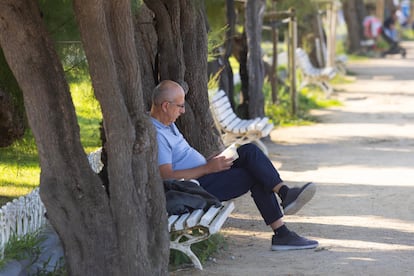
Massimo Salgaro, a German philologist who has been studying the cognitive and emotional effects of literary reading for years, is more cautious in his conclusions. He believes that with the topic of reading, we are facing a recurring moral panic. “The underlying attitude is as old as humanity itself,” he explains in a message exchange. “Plato condemned the introduction of writing; in the 19th century, there was a fear of addiction to novels, which would distract young women especially from household chores; in the 1950s, a crusade against comics broke out in the United States.” Today, reading is no longer that new invention threatening our culture, but rather the value to be preserved in the face of the novelty of the internet. But to be objective, says Salgaro, it is difficult to draw a long-term assessment. “There is a lack of reliable and comparable data in research on reading,” he concludes. “And this is due, among other things, to the fact that in the past, science and society were less interested in this activity.”
Reading as a healthy habit
This raises the question of why there has been increased concern about reading habits. Are books a more prestigious cultural vehicle than others, or can reading actually have some positive effects on health? “We don’t usually think of reading as a healthy habit, but it is,” Sonke points out. “Just like exercising or watching our diet, reading can help us improve our health.”
The evidence for this claim is limited but promising. A review of five studies published in 2023 in the journal PLOS One concluded that reading fiction can positively influence mood and well-being, highlighting that the benefits emerge especially when there is reflection and discussion. In that sense, book clubs would be a perfect recipe, combining this reflection with social connections.
Another study, published a year later in the same journal, found how reading reduced anxiety and improved sleep quality and life satisfaction in a group of 2,800 students. But the most beneficial effect may be its choice over other forms of leisure, especially digital ones, which have been robustly shown to have detrimental effects on mental health.
Reading isn’t natural: the brain has to make a certain effort to transform strokes into letters, then these into words, give them meaning, and combine them to create a complex and emotional plot. Reading, at its core, is staring at strange symbols until you hallucinate. During this process, the areas of the brain related to vision, semantic comprehension, and sensory simulation are activated. Salgaro explains it more poetically. “According to Umberto Eco, literary texts are ‘lazy mechanisms,’ which means that reading requires the reader’s active participation. A literary text contains many unspoken elements, the so-called blanks, which the reader must fill in with their imagination. Through this creative activity, each reader brings the characters to life, imagining their faces, voices, colors, and atmospheres in a unique way, according to their own experiences and sensibilities.” This makes reading Wuthering Heights something completely different from watching a film adaptation, even though both tell the same story. It’s not that the movie is worse than the book, it’s that it’s worse than our personal interpretation of the book; it doesn’t live up to our imagination.
Some say that reading fiction could also make us more empathetic. Despite being a solitary act by definition, a good book puts us in the shoes of a character whose innermost thoughts we know. The most comprehensive meta-analysis on this subject was published last year, and it didn’t reach very clear conclusions. “The evidence, as it stands, doesn’t do much to justify the compelling intuition that imaginative, sophisticated, and creative language exercises make us more sensitive moral agents,” it concluded. The study noted that generalizations cannot be made about something as vast and diverse as books. Certainly, we can suspect that reading Madame Bovary doesn’t have the same effect as flipping through a romance novel. In terms of empathy, spending the afternoon poring over Mein Kampf or immersed in The Diary of Anne Frank won’t be the same. There’s no study that proves it, but it’s something everyone has experienced in their lives: there are people who are well-read and very selfish, just as there are empathetic people who have never picked up a book.
There’s less doubt when it comes to the conclusion that reading, in general, makes us more educated. Various content studies have shown that there is more linguistic richness in a children’s picture book than in all common oral corpora: conversations between adults, movies, television programs... This means that exposure to the written word is the only way to develop advanced language, essential for constructing complex thoughts. “The term foregrounding refers to a writer’s original stylistic choices, that is, deviations from standard language: rhetorical figures or poetic structures,” explains Salgaro. “Foregrounding makes words new and interesting, surprising the reader with unusual linguistic choices. For an experienced and motivated reader, this complexity is often an added value; for a less experienced reader, it can represent an obstacle to enjoying the text.”
Reading offers many benefits, but it shouldn’t be reduced to a productive activity from which you extract assets or knowledge. One of the things that happens when you’re reading a book for hours is that you’re focused on a story. You’re not trying to reach the end to gain anything, you just enjoy the process, knowing it can take days or weeks. And that, in the fast-paced, dopamine-fueled world we live in, is a rarity. Carl Sagan said that books allow us to travel back in time and tap into the wisdom of our ancestors. We connect in an intimate way with people we’ve never met, those separated by centuries, distance, and cultures. And it’s true, books allow us to connect with others, but perhaps most importantly, they allow us to connect with ourselves.
Sign up for our weekly newsletter to get more English-language news coverage from EL PAÍS USA Edition









































