
The perfect storm in a glass: The threats darkening Spanish wine’s horizon
Climate change, decreased consumption, tariffs, price hikes and greater competition in new terroirs complicate the market

“Famous Wine Country Fought Over.” Such was the headline in The New York Times on September 11, 1944. “The French and Americans have been fighting the Germans over perhaps the most famous vineyards in the world—the Burgundy district […] How much damage has been done to this heritage has not yet been reliably assessed, but, according to many reports, the Germans had already gone a good distance toward the total ruination of the envied countryside,” ran the article. That’s all changed in the last 81 years. Global consumption of wine was estimated at 214 million hectoliters in 2024 — seven million fewer than in 2023. Young people are drinking less, production costs are rising, bottle prices growing, geopolitics are in an uncertain state and climate change is causing the harvest season to begin in July.
Who would have imagined back in 1944, when people were risking their lives for their vineyards, that even the United Kingdom and Cameroon would be manufacturing wine? Certainly no Burgundian vintner would have believed it. Nor that their great ally the United States would, 81 years later — thanks to the Trump administration — enact a 15% tariff on the entry of their legendary product into the country. “All that’s left is to adapt,” sums up Quim Vila, founder of Vila Viniteca, one of the more prestigious names in the wine business. “During his first administration, [Trump had] already levied 20%,” Vila recalls. Biden brought that back down to 10%. “But it’s not just the tariffs: it’s the world’s instability,” he adds. That’s a much bigger issue.
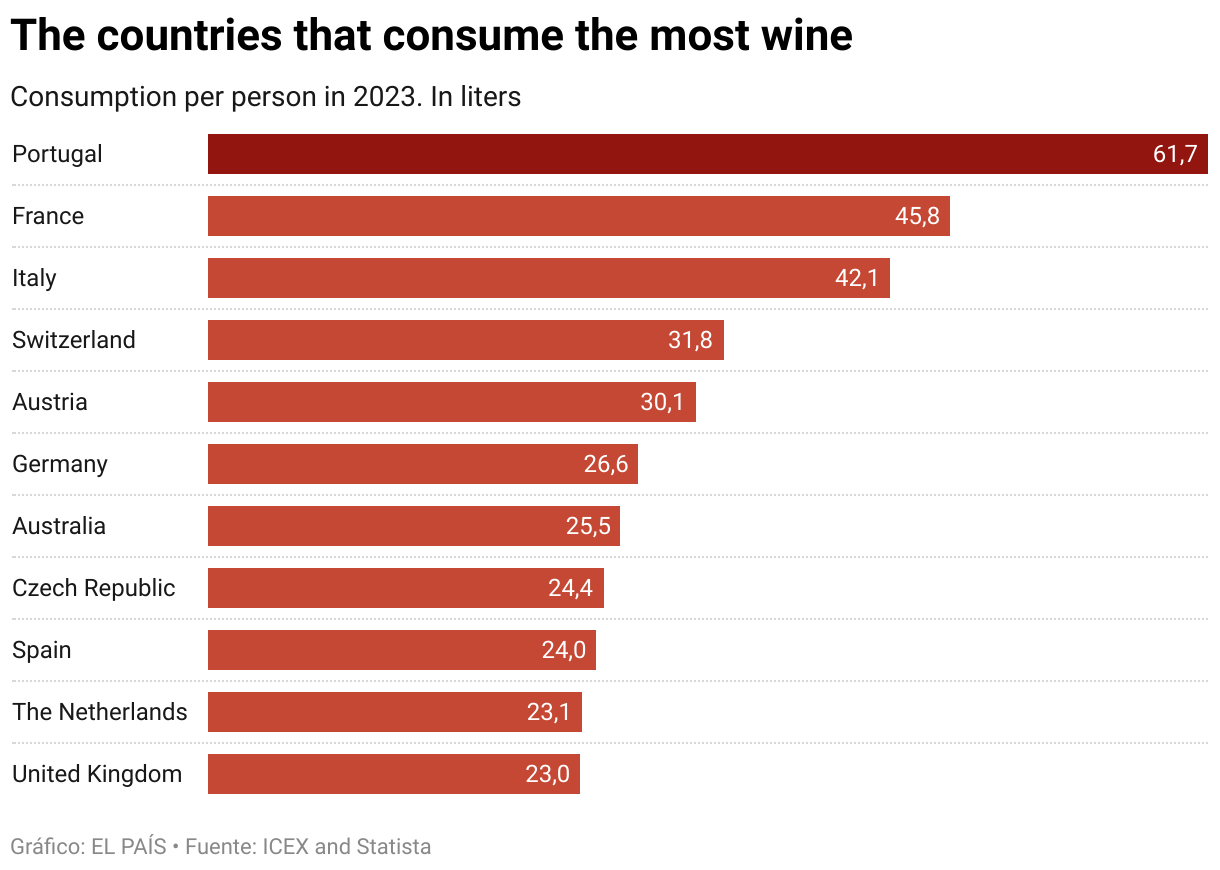
In 2024, consumption in Spain stood at 987 million liters (a rise of 2.5%). Exports fell 5.7% in the first 11 months of the 2024/2025 season. The biggest consumers at 61.7 liters per capita are the Portuguese, according to the Spanish Wine Interprofessional Organization (OIVE), whose own country barely imbibes 24 liters per person. Some of its small distributors and producers feel like they’re slow-dancing with Trump in a room on fire.
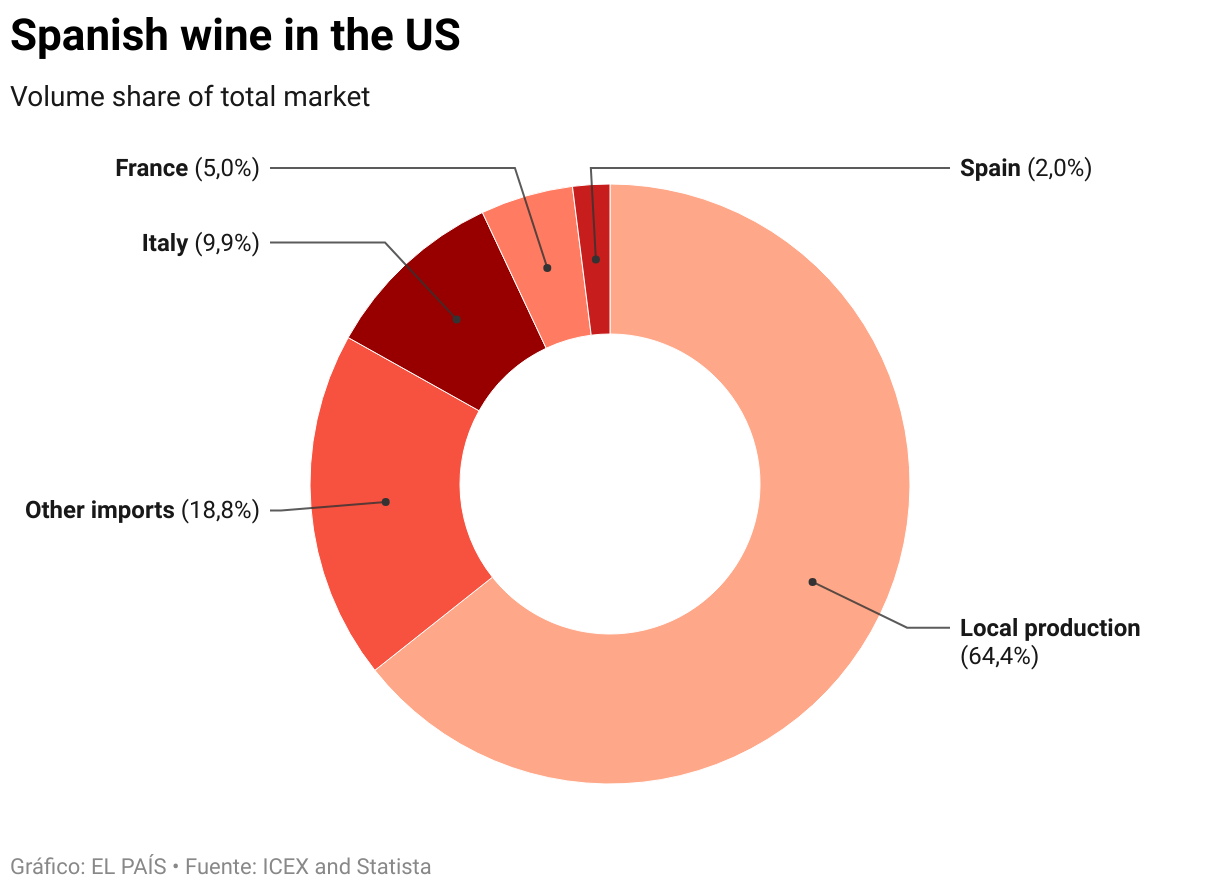
Wine is on fire. And not just due to the wildfires that have engulfed grape fields in northwestern Spain this summer. The symbolic flames are not equally distributed. For example, it’s a good time for the magic elixir made in Rías Baixas, in the Galicia region. Last year the region’s exports reached 8,106,965 liters, translating into sales of nearly $76 million. The price of the Albariño grape, on which the majority of local supply is based, rose to $4.21 per kilo. That’s a lot. For comparison, the Mencía grape stands at 58 cents in the nearby province of León. “We’re in a sweet spot. We have 350 hectares that produce between three and 3.5 million bottles, which provides a livelihood for 400 families,” says Xavier Zas, general director of the Condes de Albarei cooperative. United States is one of his best customers, buying 14% of their product. That’s in part thanks to a 2024 vintage that was rated as “excellent”. Orders sent to the land of stars and stripes grew more than 13% in volume (2.9 million liters), to the tune of $27.5 million in sales. “This uncertain situation is very negative, but we have to continue working as we always have and wait for common sense to triumph,” sums up Zas. Their appellation is home to 88 cellars that export to the United States. “It’s what young people are looking for, wines that are fresher, that have spent less time in the barrel,” says Ramón Huidobro, secretary general of the regulatory council for the Rías Baixas designation of origin. No one wants to drink a 15% ABV wine in the middle of the stifling summer. Even Japan has learned of these virtues. Six years ago, producers there started planting the Albariño grape. Nearby in China, where he is currently traveling, wine critic Juan Manuel Bellver says, his voice full of experience, “The future lies in market diversification, in minority niche products, in recovering abandoned native varietals and producing with a much lower alcohol content for a wine that is easy to drink, less woody.”
Wine is facing a historic shift. Perhaps its most considerable one since the terrible years of the phylloxera plague circa 1860. It is no longer the golden child. Young people are consuming it less, climate change threatens to disrupt its fields, the state of geopolitics — and Trump’s 15% tariff “nightmare” — is as reliable as looking at the sky to guess the coming weeks’ weather forecast. Wine increasingly dances to the beat of the new money (especially, that of Southeast Asia), and its prices in restaurants vary between affordable and insane. And there are also those who say that, as in Bordeaux, there are too many wines. Quite a few, think many in the world-famous winemaking region of La Rioja in northern Spain.
Things are getting out of control. “Businesses can’t grow, grow, grow. One must also sit, breathe, be tranquil,” reflects Pablo Álvarez, chief executive officer at Tempos Vega Sicilia. “It’s time to stop,” he emphasizes. In 2023, his legendary company had $47 million in sales, with profits of $21.8 million and total assets of $153.4 million. That’s all from 100 employees. Álvarez is calling for calm. Wine is a mix of earth and time. But these days, new labels are popping up incessantly. Supply resembles an endless ocean. “The great cellars are getting smaller all the time, and the vintner doesn’t only have to produce a great wine, they also have to know how to sell it,” says Álvaro Palacios, a winemaker who works in three appellations: Bierzo (Descendientes de J. Palacios), Rioja (J. Palacios Remondo), and Priorato (Álvaro Palacios). He has received 100 Parker points from the prestigious U.S. critic Robert Parker, collecting them like Vladimir Nabokov amassed butterflies. His most recent 100 is Quiñón de Valmira 2023, which retails around $544. Palacios exports to 90 countries, and between 170,000 and 200,000 bottles (18% to 20% of production) are sent to the United States. “From 10% to 15% is not important. At the end of the day, you manage margins with the distributor. The important thing, ultimately, is for the fear to go away,” he says, in reference to the uncertainty unleashed by the U.S. president’s policy announcements.
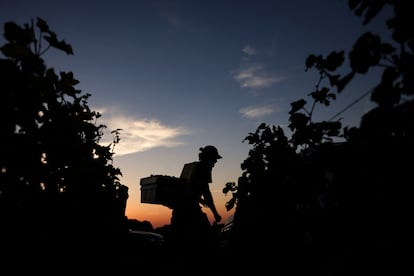
But if there is an industry that proves Einstein’s theory of relativity, it’s that of wine. “God is rolling the dice,” warns Mar Vilanova, director of vine and wine at the Spanish National Research Council (CSIC). One good year does not guarantee that the next will be the same. “The impact [of climate change] is brutal in ecological viniculture,” she says. In Rías Baixas, not many wines are produced ecologically. There is constant mildew and powdery mildew (two pathogens that attack vines, especially during the last rains of summer and August mist), that must be treated. But this year has been dry. Winemakers are changing their latitude and altitude in light of climate change, and planting higher up. In La Rioja they’ve gone from 2,000 feet above sea level to nearly 3,280 on some occasions. Of course, this increases the risk of frost. Grapes are ripening earlier, have less acidity and their aroma (its phenolic universe, in chemical jargon) and flavor (polyphenols) have been altered. Everyone knows that winemakers are using more and more varietals. Mauro — which is produced in four regions — utilizes 17. In the summer, little wine is exported, so the consequences of U.S. tariffs will be slow to materialize.
There have been two weeks of unceasing rain. At last, heat comes to Espanillo, León, in the Bierzo region. It is mid-June. The rows of Godello and Mencía grapes are planted on clay slopes as steep as vertical gardens. The mini-tractor (it only has room for one person) tries to pass through a five-foot-wide path between rows of vines. But it slips and flips over, seeming to die as conclusively as if it had been shot. But it’s only a scare — the Plexiglas cabin has absorbed the blow.
“It would be better to use the mules,” notes Gregory Pérez, who produces Mengoba and Brezo, among other labels.
After the fall, conversation returns. “To be honest, we can’t keep up with the demand for white. We’ve increased sales by 40%. Red wine sales are more stable. Some months we have orders, other months we don’t,” says Pérez. As he speaks, he watches over his six hectares and waits for the small tractor to be righted. He says, “Mencía will come back in style. I’m going to plant more of it.”
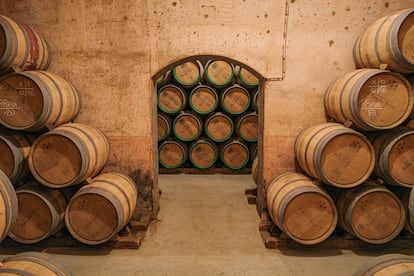
Pérez reflects on the new kind of winemaker referenced by Palacios. He is young, and came up in a great house: Château Cos d’Estournel in Bourdeaux. He knows the new realities of wine. He produces in the town of San Juan de Carracedo in León, where his barrels reside — some of them, made of glass.
The arc of a blue moon already hangs in the western sky and the lights are slowly twinkling, illuminating the titanium exterior of the Rioja-based cellar Marqués de Riscal, built by U.S. architect Frank Gehry. This designation of origin produces some 330 million bottles per vintage, and 4.5% of them wind up in the United States. “It is not a question of percentages, it’s a market in which we have to be, come what may,” ventures José Luis Lapuente, general director of the Rioja qualified designation of origin (DOCa) “The biggest damage, without a doubt, was the uncertainty, but the country drinks more wine than it produces and asks for it by name. No one says, ‘Serve me a Coppola! [the filmmaker who produces on an immense 800 hectares in Napa Valley],” he says. To Lapuente, the geopolitical tableau is clear. Russia doesn’t figure, nor do its neighboring countries and former satellites. China has been planting vines for some time. And in nations like Singapore, they can combine two restaurants and become importers. Other destinations are further afield. In Cameroon, there are countless shops that sell wine in bags and with their own packaging. Africa, due to its youth and newness on the scene, may be the promised land of wine. There is also hope for South Africa, a major producer in terms of volume and quality.
But for now, everything comes back to the Old World, where it all began.
Because of this, La Rioja has changed its own rules of the game. Red wines in the designation of origin, says Lapuente, will have a minimum alcohol content of 10% (before it was 11.5% by volume) and 9% (previously 10.5%) in the case of white and rosé. And sparkling wines will have a minimum amount of 10% (previously 11%) and a maximum of 13% by volume. This is all somewhat remarkable. “The bottom line is typicality. Rioja wines have certain basic characteristics that are not up for debate,” says Lapuente. But suddenly, like a late-season hailstorm, came the tariffs from the country that is the second-largest destination of the region’s wines. Currently, the rules are bad, but at least they are clear. The sector will fight “to ensure that wine is excluded from the details of the agreement,” says Lapuente. “Otherwise, La Rioja will show its resilience. It is a product that is requested by name. Even so, it is to be hoped that the situation can be resolved in the medium to long term.” A complex blend.
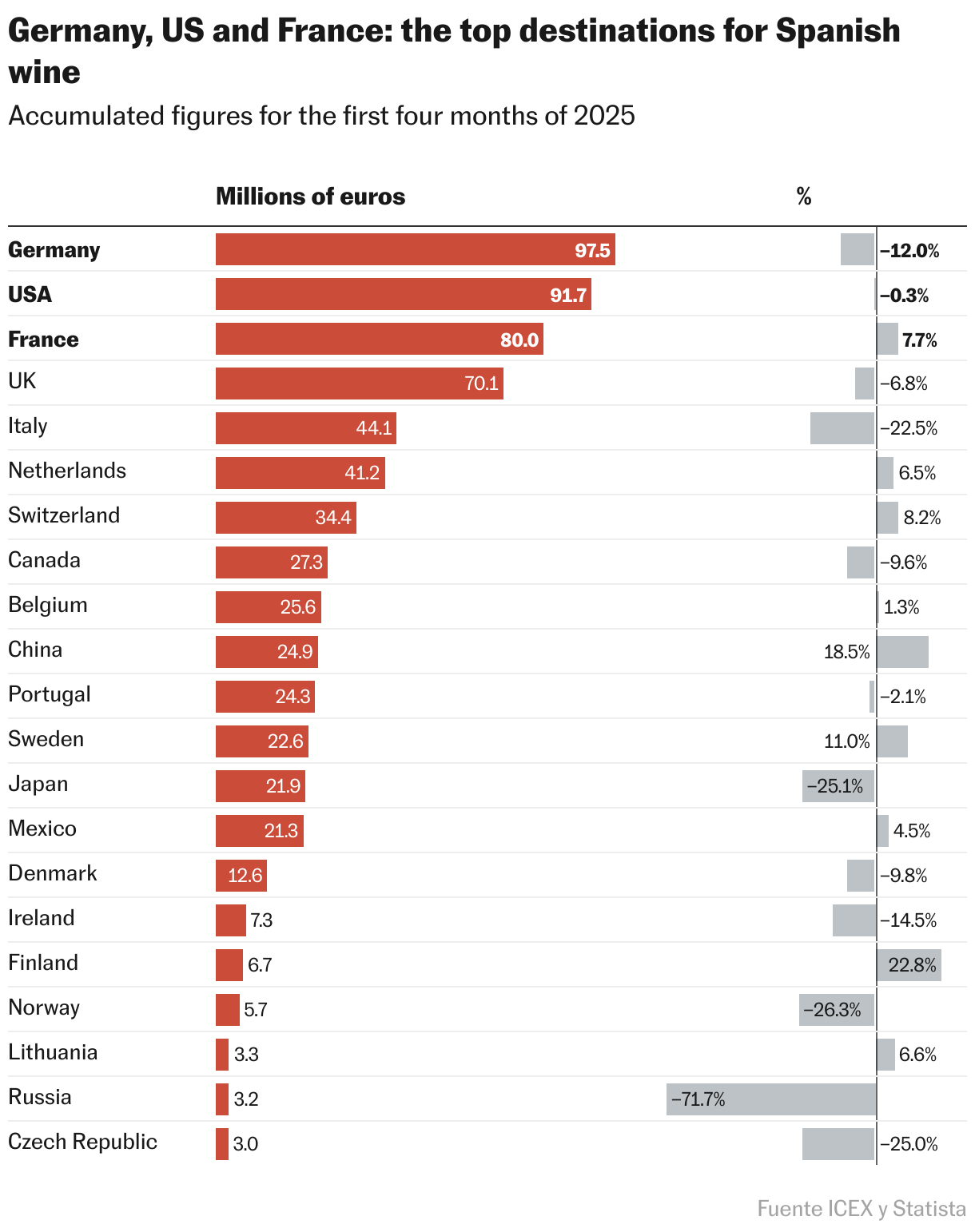
The next question, besides Trump, is as knotty as an old vine. How to attract young people? Aseuniv Grandes Vinos celebrates three decades of distributing legendary wines this year. Other long-running brands include Álvaro Palacios, Marqués de Murrieta, Dominio de Pingus, Vega Sicilia, Hacienda Monasterio, Gramona and Belondrade, along with the great champagne houses (Veuve Clicquot and Dom Pérignon) as well as other cellars from around the world. A representative from Aseuvniv identifies a generational rupture. “There hasn’t been enough education about the history of wine, tying it to gastronomy, culture, the rural environment and differentiating it — clearly — from other kind of alcoholic beverages,” says a spokesperson from the brand. Coming back from this seems impossible. “It’s necessary to promote responsible consumption, tying it to cultural values and territorial sustainability,” they continue. The challenge of a generation. Few know that in many cases, harvest surplus — even that of renowned wineries — end up with mega-producers like García Carrión and Félix Solís. The debatable prestige of the coupage of a country like Spain that has Germany (at $167.1 million, 20.2% of its production) as its primary bulk market, where its national rejects land. In terms of volume, this amounts to 3.4%. When it comest to bottled wine exports, Belgium (at 15%) is the country that uncorks the most Spanish wine, and in terms of sales, Mexico accounts for 15.2%. The United States is (up until now) a larger market but has a lower percentage (5.6%) and higher sales ($287 million).
Perhaps today more than ever, every cellar is its own world. Mariano García, the 82-year-old patriarch of Ribera del Duero, produces 32 vintages at Vega Sicilia and manages five wineries (together with his sons Alberto and Eduardo) spread across three companies (Mauro, San Román and Garmón). His business is worth $18.7 million, employs 43 workers, and 35% of its sales are exported to 65 countries. The United States represents just 10% of them. He knows his 280 hectares by heart, has lived on them since the times when bottles were nearly worthless, up until today, with its impossibly high prices. “If you have a quality wine, with its own personality and you respect the terroir, you will always have a market,” he says. “15% is manageable,” he qualifies.
Since 1954, the La Aguilera cooperative has worked the fields of Ribera de Duero. These old vines support 35 families and are nearly all gobelet-trained, of the tempranillo varietal. Their work produces, according to winemaker César Maté, between 150,000 and 200,000 bottles from 50 hectares. They export to 20 countries. “We don’t have any problem with the United States; the uncertainty has cleared up,” says Maté. That’s in part because his wine also travels to Asia and Japan. These new and old topographies result in $1.2 million in sales.
Scene change. There was a time when Priorat was such an unknown region that the vineyards would often sport black ribbons. The appellation now covers 2,244 hectares, and last year 4,037,529 kilos were harvested by 363 winegrowers and 118 wineries. Spain consumes 57.2%, Europe 16.4% and other countries account for 26.4%. It is here that Álvaro Palacios produces the well-known L’Ermita and Les Aubaguetes.
Still, some numbers are somewhat bleaker. Production in Europe is steadily declining. Last year, 138 million hectoliters of wine and must were produced. If we go back five years, according to the Committee of Agricultural Organizations and Community Cooperatives, there has been a 10% decline. The largest producer of wine last year was Italy (44 million hectoliters), followed by France (36 million) and Spain (31 million). For Spain, the country that still has the largest vineyards by area, this number represents a drop of 11%. China and its promising commitment to wine (its the third country in terms of area devoted to cultivation) remains just that, a promise. It currently ranks 15th on the list of producers.
Other imbalances exist, some caused by abuse of wine’s legacy. “Restaurants have been wanting to make a lot of money from wine, and that is something I’ve seen as very annoying,” says Ruth Sierra, manager of Bodegas Sinforiano in Valladolid, Spain. She adds, “Sometimes, when I see the price, I opt instead to order water or beer. Of course, they’re not going to fool me. I know how much many of those bottles cost.” Palacios has seen his Montesa (which retails for under $20 in stores) priced at $78 on a menu. What does this do to clientele? Even if they are older than 30 years and enjoy a certain economic stability, such prices alienate many young people from wine. Restauranteurs blame the supply chain. Glass, gas, fertilizers, transportation and now Trump. Altogether, it can mean that wine arrives from its denomination of origin at quite a high price point. And in consequence? Many bottles age on restaurant shelves, never to be sold.
Under the June heat, next to the botanical gardens, runs Madrid’s Montalbán Street, which divides the wealthy neighborhood Los Jerónimos in two. Here stands the García de la Navarra restaurant, which stocks some 2,200 wines. The business is named for the surname of its owners Luis and his brother, the former calculating that 95% of their clients order wines between $35 and $47. “Tickets have dropped after the euphoria that followed the pandemic,” he says. García de la Navarra knows about vines. For 14 years, he has been a instructor in the sommelier course at Madrid’s Chamber of Commerce. “The Latin American client is mainly about Ribera del Duero,” he says. Geographical tastes. But wallet cartography is a different story. Wine hasn’t faced so much uncertainty, in terms of climate and geopolitics, since the days of phylloxera. But the farmers who cultivate its vines are convinced that there is a special relationship between war and grapes. They’ve always said that God himself sent a poor wine harvest when war began, and a large and happy one when it ended. Wine always leaves behind traces of optimism.
Charred vineyards in Galicia
Devastating fires will ruin much of this year’s harvest in Ourense, a province home to four of Galicia’s five wine appellations: Valedeorras, Ribeiro, Monterrei and Ribeira Sacra. The excessive heat is interrupting the flow of sap and drying out the grapes, which are currently in the final stage of ripening.









































