
The quarter-life crisis is the new midlife crisis: Young people’s problems are crushing the unhappiness curve
A study points to a paradigm shift, due to the mental health crisis faced by younger generations. Today, distress decreases with age


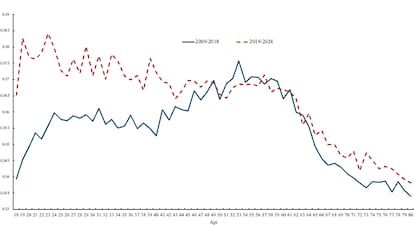
The unhappiness curve is disappearing… but this isn’t good news. Until now, life satisfaction had the shape of a smile. It started high in youth, sank in middle age — in what has become known as the “midlife crisis” — and then rebounded. Unhappiness, on the other hand, used to be shaped like a hump, or an inverted smile. However, a comprehensive study published on August 27 in the scientific journal PLOS One shows how this curve has eroded to the point of almost disappearing. It’s not that the midlife crisis has subsided, but rather that we’ve begun to see something we could easily define as a quarter-life crisis. Unhappiness now starts at a high level — at very early ages — and tends to decline throughout life.
The study was conducted with responses from more than 10 million adults in the United States (they did so between 1993 and 2024), with a longitudinal analysis involving 40,000 households in the United Kingdom. There were also two million questionnaires administered by the Global Minds Project in 44 countries. Lots of data, many countries… but one unequivocal conclusion. “The truth is, we were surprised that the results were so [universal],” acknowledges David G. Blanchflower, an economist at Dartmouth College and the study’s lead author.
The researchers didn’t ask about the reasons for this, but they point to the consequences of the pandemic, the housing crisis and — above all — the widespread use of smartphones. This would explain the uniformity of the data in very diverse contexts. “What a boy from Germany and another from New York have in common, for example, is access to the internet and smartphones,” Blanchflower explains. “In developing countries, however, we saw that those without internet access didn’t [seem to have] as poor mental health.”
The author doesn’t believe this is due so much to the effect of cell phones themselves, but rather to the way they deplete free time, squeezing it away until it disappears. “Cell phones have displaced beneficial activities. Children no longer play, they no longer talk... spending too much time on the internet distances people from useful activities.”
This could explain another of the study’s notable findings: in all the countries analyzed, young women report significantly higher levels of distress than young men. In fact, this is a constant in all studies analyzing the impact of the internet and social media on perceived well-being. The most recent example was provided via a study conducted by Health Behaviour in School-aged Children (HBSC), a WHO collaborative cross-national study. It indicated that this problem affects girls twice as often (with a prevalence of 51.2%) as boys (25.2%).
This study is important because of the large amount of data on which it’s based. Additionally, it places the distress of younger generations in a broader context, comparing it with the self-perceived satisfaction of their elders. Its conclusions are devastating, but not surprising.
Something began to go wrong starting in 2010. A wealth of scientific literature has clearly documented this. Rates of depression and anxiety among adolescents soared by 50%. Suicides rose by 32%. Members of Generation Z — those born after 1996 — began to suffer from anxiety, depression, and other mental health disorders, reaching higher levels than any other generation in recorded history.
The midlife crisis has shattered the unhappiness curve. But it’s important to keep in mind that this is a snapshot that will need to be updated. Young people in Generation Z, who suffer from more mental health problems than their elders, will eventually reach their 40s and 50s. And there’s no guarantee that they won’t then face the same life-threatening consequences that have plagued previous generations. Meanwhile, new generations will be added to the curve… and nothing suggests that they’ll be less dependent on their cell phones. In other words, the happiness curve has only disappeared for the moment. It’s expected to return in a few years, although it will be more extreme. Hitting “rock bottom” will mean going even further down.
“I don’t know how the situation will evolve,” Blanchflower acknowledges. “Every year, a new cohort of 12-year-olds joins and the rest age a year, but nothing changes. The group born [after the year] 2000 seems to have poor mental health. I hope we can stop this.”
It doesn’t seem easy, the author explains. Hospitalizations among young people for depression continue to rise, as do suicides and antidepressant use. The recent study is based on self-perceived mental health, but it’s underscored by all the data. In the United States, according to the National Healthcare Quality and Disparities Report (NHQDR), between 2016 and 2019 the rates of emergency department visits with a primary diagnosis related to mental health increased in the 0-17 age group, from 784.1 per 100,000 people to 869.3 per 100,000 people.
The midlife crisis began to be formally described in 2008. Since then, it’s been documented in more than 600 studies in different countries. The increase in worry, stress, and depression with age has been widely documented in sociology over the past 20 years. Blanchflower himself examined the phenomenon in previous studies. “In a whole series of articles, I argued that the U-shaped curve was an important finding… until it wasn’t! The data was correct, but something has changed; it doesn’t seem to be inscribed in the genes,” he notes.
Maite Garaigordobil Landazabal, a professor of psychological assessment and diagnosis at the University of the Basque Country, praises the recent study for its large database. Speaking in an interview published by the scientific website SMC, she notes that “it’s relevant because it questions a well-established empirical finding: the existence of the U-shaped curve of well-being and the hump of ill-being throughout life.” Garaigordobil considers the results to be “very novel,” noting that they “break with one of the most-cited regularities in the social sciences.”
On the same website, Eduard Vieta, a professor of psychiatry at the University of Barcelona, elaborates on the quality of the data and agrees with the diagnosis. But he adds another possible cause. “I think the contrast between expectations and reality is missing. The younger generations in most of the countries included in the study have received a very overprotective education and have developed a low tolerance for frustration. I think this aspect is also relevant to explaining their emotional distress,” he adds.
The article concludes that this global trend demands urgent attention from governments, researchers and civil society to reverse the decline in youth well-being. When asked about any specific ideas or measures, Blanchflower suggests restricting access to phones as one possibility. But, above all, he emphasizes the importance of offering alternatives. Migrating social life again, but in reverse: from the screen to the streets. We must encourage play, socializing, and outdoor time. “[We must] encourage children to behave like children,” he says.
Sign up for our weekly newsletter to get more English-language news coverage from EL PAÍS USA Edition









































