
Israel bombs southern Lebanon despite the truce: ‘We feel like we are still at war’
Nearly 330,000 people remain forcibly displaced as negotiations stall and the Israeli military expands ground operations
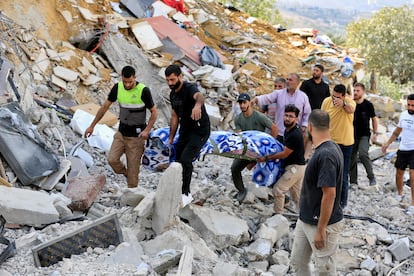

The two ceasefire agreements the United States promoted in recent months in Lebanon have de-escalated the war between Israel and the fundamentalist party-militia Hezbollah, but the conflict continues in the country’s south, where Israeli forces still occupy 600 square kilometers (230 square miles) — about 6% of Lebanese territory. Their strikes farther north of that area prevent civilians in parts of the devastated region from returning to normal life. As negotiations to cement the truce stall and nearly 330,000 people remain forcibly displaced, according to the International Organization for Migration (IOM), those who decide to return move between terror, confusion, and despair. “We feel like we are still at war,” laments Mariam Ghazal, a 42-year-old teacher, from Majdal Selem, a municipality near the occupied area.
On Sunday, Israel issued its first evacuation order since June, saying it responded to two Hezbollah drones that struck its forces without causing casualties. The announcement identified a residential building that the Israeli military destroyed in Arab Salim.
Other strikes — without prior warning — beyond the occupied zone killed four people, including two women, and wounded another 20, including children. Israel demolished a hospital near the southern town of Nabatieh that had fallen out of use but previously provided services and shelter to displaced people, saying Lebanese militiamen were hiding there. It also damaged a building belonging to the Finance Ministry in that same municipality.
At the same time, the Israeli army continues to expand its ground operations beyond the so-called “security zone,” without issuing any official statements. It encroaches on territory in neighboring villages, causing the population to flee — and allowing Hezbollah to infiltrate — without establishing a permanent presence, opting instead for occasional raids or control through fire.
Lebanese President Joseph Aoun, an advocate of disarming the group, condemned Israel on Sunday for a “dangerous escalation” that “extends to state institutions or health centers,” and which “disrupts the continuity” of the state and public services. Aoun urged the U.S., as mediator and guarantor of the pact, to “stop” those violations.
A first truce signed in April between Benjamin Netanyahu’s government and the Iran-backed Hezbollah militia spared Beirut from renewed Israeli attacks, concentrating the war and destruction in the south. In June, the arrival of a memorandum of understanding between Washington and Tehran — which demanded a ceasefire on the Lebanese front to protect its ally Hezbollah — and a framework agreement between the governments of Lebanon and Israel further reduced levels of conflict.
That pact, which the U.S. imposed on the Israeli government, aims to disarm Hezbollah and lift the occupation through reciprocal progress in several pilot areas, so far implemented in only one of the 68 occupied municipalities. But both parties reject that gradual approach and demand that the other side concede first, pushing any end to hostilities further away.
Open war returned to Lebanon on March 2, when Hezbollah fired at Israel in solidarity with Tehran after the assassination of Ayatollah Ali Khamenei in strikes launched the previous day by the U.S. and Israel. The Israeli military has since killed over 4,350 people in Lebanon and wounded more than 12,000 — the vast majority civilians — according to the Lebanese Health Ministry. Hezbollah has killed 33 Israeli soldiers and three civilians, according to the last UN tally in June. To that total were added two more Israeli service members killed in August.
“We spend the day hearing explosions”
Most of the 1.2 million people the IOM registered as forcibly displaced have returned to their communities. But residents of villages that remain under occupation are forbidden from going back, and those in nearby areas live under Israeli aviation and its occasional bombardments.
“We spend the day hearing the explosions with which Israel destroys the nearby [occupied] villages,” Ghazal says by phone. Her municipality sits next to villages Israel has been razing with controlled detonations. Israel’s defense minister, Israel Katz, has acknowledged the military has erased dozens of municipalities “where there is nowhere to return.”
Faced with the Israeli threat and the destruction of water and electricity networks, Ghazal does not see her neighbors making a definitive return. She has solar panels and a well, but people, she says, are “very angry” with the Lebanese authorities. Many criticize them for negotiating with Israel — with which Lebanon has no diplomatic relations — only to secure an agreement they view as unfavorable. “They have left us to fend for ourselves under the attacks,” she says, expressing how “confused” families are about whether to enroll their children in schools farther north for safety as the school year begins.
In Zawtar al-Gharbiyah, the only locality where Israel has lifted the occupation thanks to the framework agreement, hope is not in greater supply. Bombs are not their only worry. The Israeli army is a few meters away, in the neighboring village, where new homes were detonated this Friday. “Some neighbors can hear the Israelis talking and laughing during the night,” says Mira Darwish, a 24-year-old engineer.
Like other residents, she spends the day in front of her house, now unusable, and sleeps in another municipality. “The uncertainty is such that people avoid spending money to repair their homes and businesses and leave them as they are,” she laments. “We gave the government a chance [to negotiate with Israel], but they have not shown us it was worth it.”
After securing control of a strip that neutralizes Hezbollah’s anti-tank missiles — whose accuracy even at distances of up to 10 kilometers (6.2 miles) represents the greatest threat in northern Israel — the Israeli army has since June concentrated part of its hostilities in municipalities around the strategic Ali al-Taher ridge, some six miles beyond its border.
Last Thursday, Israeli troops announced they had captured that hill, saying they discovered an underground command center “financed by the Iranian terrorist regime,” where Hezbollah had military facilities, dormitories, showers, and a kitchen.
According to information received by Reuters, members of Iran’s Revolutionary Guard were present at those facilities alongside Hezbollah militiamen, but there is no indication that Israel captured them. The agency added that Tehran had conveyed to Washington its intention to respond forcefully if Israel stormed the ridge.
The capture of the hill “consolidates the security zone,” Katz said, trying to convey a message of military victory ahead of parliamentary elections scheduled for October in Israel. The army, he warned, will not withdraw “until Hezbollah is disarmed throughout Lebanon,” again rejecting the phased approach to the truce and setting an objective that would be difficult to verify; coupled with the absence of a neutral observer, this could prolong the occupation indefinitely.
Israeli authorities distrust that Beirut will act to neutralize Hezbollah’s military capabilities, as the agreement requires. The Israeli government has accused Lebanon of dragging its feet in Zawtar al-Gharbiyah and two other municipalities designated as pilot zones despite not having been occupied.
Abductions in the south
The stalled diplomatic process — which in the coming days will bring Lebanon and Israel together for the first time in a month — has allowed Beirut to claim a small victory. Between last Thursday and Friday, Israel released five people, two of them Syrians, whom it had held for months after abducting them in southern Lebanon. “After interrogating them, we saw they are civilians unconnected to terrorist organizations,” Netanyahu said.
“Freedom has no price,” said Hussein Abdalla Ayache, the brother of one of those released. A group formed by families of people held by Israel said in August it had 36 registered cases, several of whom were abducted during the truce that Hezbollah observed during 2025. “This reaffirms the effectiveness of Lebanon’s firm stance” and the need “to complete” the framework agreement, the Lebanese president claimed on Friday. Aoun expressed his gratitude in a note to the U.S. — whose ambassador to Lebanon, Michel Issa, visited Israel in the days beforehand — and to the International Committee of the Red Cross, which handled the transfer of the prisoners across the militarized border.
The joy was short-lived. On Thursday, before the Israeli army freed the first of the five kidnapped civilians, it raided the Sunni-majority village of Halta — one of the few in the occupied zone that Israel has not forced to evacuate and where Hezbollah does not operate. After interrogating several residents, they detained three of them. “We don’t know why they took them or where they took them,” a resident told The National.
Sign up for our weekly newsletter to get more English-language news coverage from EL PAÍS USA Edition









































