
Lebanon faces the end of UN peacekeeping mission: ‘Without the blue helmets there will be more impunity’
The UNIFIL force plans to withdraw starting in January after 48 years, despite the ongoing war
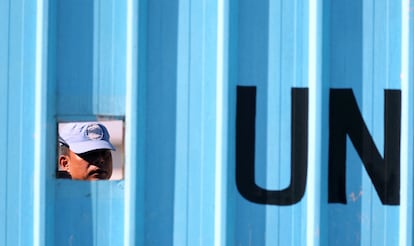

Irish soldier John Timmins traded the green meadows of Baltinglass, an hour from Dublin, for the military bases that the United Nations Interim Force in Lebanon (UNIFIL) maintains in the country’s hills near Israel. Timmins, 26, arrived last year in that conflict zone inspired by Ireland’s peacekeeping tradition and by his father’s career: four decades earlier he had served in the same force and patrolled the villages where Timmins now serves as captain of the Irish-Polish Battalion.
“We do important work,” he says by phone from southern Lebanon, which has become the battlefield between the Israeli army and the Lebanese party-militia Hezbollah. Timmins contacted EL PAÍS as the bombing subsided and he left the bunker at position UNP 2-45, one of dozens UNIFIL has in the south of the country and right on the edge of the vast territory (about 230 square miles) that Israel occupies in Lebanon. “We document events so the UN has eyes and ears on the ground and understands what is happening,” he adds.
The way some Lebanese speak reveals how deep-rooted this peacekeeping force is. In the sector where the Irish operate, there are people who learned to speak English with an Irish accent without ever having set foot in Ireland. Others use Spanish in Marjayoun, where Spain has contributed a contingent since 2006. “If you’re not looking, sometimes you don’t know whether you’re hearing a Lebanese or an Irish person,” Captain Timmins admits.
But those eyes and ears officially have their days numbered. After creating UNIFIL 48 years ago, the UN Security Council decreed in 2025 the dismantling of the mission, which must take place in January 2027. If that schedule holds, the 7,478 soldiers from 47 countries who currently make up the contingent will end a decades-long presence while the conflict UNIFIL aimed to help resolve continues to rage.
The south of Lebanon has not escaped turmoil since 1948, when the State of Israel was born. The Israeli army launched the third invasion of that territory in 1978, after years of clashes with Palestinian militias that fought Israel from the area. That year the first UNIFIL troops arrived, tasked with pacifying the area and overseeing the Israeli withdrawal.
Over time, the emergence of Hezbollah — a local militia built on resentment from those invasions and supported by Iran — led to an expansion of the peace force’s mandate. After a brief war in 2006, UN Resolution 1701 ordered an end to hostilities and required that the Lebanese army be the only armed force in southern Lebanon aside from the blue helmets. The mission was assigned to arbitrate the ceasefire, to assist with the deployment of Lebanese troops and to ensure the safe return of the displaced.
Those objectives were meant to stabilize the border area between two countries with no diplomatic relations. Now, the United States’ willingness to cut its contribution to the UN and pressure from its ally Israel are dismantling the mission in a context similar to that which prompted its establishment in 1978: a war shaking an already fragile country while Israel militarily controls part of Lebanon.
“For a change, we have good news from the UN,” said Danny Danon, Israel’s ambassador to the international organization, when the withdrawal was decreed. Benjamin Netanyahu’s government accuses UNIFIL of failing to prevent Hezbollah’s reestablishment in the territory.
“Hope of being liberated”
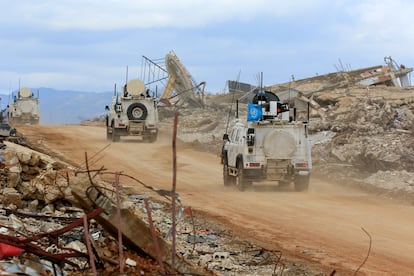
Dima de Clerck, a Franco-Lebanese historian specializing in Lebanon’s wars, views the possible departure of the peace contingent with alarm. She says Israel is uncomfortable with its presence because UNIFIL is a witness “to every breach, shot, and kidnapping,” providing the UN with documentation that could one day be used in international justice.
“UNIFIL means this land retains the hope of being liberated,” she explains. The Lebanese people would like the mission to have the teeth to stop — not merely record — Israeli aggression, but UNIFIL lacks that mandate. De Clerck, in any case, praises the mission’s contribution to southern Lebanon. “They have helped the population remain,” she recalls, mentioning humanitarian work in times of war like the present, and the strengthening, together with other actors, of agriculture, education, and other basic services in moments of stability.
The longest of those periods occurred after 2006 and lasted 17 years, during which no skirmish or aggression — Israeli forces violated Lebanese airspace thousands of times — escalated into an outbreak of conflict. Until October 7, 2023, when Hamas attacked southern Israel and Hezbollah began striking that country to support its Palestinian ally, in what it called “a front of attrition.” “Many in Lebanon thought mutual deterrence would endure,” De Clerck says. Today she sees it as “a mirage,” faced with an alleged “Israeli expansionist project” she believes has existed for decades.
“During those years a lot of work was done to advance the peace process,” said Andrea Tenenti, UNIFIL spokesperson from 2006 until 2025, in an interview with the Lebanese outlet L’Orient Today after leaving the post. “We were progressing toward lasting stability, but the foundations were still too fragile to withstand the October 2023 conflict,” he lamented.

Timmins joined the peace mission in November 2025, when, since the previous year, a truce based on Resolution 1701 was in effect. During that period, UNIFIL was able to resume its original mandate. “We supported the Lebanese army in establishing itself in southern Lebanon,” the Irishman explains, who at the time commanded those tasks from position UNP 6-52, south of Bint Jbeil and right on the unofficial border. The Lebanese forces, he says, “were increasing their presence to replace the upcoming withdrawal of the peace mission.”
That process was advancing in parallel with Hezbollah’s gradual disarmament. Beirut had set that objective last August, driven by popular frustration with the pro-Iran militia, criticized for engaging in military adventures many saw as disconnected from Lebanon’s national interest. The army began the project from the south, where the blue helmets operate. The Lebanese government even announced the dismantling of the militia in the border region, where 10,000 rockets were seized.
That work was cut short again in March of this year. Hezbollah fired at Israel — this time in solidarity with Iran — arguing the action responded to the 400 people Israel had killed during 15 months of truce that the militia had respected, according to UNIFIL, and in the process derailed the state’s process to disarm it, a proposal Hezbollah had always refused beyond the southern area.
Since then, the return of open warfare has sent the blue helmets back to humanitarian work and to constant trips to the bunkers, while the Lebanese army — which is not participating in the conflict — pulls back to the north. Timmins admits crossfire limits their “freedom of movement,” and says they must carry out “deconfliction” tasks (sharing information and coordinating with combatants in a war) before each deployment “to avoid misunderstandings.”
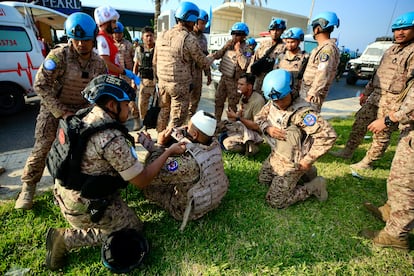
Seven blue helmets have died since March in incidents mutually blamed on Israel and Hezbollah. Last Friday, two soldiers of Malaysian nationality were wounded in an attack near the southern town of Haris. The Lebanese government, which asks that the international community remain in some form in the south even if UNIFIL withdraws, accuses Israel of killing 30 members of the Lebanese army. The government argues those attacks, together with the military occupation, make southern deployment and the sidelining of Hezbollah impossible.
From March 2 to June 9, UNIFIL recorded about 53,700 trajectories of fire, Tilak Pokharel, deputy spokesperson for the mission, explains from its headquarters in Naqoura. The contingent attributes some 6,000 to non-state actors, “presumably Hezbollah.” The other 47,000, or 89%, to the Israeli army. The figures, he warns, exclude the controlled detonations with which Israel levels villages in the 6% of Lebanon it occupies.
“Without the blue helmets there will be more impunity,” De Clerck laments. That vacuum will lead to “disaster,” according to Tenenti. “Without an impartial mission” to prevent hostilities, the former spokesperson warned the Lebanese outlet, “the risks of escalation are simply too high.”
Sign up for our weekly newsletter to get more English-language news coverage from EL PAÍS USA Edition









































