
The Meteoriticists, a trio of women scientists hunting fallen celestial bodies in Brazil
The group searches for cosmic fossils in a race against collectors, intent on uncovering the secrets of the universe

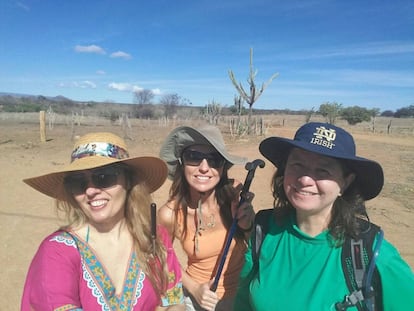
The story of the trip on which the Meteoríticas (Meteoriticists) were born is reminiscent of the movie Thelma & Louise, the road trip buddy film starring two women that became a major hit in the 1990s. Brazil, 2017: three scientists drive for two days from Río de Janeiro to Bahía, following the path of a meteor. The trio, who met each other at a university, were sporting wide-brimmed hats and traveling in a rented car down dusty roads that led them to increasingly more arid lands.
In Thelma & Louise, its two road warriors were on the lam. But these Brazilian scientists were on the hunt for celestial fossils with which one could uncover the mysteries of the solar system. One of their priorities was to find the meteorite before the collectors, who often have more resources for such hunts. The Meteoriticists have been the engineers behind Brazil’s breakthrough in meteorite discovery. They are responsible for finding 70% of the country’s officially verified meteors over the last 15 years.
Their work requires an openness to changes of plan. “When a meteorite falls, a frenetic race begins. You have to really hurry, book the flight the same day to go look for it, and get there first,” explains 69-year-old astronomer Maria Elizabeth Zucolotto at the Federal University of Río de Janeiro laboratory the team uses as its headquarters. The Meteoritical Bulletin Database, their field’s canon publication, has registered 95 Brazilian meteorites, of which the women have contributed 39.
Brazil’s total pales in comparison to the 4,000 meteors catalogued in Chile — thanks to the Atacama desert — the United States’ 1,900 and the 1,700 that have been documented by Morocco. The Meteoriticists are convinced that their country has enormous unexplored potential, which is why they are committed to tracking down new allies.
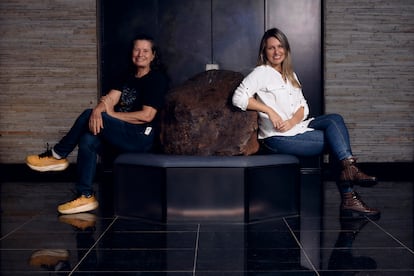
They have quite the precedent to live up to: the Bendegó meteor, one of the largest in the world, was found by a child in 1784 in Monte Santo, in the interior of Bahía (a state that is geographically larger than France). Its transfer a century later to the National Museum was epic, particularly the first 73 miles to the nearest rail network. Since then, it has been housed by the institution, even after the museum burned down in 2018 along with the largest scientific collection in Brazil at 20 million pieces. The colossal rock, which weighs five tons, survived intact.
Zucolotto, who is the curator of the National Museum’s meteorite collection, has been studying the time capsules for four decades. In addition to being the Meteoriticists’s most veteran member, she is considered Brazil’s top expert on the subject, and one of its leading voices.
A researcher and professor, Zucolotto recalls one chaotic hunt that seems taken from a movie, which culminated in a Solomonic scene: “When I arrived, there was already a smart aleck there, but — kindly — he didn’t keep [the meteorite] for himself. The mayor wanted half the meteorite. Everyone was arguing, lots of phone calls… until we reached an agreement: ‘Let’s split it — a piece for each of us.’” Everyone agreed to the plan. Cutting up a meteorite doesn’t diminish its scientific value, she clarifies.
And so she was able to bring a fragment back to the lab, analyze it, confirm its cosmic origin and determine its composition, thanks to a costly electronic microscope whose purchase was made possible through a donation from the Brazilian gas company Petrobras.
Operating that microscope was 41-year-old geologist Amanda Tosi. She, along with Zucolotto and 51-year-old astronomer Diana Andrade, have been the core of the Meteoriticists since that trip in 2017, when after 15 days on Bahía roads, it became clear that they made a great team. Zucolotto recalls how for decades, she brought her family on expeditions around the country to find rocks that had fallen from the sky, and later, her students. She has many stories featuring numerous leaps in time and space, and tells them all with truly contagious enthusiasm.
“Meteoriticists have three lanes: research, meteorite hunting, and scientific communication,” explains Tosi, the geologist. One of their biggest challenges is for the people who first discover a meteorite to know that the rocks, which can at times look relatively unimpressive, hold keys to learning about what our solar system was like millions of years ago.
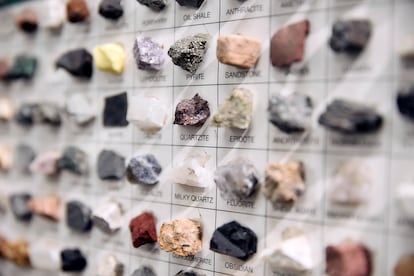
Recently, they embarked on a PR tour that has brought them to 75 cities throughout Brazil to explain the mysteries and scientific relevance of rocks that fall from the sky. To commemorate the recent International Asteroids Day on June 30, the Meteoriticists led an excursion of aficionados to the area in Bahía where the Bendegó landed at the end of the 18th century.
They lament the scant interest shown by some educational institutions when they visit to explain their project, but are grateful for the enthusiasm with which they are received by many educators — not to mention their students. They often arrive with samples and a desire to educate the public in cities near impact sites, where residents have often already heard stories about the fireballs in the sky, and are somewhat curious.
The Meteoriticists have a network of collaborators from throughout Brazil, including amateur astronomers, and they are alerted when someone gets word of a new meteor. Zucolotto makes sure her phone is always charged. Years ago, they launched a campaign called An ET on your patio, which shared simple tips for recognizing a potential meteorite. They hand out tiny stars made of celestial material. They ask people who find what they believe to be a meteorite to send them a video for an initial evaluation. If those results look promising, they buy a plane ticket to get there as soon as possible.
Collectors are getting more astute, because the meteor market is on the rise. While the crudest pieces may sell for a few dollars, others reach extremely high prices. A year ago, a 53-pound fragment from Mars was auctioned off by Sotheby’s, selling for $5.3 million. It was called NWA 16788, and was discovered in Niger.
Zucolotto emphasizes that in Brazil, the world of stones from the stars is a small one, in which everyone knows each other. “We are all friends, until one falls, and then it’s every person for themselves,” she says. Her trio is also battling the illegal meteorite trade, which often ships the rocks out of the country. One of their biggest obstacles is that Brazil, in contrast to Argentina and other countries, doesn’t have a law that designates meteorites as property of the state.
And as the public funds available to the Meteoriticists are limited, they often have to use a great deal of persuasion to acquire the stones so valuable to their profession. What is their greatest tool in that process? They bring up one past case: “A woman said that she’d mail us a large piece so that we could analyze it. Then she wanted to sell it, but collectors wouldn’t buy it anymore, because they prefer complete pieces.” To thank her for prioritizing science, they bought it off her instead.
Sign up for our weekly newsletter to get more English-language news coverage from EL PAÍS USA Edition









































