
Crimea, from triumph to tragedy
The Kremlin’s swift occupation of the Ukrainian peninsula in 2014 is now being tested by Kyiv’s offensive
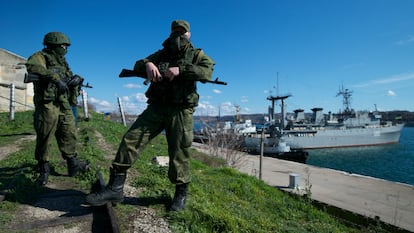

With the swift and decisive annexation of Crimea in 2014, Vladimir Putin became, in the eyes of his fellow citizens, the great leader capable of “restoring historical justice” and “definitively returning” the Black Sea peninsula to Mother Russia. Now, with the peninsula devoured by war, the 2014 triumph has turned into a tragedy for those who live there.
The situation could get even worse. New questions open up before the peninsula: will it become a besieged and isolated fortress plagued by chronic shortages? Will Ukraine’s current offensive provoke a retaliatory response from the Russian leader — so personally and historically bound to Crimea — and lead to a heavy human toll?
On the first anniversary of the annexation, Putin revealed that, when launching the operation, he had issued “instructions” and “orders” to the military regarding “Russia’s possible actions and the conduct of our Armed Forces under any scenario.” Asked whether he had placed Russia’s nuclear forces on alert, he replied: “We were prepared for the worst-case scenario.”
“In Crimea everything is literally soaked in our shared history and pride. Here is ancient Chersonesus, where Saint Prince Vladimir was baptized […] In the hearts and minds of the people, Crimea always was and will remain an integral part of Russia,” Putin said in March 2014 in his annual state-of-the-nation address.
“The people of Crimea have made a decision and have voted. The matter is closed historically. There is no return to the previous system. None,” he said in September 2016.
The strength of Russia’s narrative about Crimea — and the certainty with which Putin expressed it — was such that a number of prominent Western politicians voiced understanding for the Russian leader’s position, regardless of international law, including bilateral Russian-Ukrainian agreements, which left no doubt that the peninsula fell under Kyiv’s jurisdiction.
Those who appeared on the list of the “sympathetic” included former French president Nicolas Sarkozy, former Italian prime minister Silvio Berlusconi (who visited annexed Crimea), former German chancellor Gerhard Schröder, and a cast of deputies from across the political spectrum who likewise traveled to the peninsula. They were joined by Maria Vladimirovna, head of the Romanov family, and other relatives who visited Crimea in 2016.
For years, Crimea was effectively untouchable in efforts to reach an accommodation between Ukraine and the country’s pro-Russian forces. The clearest example was the Minsk talks held in February 2015 under the sponsorship of the Organization for Security and Co-operation in Europe (OSCE), with France and Germany participating. Those negotiations dealt only with the separatists of the self-proclaimed Donetsk and Luhansk people’s republics, not Crimea, and culminated in a ceasefire agreement and the separation of forces in the Donbas.
Avoiding any mention of Crimea was the only way to bring Russia to the negotiating table over what was then formally presented as a conflict between Kyiv and the self-proclaimed republics. Crimea remained off limits because Russian leaders had proclaimed that, unlike the Donbas, the peninsula was an inseparable part of Russian territory.
In practice, efforts to “anchor” Crimea to Russia and build an umbilical cord to Moscow proceeded quickly. A new highway, a new airport and the 11-mile Kerch Strait Bridge — opened in 2019 — were constructed. New residents arrived from Siberia and distant Russian regions, eager to start a new life in the peninsula’s idyllic setting and to replace Tatars and Ukrainians, whose communities were shrinking through exile and displacement.
According to Ukrainian data, more than 140,000 Russians settled in Crimea between 2014 and 2018. By 2021, the population — partially and deliberately reshaped — stood at 1,934,630. Before the annexation, in 2013, it had been 1,956,422.
Tourism took off again, especially after the bridge opened. Planes flew between Russian cities and Simferopol and, although they had to detour to avoid Ukrainian territory, flights were frequent and affordable. In 2021, the number of tourists exceeded nine million (9,390,000).
Crimea’s Russian-installed authorities organized international investment forums and facilitated a murky redistribution of property through reviews of ownership rights previously recognized by Ukraine. Banks developed mechanisms to operate around international sanctions, while imports flowed through intermediaries in Russia.
Behind the scenes, some European diplomats saw the possibility that, over time, Crimea — though never formally recognized — might gradually become accepted in practice as part of Russia, perhaps even acquiring official status through an internationally recognized referendum or some form of compensation payment to Kyiv.
Meanwhile, in the Donbas, the OSCE monitoring mission functioned reasonably well, and the region was settling into the status of yet another “frozen conflict” in the post-Soviet space. It was not a perfect arrangement, but it offered advantages for both Ukraine’s pro-Western forces — since it removed a sizable contingent of pro-Russian voters from the ballot boxes — and for Russia, which did not have to openly take responsibility for an aging industrial territory in need of major investment.
That remained the case until 2022, when Putin’s expanding ambitions in Ukraine brought Crimea back onto the board and turned it into a theater of war.
Today Crimea is flown over by drones that have destroyed refineries and vital infrastructure and now threaten communications by land (the corridor seized from Ukraine that links Crimea to the mainland) and by sea (access to the Kerch Strait Bridge from both Crimea and Russia’s Taman Peninsula).
Crimea is seeing shortages of fuel, electricity and water, and authorities have taken the unprecedented step of evacuating children from summer camps, including Artek, the most famous of them all, which hosts thousands of children every year. Tourists are fleeing or canceling reservations, and damage to the main local industry is enormous.
But an attack on Crimea is also an attack on Putin’s “inner core,” on his self-image. The question is whether a man who has already secured his place in the history books will accept being remembered instead as a reckless zealot who, in pursuit of a chimera, sacrificed lives, ruined fortunes and turned a paradise into a hell.
Sign up for our weekly newsletter to get more English-language news coverage from EL PAÍS USA Edition









































