
Nicolas Sarkozy, the fall of the president drawn to wealth and glamour
Despite facing multiple legal proceedings, the former French leader — the first to enter prison — kept his political and business clout

On the morning of May 13, 1993, a man dressed in black and rigged with explosives entered a daycare center in Neuilly-sur-Seine, a wealthy suburb of Paris, and took 20 children and their teacher hostage. In exchange for their release, the kidnapper demanded 100 million francs (about $17 million). But the town’s mayor, a young and ambitious politician named Nicolas Sarkozy, decided to ignore the police’s advice and go in to negotiate with the abductor.
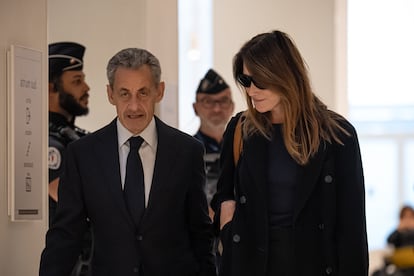
He achieved nothing. Or rather, he only managed to carry out one child in his arms and create a photo for the history books. One that would define him: a direct, forceful, and somewhat reckless man. But also particularly ambitious and close to money, to businessmen. To dazzling success. A cocktail that now taints his legacy as president of France and leaves another photo, 32 years later: that of the first president of the Fifth Republic entering prison.
“If they absolutely want me to sleep in jail, I will sleep in jail, but with my head held high,” he warned his fans —and his critics — still in the courtroom that on Thursday sentenced him to five years in prison and a €100,000 fine for criminal conspiracy in the trial over the alleged financing of his 2007 presidential campaign with money from the Libyan regime of Muammar Gaddafi.
The roar of Sarkozy’s rise was as loud as his fall. As a 19-year-old, he captivated the leadership of the traditional right-wing party when he spoke at a congress in Nice in 1975. “To belong to the Gaullist youth is to be a revolutionary, but not like those who are professional demonstrators,” he declared. Jacques Chirac recruited him; he became mayor and minister of several portfolios. And he reached the presidency in 2007, at the age of 52. But in just a decade, he went from the man who promised to modernize France to a convicted ex-president, stripped of the Legion of Honor, and entangled in courts and multiple convictions. Yet even so, until the very last minute, he retained his influence.
The former head of state represented a generational change, a different way of exercising the presidency (2007–2012), more media-focused, more intense. Less restrained. A personality, and a vision of politics, that he continued to spread through the advice he often gave to the current president, Emmanuel Macron, and other active politicians. That is the paradox now.
Sarkozy was the first former president of the Republic to wear an electronic ankle bracelet for several months — until last May — to serve a prison sentence. But it seemed to make little difference. Much of the political and business elite continued to visit his office on Rue Miromesnil. This included the current prime minister, Sébastien Lecornu, who regularly dined with his wife, Carla Bruni; and the president of the far-right party Rassemblement National (RN), Jordan Bardella, in early summer, to consolidate his integration into the French business class. And before them, the president of the Gaullist right-wing party Les Républicains, Bruno Retailleau, and the former justice minister, Gérald Darmanin. It was as if, at least symbolically, part of the political game still played out in his office.
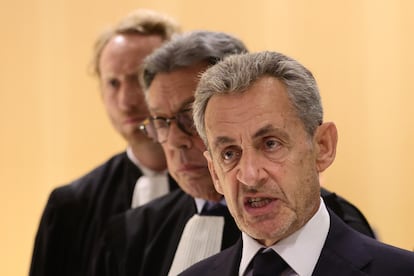
Even Macron — who Sarkozy had been criticizing ever since the president dissolved the National Assembly in June 2024 against his advice — had played that card in an attempt to attract the right. Sarkozy’s last foray into politics ended in a bitter defeat in the Les Républicains primaries in 2016. Since then, he has mostly been a consultant and a bestselling author with Hachette, part of the Lagardère group (where he sits on the board of directors).
Coming from a middle-class family, Sarkozy has always been drawn to glitz and luxury. Born in 1955, the son of a Hungarian immigrant and a French woman of Sephardic origin, he did not attend elite schools nor belong to their circles. His story was, until recently, a perfect symbol of the old idea of social mobility: an ambitious young man, trained as a lawyer, mayor of Neuilly-sur-Seine at just 28. “A bastard,” he used to call himself, referring to his distance from the elite.
From there, his career skyrocketed. He became budget minister at just 38, then interior minister. There, he gained a reputation as an energetic and combative politician, with an aggressive stance against insecurity and an innate talent for controversy, which peaked when he called the residents of a Grenoble suburb racaille (“scum”) following a wave of riots in 2005.
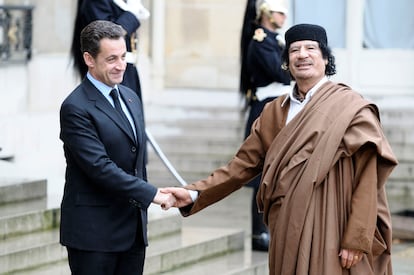
Sarkozy understood the power of political communication and media trenches before anyone else. Where other right-wing leaders appeared limp and restrained in their messaging, he projected urgency and toughness. He was also the first to stoke the migration debate to counter the rise of the far right using the same rhetoric. In 2007, he took up residence in the Élysée, which was still reeling from the riots and a growing sense of economic paralysis. There were highs and lows. He pushed through a pension reform, liberalized sectors of the economy, and attempted to make the labor market more flexible. He became a key interlocutor during the 2008 financial crisis and supported the intervention in Libya in 2011 — a scenario that ultimately bogged down his entire presidency. And his legacy.
Pop president
More reminiscent of Silvio Berlusconi than Charles de Gaulle, Sarkozy was a pop president. Divorces, love affairs, and romances ideal for the glossy magazines piled high at newsstands. First with his first wife, Marie-Dominique Culioli, mother of two of his children. Then with Cécilia Attias (née Ciganer-Albéniz), whose successive separations and reconciliations, and eventual divorce coinciding with his arrival at the Élysée, played out like a real-life soap opera.
Drawn to the glamour of power, he broke with the restrained style of his predecessors and landed on magazine covers aboard yachts with Carla Bruni. The presidency became a spectacle. That same style brought him glamor, but also took a toll. The economic crisis, the perception of a president too close to the powerful, and an authoritarian style cost him the 2012 election to the socialist François Hollande.
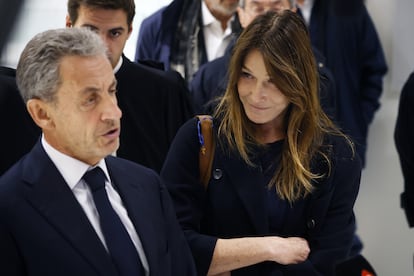
Defeat did not bring him down. He tried to reclaim leadership of Les Républicains in 2014. But his authority was no longer rock-solid. And, above all, a judicial pursuit began that reached its peak this Thursday. Cases piled up on his lawyer’s desk: the Bygmalion affair, over the irregular financing of his 2012 campaign; the wiretapping case (affaire Bismuth), in which he was convicted of corruption and influence peddling; and, finally, the Libyan case, in which he was accused of receiving millions from Gaddafi’s regime for his 2007 campaign.
Sarkozy has always argued his convictions were a vendetta against him for criticizing magistrates and proposing a reform they disliked. He recounted it in Le temps des combats (The Time of Battle): “I would soon discover the depth of the animosity that my person had aroused, quite unjustly, among a section of the judiciary.” Given the influence he retained until this week, this narrative was accepted by both the public and the political class.
Sign up for our weekly newsletter to get more English-language news coverage from EL PAÍS USA Edition









































