
Venezuela activates an electricity saving plan to reverse blackouts
The government is asking Venezuelans to reduce consumption due to the impact of the dry season on hydroelectric plants
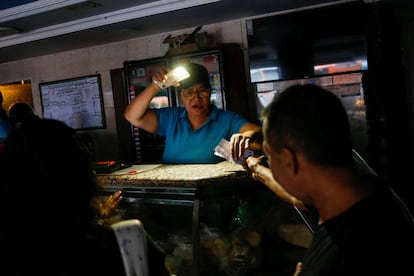

The blackouts arrived long before the energy-saving plan announced by acting president Delcy Rodríguez last weekend. Reports of power dips are flooding social media. On Monday afternoon, users across the country wrote “bajoooon” or “bajoneitor” (a power outage as powerful as Terminator), the Venezuelan way of humorously addressing the precarious situation. The energy crisis that has plagued Venezuela for years continues to leave much of the country’s western states, such as Zulia, Falcón, Lara, Trujillo, Mérida, and Táchira with power cuts of up to eight hours a day.
For Venezuelans, the severe power outages are a never-ending nightmare, with appliances flickering on and off, making noises as the electrical current surges or drops, and sustaining damage. The blackouts also hinder economic recovery and jeopardize the development of investments announced after the restoration of relations with the United States following the fall of Nicolás Maduro.
The Venezuelan government attributes the increased electricity demand to solar declination—an annual astronomical phenomenon in which the sun’s rays strike this region of the planet perpendicularly. In response, the acting president announced the National Energy Saving Plan. “For 45 days, the sun’s rays will fall directly on Venezuela. This calls for civic responsibility and a plan to conserve electricity,” said Rodríguez.
Between March and May each year, the dry season affects the water levels in the hydroelectric dams that supply electricity to most of the country. It is a natural cycle that, with the variations typical of the tropics, is more or less regular and predictable.
On the street, in chat rooms, and on social media, Rodríguez’s announcement is seen as a sign of more power outages to come, even though none have been officially announced. Regions of the country have been experiencing unannounced rationing for several years. Last week, for example, a massive blackout affected the Andean states. The system’s instability caused failures in internet, telephone, and commercial services, without authorities reporting the causes. Now, Rodríguez has urged Venezuelans to keep air conditioners no cooler than 21ºC (70ºF), unplug non-essential electrical equipment, and avoid charging multiple devices simultaneously—measures that appear insufficient to overcome the problems plaguing public services in Venezuela.
The electricity sector is one of those that changed leadership after Maduro’s fall. Delcy Rodríguez appointed Rolando Alcalá, an electrical engineer from Simón Bolívar University, to head the sector. His arrival marked the beginning of a new era of technical expertise over the military, who had previously controlled critical infrastructure.
“We are going through a recovery process and projects that are strategic in the consolidation of the national electricity system, which has been recovering capacity, but which is not enough for the demand of the population, and is not enough for the economic growth process of our country,” said Rodríguez.
Colombia has expressed interest in entering the Venezuelan electricity sector. The South American country’s foreign minister, Rosa Villavicencio, recently told EL PAÍS in an interview that “the United States is very interested in exploiting oil in Venezuela and participating in its sale,” but that “without energy, it is difficult to move forward.” “Venezuela has oil and gas, but it lacks energy. Colombia, on the other hand, has the technological and logistical capacity, through Ecopetrol, to produce that energy and allow Venezuela to develop its resources,” she added.
The United States has also planned its share of the market. Last February, the Treasury Department issued licenses 48A and 49A, authorizing U.S. companies to sell technology, services, and operations related to electricity generation, distribution, transmission, and storage systems. This is a prerequisite for the economic recovery promised by Donald Trump in his three-phase plan for Venezuela, following his order for military intervention on January 3. To finalize the necessary measures, Chris Wright, U.S. Secretary of Energy, recently visited the country.
The problems in Venezuela’s electrical system are structural, and for over a decade the country has failed to achieve significant improvements. Chavismo has confronted successive crises with rationing measures, such as turning off advertising signs or reducing the workday, militarizing infrastructure and high-voltage towers, or announcing major projects that were never completed. The Tocoma hydroelectric plant is one example.
At the same time, the government has denounced electromagnetic conspiracies in the past to justify national blackouts, denounced workers of the public electricity company and made investments in used thermoelectric plants that, during the government of Hugo Chávez, were at the center of the first corruption scandals of the Bolivarian revolution. The officials and businessmen involved ended up being investigated by the justice system of the microstate of Andorra in the money laundering scheme of Banca Privada d’Andorra.
Sign up for our weekly newsletter to get more English-language news coverage from EL PAÍS USA Edition









































