
Brazil, world champion of super-salaries: 53,000 civil servants earn more than the legal limit
A study compared civil service salary caps in 11 countries as Congress debates public administration reform in a nation with particularly high social inequality

A short walk through the most central neighborhoods of São Paulo is enough to witness the enormous inequality that divides Brazil. While barefoot men with gray blankets over their shoulders rummage through the garbage for food or empty cans to scrape together a few coins, helicopters fly over the skyscrapers, following air corridors. On board are executives on their way to work or families with children and nannies heading to their weekend getaways. This disparity is also reflected in the civil service. More than 53,000 public employees, mostly judges, receive salaries above the limit imposed by the Constitution thanks to various loopholes. There are 12 such cases in Colombia and three in Portugal. A recent study comparing the salary cap for civil servants in 11 countries clearly demonstrates the extraordinary nature of the Brazilian case. “The country will never be a decent democracy as long as it allows itself to be plundered by a predatory civil service elite,” declared an editorial in the newspaper Estadão.
Congress is debating a civil service reform to eliminate these privileges. Although inequality is decreasing in Brazil, the country remains high in the ranking of countries with extremely privileged elites. The drop in unemployment and the implementation of social programs, such as the well-known Bolsa Família, have brought the Gini coefficient to its lowest level in a decade (to 0.504, where 0 represents absolute equality and 1 the maximum inequality). Yet, although the gap has narrowed somewhat, in very few countries is income so unevenly distributed: the wealthiest 10% earn three times more than the poorest 40%.
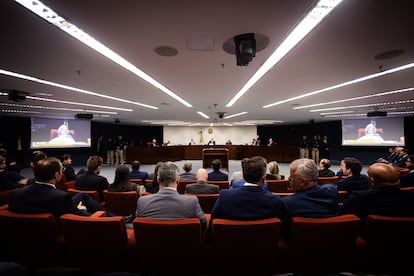
If anyone wants to see the faces of the wealthiest 1% of Brazilians, the best place to start is a courthouse, where they should look for the judges. Judges make up the bulk of the 53,000 officials who earn salaries above the constitutional ceiling, which is the salary of a Supreme Court justice (or the president of the Republic). In numbers, that’s $8,700 gross per month.
The salaries of those 53,000 employees of the elite of the elite of the administration cost the public coffers $3.7 billion in 2024 and, thanks to that huge amount of money, a good part of them also make up the richest 1% of Brazilians.
And, since this is a country more accustomed to focusing on regional differences than to comparing itself to the rest of the world, two civil society organizations, Movimento Pessoas à Frente and república.org, decided to conduct an analysis to understand where Brazil stands in an international comparison. So they studied the situation in 11 countries, including its neighbors and others historically considered international benchmarks. The idea is that this information will help lawmakers in the debate on public service reform.
Given the results, the Brazilian anomaly — the magnitude of the privilege — becomes even more evident. Brazil’s highest-paid judges “earn up to six times more than the highest authorities in the Portuguese judiciary” and four times more than the justices of the constitutional courts of Germany, France, Argentina and the United States, says the 89-page report.
“Brazil, world champion of super-salaries; I feel ashamed,” reacted center-left congresswoman Tabata Amaral in a video on social media. Brazil, with 53,000 public officials earning more than the constitutional limit, is followed by Argentina (with 27,000), the United States (with around 4,000), the United Kingdom (almost 2,000), Mexico (around 1,600), Chile (around 750), and, far behind, France (77), Italy (46), Colombia (12), Portugal (3), and Germany, which has no public servants earning more than the constitutional limit. There, the report explains, top political leaders always earn more than the highest-paid bureaucrats.
So Brazil stands out in two areas: the amount and the number of beneficiaries. Eighty percent of judges earn more than the official salary limit. How is this possible? Thanks to what Brazilians ironically call “penduricalhos,” meaning trinkets.
These are bonuses the workers receive, for example, for not taking all of their 60 annual vacation days or other legally authorized time off, for covering for absent colleagues, or for things like housing allowances, food subsidies, or health insurance. And these amounts not only aren’t considered part of their salary, but sometimes they aren’t even taxed as income. This leads to the situation that wealthy businessman Warren Buffett warned about many years ago: they pay less tax than their secretaries.
“The ongoing administrative reform is an opportunity to address this problem and put an end to exorbitant salaries in the public sector,” Jessika Moreira, executive director of Movimento Pessoas à Frente, explained to the newspaper Estadão. The relevant minister, Esther Dweck, emphasized the need for dialogue and consensus-building because “without consensus, this agenda will not move forward.”
And although more than 80% of Brazilians support ending these excesses paid for with their taxes, the civil service elite is an extremely powerful lobbying group. When one of its members obtains a benefit, others emulate it, warns the activist Moreira. “Now we see that incomes above the constitutional limit, which were once concentrated in the Judiciary and the Public Prosecutor’s Office, are migrating to state lawyers. In other words, there is a shift; it is beginning to influence career paths within the Executive Branch.”
Congresswoman Amaral emphasizes that the issue of exorbitant salaries concerns the top 1% of civil servants who operate the state apparatus. “It’s a tiny elite that has seized control of the budget and invented rules for themselves. Some judges have received as much as $1.3 million in a single year — it makes no sense,” she asserts. And the harm, in her opinion, is twofold: “This not only wastes money but also demoralizes those who work well and earn little,” referring to the majority, the day-to-day workers who keep the administration running: teachers, nurses, health workers who serve in underserved areas, and police officers.
Sign up for our weekly newsletter to get more English-language news coverage from EL PAÍS USA Edition









































