
The political aspirations of African descendants in the Americas
In the early 2000s, a group of Afro-Colombians went to Washington to pressure their president, who was negotiating a free trade agreement. They wanted to ensure that Black people would be appointed to the Colombian government. Now, Black women’s collectives are paving the way for political inclusion in Latin America

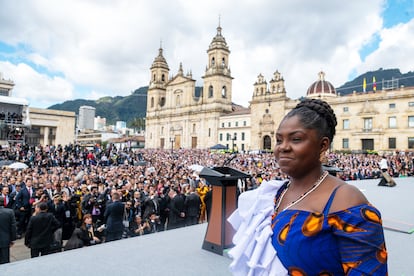
More than three years have passed — which sometimes feel like centuries — since Francia Márquez was sworn in as Colombia’s vice president on August 7, 2022, in Bogotá’s Plaza Bolívar. That day, Latin America recorded a key moment in the historical struggle for inclusion. For the first time in more than 500 years — since the first ships forcibly brought millions of Africans to the Americas — one of the descendants of enslaved peoples reached political prominence in a country where it’s estimated that more than 20% of the population is Afro-Colombian. Dressed in a blue-and-orange wax print dress made by a designer from Colombia’s Pacific Coast and gold earrings featuring the silhouette of the country’s map, the environmental and social leader was sworn in before God, the people and her ancestors. This was the culmination of a career spent campaigning on behalf of those who have long been excluded. “Until dignity becomes the norm,” she proclaimed. The audience in the plaza gave her a standing ovation.
It was an inauguration laden with symbols, and it took on even greater historic significance considering that, just 15 years earlier, Colombia had its first person of African descent enter the senior ranks of the federal government. In 2007, at just 28-years-old, Paula Moreno was appointed as Minister of Culture. But when that young woman left the Cabinet three years later, she thought she might never again see someone like herself in a position like that. That’s why, on the day Márquez was sworn in as vice president — as the woman with the most popular support in Colombian history — she felt hopeful.
“Without a doubt, the ethnic communities mobilized, but the majority of votes came from the rest of the country. And that shows a change in consciousness, an openness that I don’t think I ever dreamed of seeing,” Moreno says, in an interview with EL PAÍS. “I didn’t imagine that, in a country so classist, so racist, so closed, there would be a level of awareness among the youth, many women, many determined people. It certainly moved me.”
Before Moreno and Márquez, when the territory that is now Colombia was the Granadine Confederation, an Afro-Colombian man named Juan José Nieto Gil was president of the territory. It was 1861, just a decade after slavery had been officially abolished. But his legacy was hidden for more than 150 years until then-Colombian president Juan Manuel Santos included his portrait in the presidential gallery of the Casa de Nariño, the presidential palace, in 2018.
Erasing the legacy of African descendants from Latin American political history is common. It happened in Mexico with Vicente Guerrero, one of the heroes of the Independence Movement and a key figure in the abolition of slavery, whose image has been traditionally whitewashed. Or in Argentina, with María Remedios del Valle, a captain in Belgrano’s army. Considered the “mother of the country,” her legacy has been championed in recent years.
Furthermore, in the region’s schools, the key role that Afro-descendants have played in Latin American history — such as in the wars of independence — is barely studied. “It’s possible to affirm that it was the Maroons [descendants of escaped slaves] who, by undermining colonial power to its foundations, paved the way for American freedom,” writes scholar Luz Martínez Montiel, Mexico’s first Africanist, in her book The Slave Route (1997). “The case of Haiti — the first free territory in the Americas — confirms that the idea of freedom was the most precious legacy of African slaves.”
Two centuries years after independence, there’s no regional data collection on how many Afro-descendants have held high-ranking governmental posts in Latin America and the Caribbean. But, considering that nearly 25% of the continent’s population identifies as such, it seems clear that the debt is enormous. Colombia, with Francia Márquez as vice president, has emerged in recent years as a benchmark for the political inclusion of Afro-descendants. There’s also a movement of Black women — including former Costa Rican vice president Epsy Campbell and Brazil’s current Minister of Equality Anielle Franco, sister of assassinated Councilwoman Marielle Franco — who understand leadership as a collective action. They’re forging powerful regional networks to ensure that changes are structural and leave no one behind.
Afro-Colombians in the United States Capitol
In the United States, it’s often said that, for Barack Obama to have been able to run, Martin Luther King had to march, while Rosa Parks had to sit. And, like the U.S. struggle for civil rights, the struggle for the political inclusion of Afro-Colombians in Latin America and the Caribbean is also being forged through the small and large actions of many people.
Some of them make up a group of Afro-Colombians who, at the beginning of this century, traveled to Washington and allied with the Black Caucus in the U.S. Congress. They did this to pressure Colombia’s then-president Álvaro Uribe, who was negotiating a free trade agreement with the United States. They wanted him to place Black people in his government in Bogotá.
“We wanted to increase the visibility of Black men and women in Colombia with what we called the pivot strategy: making complaints in Washington so that Bogotá would react,” recalls Óscar Gamboa, 63, one of the Afro-Colombians who roamed the halls of the Capitol in search of allies for his cause. Born in Buenaventura, on the Colombian Pacific coast, this graduate in Pharmacy and Industrial Engineering experienced racism and discrimination firsthand in Cali — the second-largest Afro-Colombian city in Latin America — when the manager of the company where he worked denied him a promotion because of his skin color. That experience led him to leave the private sector and embark on what he calls a “democratic struggle for inclusion.”
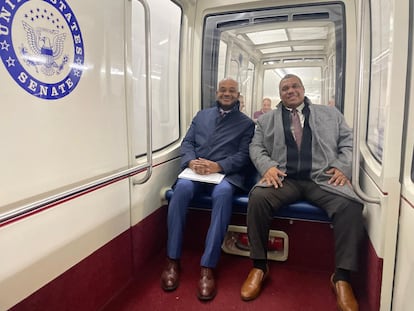
Gamboa remembers the first time he arrived in Washington. It was back in 2000, alongside his friend Luis Gilberto Murillo, a rising young politician who had briefly governed the Colombian department of Chocó. Barely speaking English, they went knocking on doors at the Capitol: “We asked a police officer how we could talk to a congressman. He asked us if we had an appointment. We innocently said, ‘no.’ And I remember him saying, ‘You’re crazy! If you don’t have an appointment, you won’t have a chance.’” Afterward, he gave them a directory of representatives and suggested they look for the offices of African Americans working on issues related to their interests.
Thus, they arrived at the office of Democratic Congresswoman Cynthia McKinney of Georgia, who promised them “a couple of minutes.” In the end, however, after learning about their origins, she spent more than 15 minutes speaking with them. “She had no idea that there were Black people in Colombia. And that made her very happy. She asked us where they lived, how many there were, what their lives were like, and that’s how we began a series of relationships, through which we gained lots of experience,” Gamboa recalls. At the time, he was the executive director of the Federation of Pacific Municipalities.
Little by little, he and Murillo gained allies: from compatriots already settled in the U.S. capital — such as Cristina Espinel and Robert Asprilla, who lent them his old car to get around — to the then-Colombian ambassador Luis Alberto Moreno, with whom they agreed to work toward greater inclusion. In those years, several Colombians lobbied on different fronts, such as Pastor Murillo, who paved the way at the United Nations, or Marino Córdoba, who reached out to congresspeople in their districts. Others worked with civil society organizations.
That lobbying effort lasted for years. It began during Andrés Pastrana’s administration (1998-2002) and continued when Álvaro Uribe took office in 2002, with the goal of signing a free trade agreement (FTA) with the United States. Increasingly comfortable in Congress, the list of Black Caucus members who expressed solidarity with Gamboa and Murillo grew longer: Jessie Jackson Jr., Sheyla Jackson Lee, John Conyers Jr., and Gregory Meeks. Once they visited the Colombians’ native regions and learned how they lived, there was no turning back.
One of the first to get involved was Congressman Meeks, who, in 2005, traveled to the Colombian Pacific, a resource-rich region home to a large portion of the Afro-descendant population. It has the highest poverty levels in the South American country. The New York Democrat then pledged to speak with his colleagues in Congress to ensure that U.S. foreign aid would include funding for these communities.
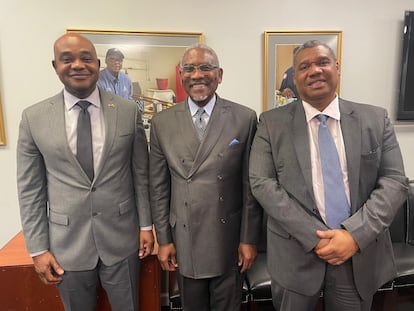
After his trip to Buenaventura, Tumaco and Quibdó, Meeks lamented that, despite the influential role they’ve played in national development, Afro-Colombians remained “marginalized from Colombia’s culture, economy and politics.” And, in the most conflict-ridden regions, he noted that they were “trapped between the state, the paramilitaries and the guerrillas.” He also said that Uribe had pledged to create a committee to “increase the representation of Afro-Colombians in public life.” This was inspired by the one that president Harry Truman created for African Americans in 1946.
Two years later, Congressman Charles Rangel — also a Democrat from New York, now deceased — became chairman of the powerful House Ways and Means Committee, which drafts the federal budget. Gamboa and Murillo approached him. “We told him that, in Colombia, there were no Black ministers, generals, or magistrates, that we were invisible,” Gamboa recalls. “What we learned was that, when president Uribe lobbied [Rangel] for the FTA, he said: ‘Well, we need to put more Afro-Colombians in positions of power in Colombia.’”
A minister with a “historic mission”
Thus, in December 2006, Bogotá native Luis Alberto Moore became the first Black police general in the country’s history. And, a few months later, on June 1, 2007, Paula Moreno — an industrial engineer with a degree in Italian Language and Culture, who had studied in Europe and who didn’t belong to the traditional elite — became Colombia’s first Black minister.
Born in Bogotá to a family of strong women who prioritized her education, Moreno grew up traveling every year to revisit her roots in Santander de Quilichao, in the department of Cauca. As a professional, she had also visited the Pacific, witnessing the structural inequality affecting Afro-Colombians. Therefore, when she was sworn in as minister, she was mindful of her historic mission as a Black woman.
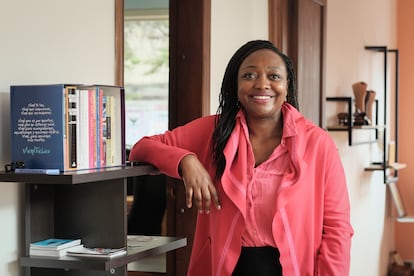
In her forthcoming book — The Power of the Invisible: A Memoir of Solidarity, Humanity and Resistance (2025) — Moreno recalls that her appointment generated a sense of “collective vindication” in Colombia and was celebrated beyond the national borders. The country has the third-largest population of descendants of enslaved Africans, after Brazil and the United States.
Moreno shared her victory with the group of U.S. congresspeople — who had advocated for someone like her to reach government — and also with her Brazilian counterpart, Gilberto Gil, whom she describes as an inspiration.
“The African diaspora is a great power and a force of global solidarity. We are more than 1.35 billion people — including Africans and their descendants — who, for centuries, have maintained that umbilical cord with a Blackness that defines our existence in the world, regardless of location. Africa and its descendants lived within me and in the reality of the more than 10 million Afro-Colombians and the more than 150 million Afro-Latinos,” Moreno reflects in her memoirs. “That collective consciousness from Africa went with us wherever we went, even if we didn’t know where on the continent we originated from. Without a doubt, I was a product of that sisterhood.”
Sitting in the offices of Manos Visibles (Visible Hands) — the organization she created after leaving government — Moreno says that her tenure at the Ministry of Culture was a demonstration of the “power of youth, diversity and culture.” She has continued to cultivate this since she founded her civic group, which has already trained nearly 30,000 Black and Indigenous leaders. She has a “commitment to service,” in order to contribute toward a better society.
“I didn’t want to be the only Black woman in a position of power,” she explains. “Rather, I wanted to help create a critical mass of leaders from the country’s marginalized areas, with the best training, support and strategic connections to be the protagonists of the agenda for change, and to build better living conditions not only for excluded communities, but with and from excluded communities,” she writes in her book.
In keeping with the pan-African philosophy of Ubuntu — which prioritizes the collective over the individual — Moreno declined any offers to continue in politics. Instead, she opted for this project, which seeks structural changes that open spaces up for those who have been historically forgotten.
That same philosophy led Brazilian politician Anielle Franco — appointed as Brazil’s minister of Racial Equality in 2023 — to support Francia Márquez’s vice-presidential candidacy and celebrate her victory in 2022. “They killed Mari [Marielle Franco] with five shots to the head. I really believed in her and in the politics she was pursuing, I felt orphaned and very sad. I felt like they had killed me a little,” she recalls. Her sister, a city councillor in Rio de Janeiro, was assassinated in 2018.
“A few years later, Francia said a phrase that left a mark on me, which was, ‘The people don’t give up, damn it.’ So, we joined forces with other Black activists to come and campaign with her,” Franco notes. Along with other women, she transformed her anger into struggle and political action. “Francia represented a sea of renewal. She meant that we were alive, even when one of our leaders had been killed.”
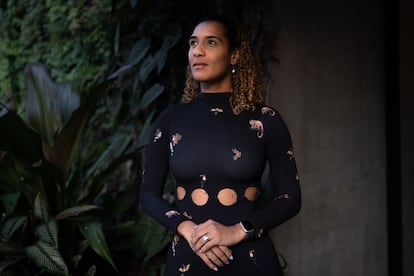
For Costa Rican politician Epsy Campbell — the first Black female vice president in Latin America (2018-2022) — Márquez’s election symbolized that the representation of Black women in power was beginning to become normalized. “It’s very striking that, up until 2018, Latin America had never elected a Black female vice president in a region with 200 million people of African descent, where positions of power remain nearly entirely closed to people of African descent, even in countries like Brazil, where the majority of the population is of African descent. The only places where one can inevitably normalize Afro-descendants is in the Caribbean, where 90% or 95% of the population is Black. We were truly very far from a representative democracy,” the Costa Rican economist reflects. “We’re still treated like visitors, even after I don’t know how many years of history and country-building.”
When Campbell was elected, some friends told her that, in the Colombian department of Chocó, many people took to the streets to celebrate. And even though she was initially surprised, she soon understood that it had to do with what the image of her victory meant in the long history of exclusion shared by Latin Americans of African descent. “I could have been Afro-Colombian or I could have been Brazilian, it all depended on where I was born, after the people who came before me were kidnapped and captured,” she reflects. “For me, the logic that we belong to something bigger has always been very present.” This rootedness is what strongly unites the networks of Afro women that are expanding across the continent. They’re protecting themselves from the political violence that — the interviewees all agree — especially affects them.
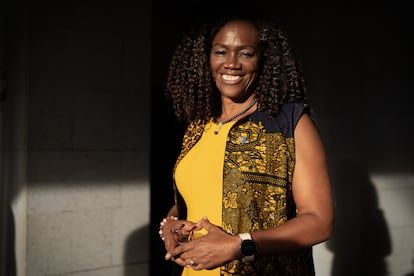
In The Power of the Invisible, Paula Moreno says that Colombia’s history was written more with an eraser than with a pencil, omitting the stories of an “Indigenous, Black, peasant, feminine country, which has regional strength and autonomy.” It’s a maxim that could easily be extended to the rest of the continent’s nations. But cases like those of Epsy Campbell, Anielle and Marielle Franco, Francia Márquez, or the Afro-Colombians who lobbied on Capitol Hill — Óscar Gamboa and Gilberto Murillo — remind us that, despite the enormous challenges that prevail in Afro-descendant communities in Latin America and the Caribbean, in every corner of the continent, there are leaders sharpening their pencils to rewrite history.