
Rodrigo Paz: ‘I hope Bolivia returns to the world and the world returns to Bolivia’
In an interview with EL PAÍS, the president-elect of the Andean country says that he considers himself a centrist politician
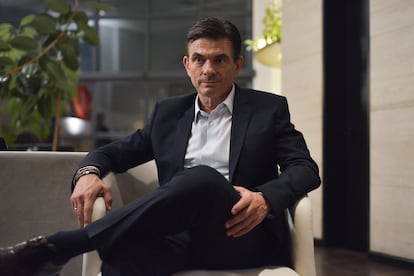

Rodrigo Paz, 58, will be inaugurated as the new president of Bolivia on November 8. On Sunday he won the second round of elections with 54.6% of the vote, nine points ahead of the far-right candidate Jorge Tuto Quiroga. He owes his victory, in large part, to the votes that previously went to Evo Morales’ Movement For Socialism (MAS), which held sway for 20 years but is now decimated by internal disputes and a lack of vision. Paz has an arduous task ahead of him. Gas is no longer the foreign exchange windfall it once was, and the new administration will be taking on an economy in recession, a central bank without reserves, high inflation, and fuel shortages.
Paz spoke with EL PAÍS late on Monday. Earlier that day he had spoken with a dozen world leaders, including Nobel Peace Prize laureate María Corina Machado. He also answered questions from around 50 journalists at a hotel south of the capital, and met with FIFA President Gianni Infantino.
Question. How do you define yourself politically?
Answer. I’m a centrist. We could say we’re a democratic, national-popular party, with a strong national connection, but a democratic one. Because there were times in Bolivia’s history when the national-popular party was linked to the civic-military.
Q. You promised during your campaign that you would solve the fuel shortage problem with help from neighboring countries. How much longer is your supply guaranteed?
A. We need time to start a different way of managing the economy, of managing this thing we call the “Tranca State” [a state that obstructs individual freedom through its laws]. It will be enough time to integrate Bolivia based on agreements we will have in the future. We are isolated from the world. A full $60 billion, which for us is an outrageous sum, has been lost over the last 20 years, leaving us with a debt of $40 billion.
Q. And how are you going to solve that? You said you won’t ask for help from the International Monetary Fund.
A. First, we need to put our own house in order. In these institutions, if you ask for money without a minimum of criteria, they apply very complicated conditions on you. After 20 years of a sort of 21st-century socialism, our slogan is capitalism for all. In Bolivia, the formal economy is 15%, while 85% is informal. Both blocs agree that they don’t want the state. The formal economy is drowning, and the informal economy is made up of people who were in the formal economy but have gone over to the informal one. Everyone wants to pay taxes, to import, to export, but they understand that this state, to sustain itself, is very expensive. In Bolivia, capital plays a fundamental role. In the city of El Alto, there is a saint called Saint Capital. If you want to experience pure and simple capitalism, just go to El Alto.
Q. What happens if this plan creates social instability? Solving the fuel shortage, for example, means doubling the price.
A. If you ask the vast majority of Bolivians today whether they want to maintain the price without fuel or a new price with fuel, they will say they prefer the latter. The most expensive diesel is the one they don’t have. If there is a vulnerable sector, we will protect it.
Q. What profile have you given to the Cabinet?
A. Meritocracy will be important. It will also be balanced, because we are a very diverse country. The names will be based on our campaign commitment.
Q. What will your relationship with neighboring countries be like?
A. We’re going to work with anyone who wants to work with Bolivia. If I learned anything from exile, it’s that in every city and country I arrived in, I had to see who my neighbors were. I recognized who the bully was, who the toughest guy was, and I dealt with them all. The point is to live together; that’s a lesson I learned since I was a child. I’m clear that we’re not going to repeat what happened on August 6, the bicentennial of Bolivia’s independence, without any president present in Bolivia. That’s a geopolitical and geoeconomic failure.
Q. On Monday, you spoke with Nobel Peace Prize laureate María Corina Machado. How did that conversation go?
A. Very well. Some have raised some doubts about our process, and I believe Corina Machado is an authoritative voice on democracy. Her actions offered not only support for elections, but also a hope for what might happen in the future. Part of my exile took place in Venezuela, and today, what’s happening in Venezuela is clearly not what I want for my country.
Q. What will the relationship with the United States be like, which was broken during the MAS administration?
A. We will resume relations.
Q. Does that include the return of the DEA?
A. First, there’s the return of the Embassy. There’s an obsession with the DEA, especially in the media. Cooperation and mutual work come first. In 2008, Bolivia exported $500 million to the U.S. market from the city of El Alto and generated 40,000 jobs. Due to a political decision by [former president] Evo Morales, in 2009, we went from $550 million to $23 million in exports. That’s treason, and he’ll have to answer to justice.
Q. But are you aware that many of your votes came from MAS?
A. Many Bolivians who voted for Tuto Quiroga, Samuel Doria Medina or Rodrigo Paz had previously voted for MAS. Those are Bolivian votes, not MAS votes.
Q. Evo Morales said that he will resist neoliberal policies.
A. I’m not a neoliberal. He should go and give his speech to the palm trees and take responsibility for the damage he’s done. I hope he helps the country move forward, not try to block it. In Bolivia, everyone has the right to speak out and protest, but you can’t harm another Bolivian, and that’s where the state has to act.
Q. Your administration ends in 2030. What do you want to leave the Bolivian people?
A. The future is better than the past. But even if we overcome all the problems we’ve been left with, whatever we are able to do won’t be enough. I hope Bolivia returns to the world and the world returns to Bolivia. And I want to create an economy for the people. The economy isn’t there for the state or for a powerful few.
Sign up for our weekly newsletter to get more English-language news coverage from EL PAÍS USA Edition









































