
Rodrigo Paz wins the presidency as Bolivia enters new political era
The center-right candidate wins the second round with 54.5% of the votes over the conservative Jorge Tuto Quiroga
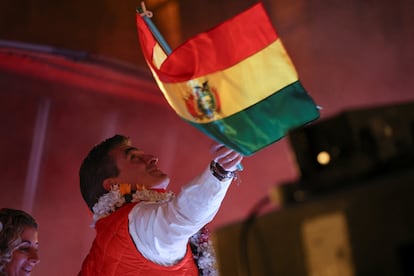

Center-right politician Rodrigo Paz is the new president of Bolivia. After the vote count was completed, Paz’s Christian Democratic Party (PDC) secured 54.5% of the votes, compared to 45.5% for the Libre coalition led by former conservative president Jorge “Tuto” Quiroga.
With this Sunday’s election, Quiroga racks up his fourth failed attempt to win the presidency (he ran in 2005, 2014 and 2020). Paz, on the other hand, has won in his first campaign with a landslide victory that, just two months ago — when he unexpectedly won the first round — seemed impossible.
“Bolivia breathes winds of change and renewal to keep moving forward,” Paz said in his first speech after winning the election. He summed up his vision of Bolivia in three words: “God, family, and country.” He ended with thanks to his father, former president Jaime Paz Zamora (1989–1993), who was present at campaign headquarters.
The collapse of Evo Morales’s left-wing party MAS, which had been dominant for 20 years, finally opened the doors of the Palacio Quemado to Paz, a politician who built his career in a provincial mayor’s office. On November 8, the date of the transfer of power, Bolivia will begin a new political era, moving away from the state-driven and redistributive policies promoted by the MAS party. Even so, the conservative shift under Paz is not expected to be as drastic as the one Quiroga might have pursued.
“Bolivia doesn’t need us to add to her difficulties right now,” Quiroga said as he acknowledged defeat an hour after the results were released, while his supporters shouted “fraud!”“I understand the pain that overwhelms us; if we had systematic evidence, we would put it on the table,” he added.
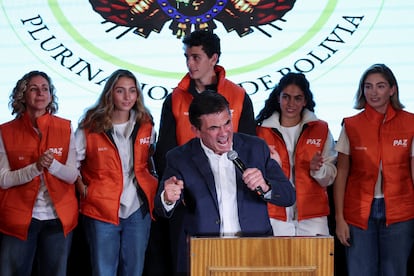
Paz picked up most of the votes that once went to Morales’s party, which remains strong in the largely Indigenous Andean west. A key factor was his embrace of what he calls “capitalism for everyone” — an as-yet-undefined experiment that managed to win over a new Aymara bourgeoisie born during the years of MAS rule. This group is made up of Indigenous Bolivians who no longer define themselves politically by their ethnic origin but by their place on the social ladder: they are university graduates, business owners, traders, transportation entrepreneurs, and in some cases highly successful and wealthy business people. Paz promised them that he would dismantle what he called “the state barriers,” which he argued prevents them from growing as entrepreneurs.
Quiroga, by contrast, campaigned on reviving the economy left in recession by MAS, through cooperation with the International Monetary Fund and greater openness to global markets. He also warned that he would eliminate fuel subsidies to end shortages — a deeply unpopular measure that would have doubled fuel prices at the pump.
The first to celebrate the result was vice president-elect Edman Lara, who declared: “It’s time for brotherhood and reconciliation — we are all Bolivians. I have always believed in God and left everything to His will.”
A former police officer, Lara is hugely popular on social media — so much so that Paz owes him much of his victory. In the streets of La Paz, it was common to hear people say they would vote “for the captain” rather than for the presidential candidate himself. The relationship between the two men will undoubtedly be tense, and it is still unclear what formula will be able to ensure internal stability in their government.
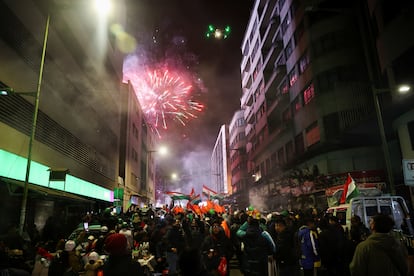
Paz’s success was unexpected — both in the first round, when polls placed him third, and in the runoff, where most analysts anticipated a victory for Tuto Quiroga. Paz won in six of Bolivia’s nine departments, evidence of the national reach of his message. In La Paz, the political capital, he took 65% of the vote; in Cochabamba, more than 60%. Quiroga prevailed by a similar margin in Santa Cruz, the eastern department that for two decades has led the opposition to MAS policies.
Santa Cruz, controlled by the far right, has long been a bastion of resistance to the state-heavy model promoted by Evo Morales. Its economy is based on soy exports and cattle ranching, while western Bolivia depends heavily on gas and mining. The Santa Cruz elites saw in Tuto Quiroga, a Cochabamba native with neoliberal policies, their ideal candidate — but the outcome did not go as they had hoped.
Paz cast his vote early in the morning in Tarija, the southern city where he once served as mayor. “These are very difficult times, but Bolivia has great opportunities to move forward,” he said, referring to the economic recession that has gripped the country amid high inflation, a shortage of U.S. dollars, and fuel scarcity. The newly elected president added that he had already begun talks with parliamentary parties to ensure governability and move forward with needed reforms. “With our caucus, we can form a majority with any of the other parties — but not the other way around,” he said, in a pointed jab at Quiroga’s Libre alliance.
The tense political climate that defined the campaign quickly subsided on election day. A ban on vehicle traffic, customary during Bolivian elections, left the major cities unusually quiet — a reminder of how peaceful the country’s voting days typically are. With only two candidates in the race, the vote count proceeded swiftly.
The only dissenting voice came from Evo Morales, who is constitutionally barred from running again and now lives in refuge in the coca-growing Chapare region. He faces an arrest warrant on allegations of sexual abuse of minors. Morales nevertheless voted, declaring that neither Paz nor Quiroga “represents the people or Indigenous communities.” According to Morales, that role still belongs to him.
Sign up for our weekly newsletter to get more English-language news coverage from EL PAÍS USA Edition









































