
Rodrigo Paz, the surprise president who promises ‘capitalism for all’
The son of the country’s former head of state, Bolivia’s election winner gained support among voters who abandoned Evo Morales’s MAS party
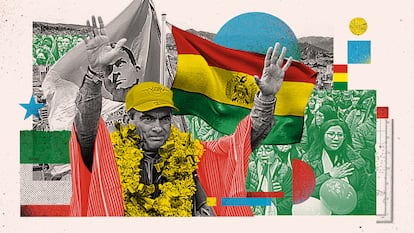

Rodrigo Paz Pereira likes to present himself as a fresh face in Bolivia’s politics — but he isn’t one. His father is former president Jaime Paz Zamora (1989–1993), one of the main leaders of the historic Revolutionary Left Movement (MIR). Now 58, Paz has already served as a city councilor, congressman, and mayor of the southern city of Tarija. He remains an active politician today, holding a senate seat for the opposition party Comunidad Ciudadana (Civic Community), led by former Bolivian president Carlos Mesa (2003–2005).
With that long résumé behind him, Paz emerged as an unexpected candidate, almost invisible to the polls. As the candidate for the Christian Democratic Party (PDC) — a defunct political label revived for the occasion — he set out to win over voters who had drifted away from the Movement for Socialism (MAS), the party of Evo Morales. It worked: in August, he won the first round of the presidential election with 32% of the vote, six points ahead of conservative Jorge “Tuto” Quiroga.
On Sunday, Paz won the presidency in a runoff against Quiroga, securing more than 54.4% of the vote, according to the preliminary count released by the Supreme Electoral Tribunal (TSE). While he avoids strict ideological labels, he could be considered a social democrat leaning more to the right than the center. When asked, he prefers to present himself to voters as a moderate reformer promoting “capitalism for all.” This has been his key platform to appeal to Indigenous sectors who climbed the social ladder during MAS’s 20 years in power and now feel unrepresented by the movement.

Economist and analyst Armando Ortuño argues that a victory for Paz will be a “triumph for plebeian Bolivia, which is the heart of MAS support.” “All of Paz’s measures are aimed at the self-employed. He says, ‘We’re going to liberalize, but not for the rich; we’ll do it for the poor,’” he tells EL PAÍS.
Political analyst Raúl Peñaranda, director of Brújula Digital, agrees: “Bolivia is a country where 80% of the economy is informal. Paz has managed to break through with his message, presenting himself as a capitalist for small entrepreneurs.” He adds: “There are so many informal workers because being formal in Bolivia is a nightmare. Paz offers a way for people affected by bureaucracy to regularize their activities.”
At his rally to close the campaign in Cochabamba last Tuesday, Paz said that in Bolivia, “there will be no more smuggling because everything will be legal.” “We will lower tariffs to put an end to this state blockade that doesn’t allow us to import products and technology. We need low-interest loans,” he said.
As a Christian Democratic candidate, Paz promised to dismantle the “state blockade” but he did not address big business in the way his rival Tuto Quiroga did. He has even proposed a mass tax pardon that would forgive debts and fines as part of a “small-money plan” to stimulate an economy currently in recession. Unlike Tuto, Paz says he will not request money from the International Monetary Fund, believing that he can finance reforms through budget adjustments and fighting corruption.

Paz was born in the Spanish region of Galicia in 1967, while his father was in exile after being persecuted by the Bolivian dictatorship (1964-1982). His mother is a Spanish native. Before returning to Bolivia at the age of 15, he had lived in around 10 different countries. He is an economist and holds a master’s degree in Political Management from American University in the United States. There he met María Elena Urquidi, his wife, with whom he has four children.
Two years before deciding to run for president, Paz traveled through more than 200 Bolivian towns, even participating in patron saint festivals and folkloric parades alongside union leaders. Those around him acknowledge that these tours were decisive in his first round victory in August. “People look at him and listen to him, and say, ‘This guy knows us,’” they say.
Paz’s popularity soared when he chose Edman Lara — a right-wing former police officer widely popular on social media for his strong anti-corruption rhetoric — as his running mate. “Lara’s rhetoric speaks against the lack of justice and the abuse of power. And the powerful in this case are both the traditional oligarchs and the MAS supporters,” says Ortuño. When the elections came, the duo won “because if you didn’t want to vote for the traditional right or the MAS, there was no other option,” he adds.
Sign up for our weekly newsletter to get more English-language news coverage from EL PAÍS USA Edition









































