
The curious story of the ‘randoseru,’ the backpack that costs hundreds of dollars and is carried by every Japanese schoolchild
For 150 years, the bag has been a symbol of childhood. It is handcrafted and used throughout elementary school. The most luxurious models can cost over $1,000
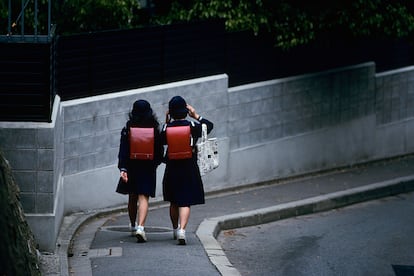

The Japanese school year begins in April. Right now, while children in the West are getting used to classes again, in Japan, parents of children who will start elementary school in 2026 are already looking for the backpacks their children will carry. This early shopping spree is explained by the fact that a randoseru is not just any backpack; it has been an essential element of Japanese childhood for almost 150 years.
The traditional randoseru, which costs hundreds of dollars, is made of leather, although today there are also versions made with a high-quality synthetic leather called clarino. It is rigid, rectangular, with rounded corners, and opens with a large flap, like a hybrid of an accordion case and a turtle shell. Such is its almost totemic status that while it is not compulsory, virtually all boys and girls use it throughout their six years of elementary school.
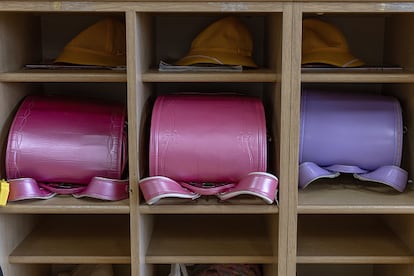
In fact, one in three Japanese children carries a Seiban randoseru, a brand that has been making these backpacks since 1946, barely altering their design. Other long-standing manufacturers, such as Kunio Tsuchiya in Tokyo (since 1965) or Yamamoto Bag (since 1969), also continue this meticulous, almost ritualistic, artisanal tradition. Each backpack requires around 150 manual processes (cutting, assembling, sewing, molding, polishing, etc.), which involves around 20 to 30 hours of work. In small workshops, a craftsman may only complete a few randoseru per week. The average price is around $400, but some models cost almost $1,000.
Another of the most renowned workshops is Tsuchiya Kaban, which has been making randoseru bags since 1965. “The most important thing for us when creating randoseru is to achieve a balance between durability and beauty,” explains Suzuki, who runs one of the workshops in Tokyo, on the brand’s blog. His workshop alone employs around 100 artisans, and his explanation of his work involves words like meticulousness, detail, tradition, and exemplarity. “We craft these bags with the utmost care, especially because they’re traditionally used by children. We want each owner to feel a connection with their backpacks every time they use them, so we prioritize both aesthetic beauty and comfort,” he explains. Prices range from around $530 to $1,270 for the most exclusive bags.
A few days ago, The New York Times dedicated an article to this precious backpack, so full of meaning, and highlighted that more than just a bag, the randoseru is a Japanese symbol that reflects the social discipline and coherence that are so deeply rooted in the country’s culture.
Although some design liberties are allowed today, the randoseru remains fairly untouchable. According to the Randoseru Association, boys maintain black as their favorite color, although some prefer green or camel, while few choose navy blue. Among girls, the traditional red is giving way to lavender or violet, and other shades are gaining popularity, such as peach and sky blue. Tentatively, the classic school bag is gradually assuming each child’s own personality.
The clean, solid, and elegant aesthetic of this backpack has spread its fame thousands of miles from Japanese schools. When Max (three years old at the time) walked through the doors of his kindergarten in San Sebastián, in Spain’s northern Basque region, his beautiful red randoseru stood out among the other children’s backpacks.
Captivated while on vacation in Tokyo, a few years earlier, by the image of children going to school all by themselves, his parents bought the backpack for him: “It was a demonstration of incredible autonomy, but our gaze always focused on one common detail: they all carried the same backpack. The randoseru was the foundation upon which each of them built their identity, personalizing it with plush keychains (nuigurumi) or adding water bottle accessories. We were fascinated to see how, on the little ones, it looked like a giant shell and how on the older ones it was perceived as a traveling companion, full of stories,” says Maite, Max’s mother. “The idea of a single backpack that accompanies you through six years of elementary school seemed like a beautiful philosophy to us. It wasn’t just an object, but a silent witness that evolves with you during one of the most important stages of your life. That’s why we brought it home, as a symbol of that story of growth and durability.”
They soon realized, however, that it wasn’t as practical in Spain: it takes up more space and there isn’t as much room on the bag racks. It is also heavier than a conventional bag (the classic randoseru weighs almost a kilo and a half when empty), and not everyone knows how to use it correctly. It works in Japan because the dynamics, spaces, and habits at school are different.
Thousands of miles away across the Pacific, in California, architect couple Airi and Rayan have chosen a mustard-colored randoseru as a backpack for their daughter Kenzo, “a cheerful and welcoming color that perfectly matches her room and her style.” Beyond its pretty appearance, this backpack serves as a deep connection to Airi’s cultural roots, as Tsuchiya Kaban explains on the brand’s blog. The most modern randoseru backpacks today offer greater capacity for carrying books and digital tablets, but their shape and structure generally remain constant throughout their history.
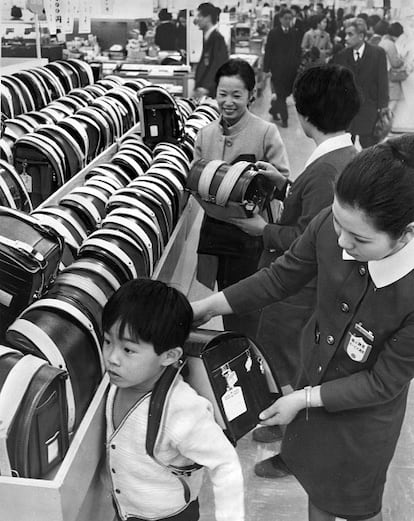
Their roots date back to the 19th century, when Japan was beginning to open up to the world after centuries of feudal isolation. Inspired by the ransel, the Dutch military backpack, they arrived in the country around 1860. In 1885, Gakushuin, the elite school of the imperial family, adopted a similar model as an official backpack, and the image of the crown prince wearing it became a symbol of Japanese childhood and discipline. Initially, it was a luxury item for wealthy families, while most continued to use furoshiki, a cloth for wrapping objects.
Over time, the randoseru became part of the country’s identity. Some companies gave them to their employees for their children, and grandparents began buying them for their grandchildren as special gifts. More than 150 years later, these backpacks remain a fixture in the lives of Japanese children and are more than just a workaday item; they are a cultural classic.
Sign up for our weekly newsletter to get more English-language news coverage from EL PAÍS USA Edition









































