
Imprisoned Alexei Navalny learns documentary about him wins Oscar
His spokeswoman, Kira Yarmysh, says the politician was attending a hearing via video link from the prison when his attorney broke the news to him
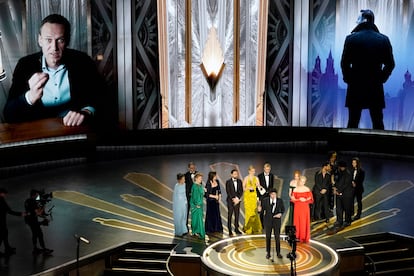
Imprisoned Russian opposition leader Alexei Navalny learned Monday from his lawyer that a film detailing his poisoning and political activism won the Oscar for best documentary feature. The 46-year-old politician was attending a court hearing via video link from the prison when his attorney broke the news to him about the documentary, Navalny, by director Daniel Roher, according to his spokeswoman Kira Yarmysh. She called it “the most remarkable announcement of an (Oscar) win in history.”
Yarmysh did not report what Navalny’s initial reaction was to the Oscar win. According to Yarmysh, Navalny faced a court hearing in Kovrov, a town near the prison in the Vladimir region east of Moscow. President Vladimir Putin’s fiercest critic participated in the hearing on a complaint he filed against Russian penitentiary officials.
At a daily conference call with reporters, Kremlin spokesman Dmitry Peskov refused to comment on the Oscar win, saying that he hasn’t seen the film and thus “it wouldn’t make sense to say anything” about it. He added that “Hollywood sometimes does not shun politicizing its work.”
Russian state TV channels largely ignored the win.
Monday’s hearing was on one of the many lawsuits the defiant Navalny has filed against prison administrators over what he alleges are violations of his rights. Two more hearings were scheduled, but those were postponed until later dates.
The documentary portrays Navalny’s career of fighting official corruption, his near-fatal poisoning with a nerve agent in 2020 that he blames on the Kremlin, his five-month recuperation in Germany and his 2021 return to Moscow, where he was immediately taken into custody at the airport. He was later sentenced to 2 1/2 years in prison and last year was convicted and given another nine-year term.
Navalny has faced unrelenting pressure from authorities. He spent several weeks in isolation in a tiny “punishment cell” and last month was placed in a restricted housing unit for six months. He is effectively deprived of phone calls or visits from his family.
At the ceremony Sunday night in Los Angeles, Roher accepted his Oscar by saying he dedicated it to Navalny and to all political prisoners around the world.
“Alexei, the world has not forgotten your vital message to us all: We must not be afraid to oppose dictators and authoritarianism wherever it rears its head,” he said.
Navalny’s wife, Yulia, also spoke, saying: “My husband is in prison just for telling the truth. My husband is in prison just for defending democracy. Alexei, I am dreaming of the day you will be free and our country will be free. Stay strong, my love.”
His daughter Dasha told reporters that the only way the family is able to stay in touch with him is through letters, with defense lawyers able to visit him occasionally. His health is deteriorating, which is worrying, she said.
Lyubov Sobol, Navalny’s longtime ally, said in an interview with The Associated Press that the documentary’s success represented “an important signal that the world sees the efforts to fight for democracy in Russia, the world supports brave and courageous people who have challenged Vladimir Putin and have been fighting the unequal battle with evil, which is now tormenting the entire world and Ukraine in the first place.”
“It’s a very important victory and I was unspeakably glad,” Sobol said.
Another Navalny ally, Maria Pevchikh, wrote on Instagram: “Alexei, this is your award. It’s not about the film. It’s about the fact that what you’re doing cannot leave anyone indifferent. Be it in Russia, in Hollywood, or anywhere else. (You’re) a true hero.”
Sign up for our weekly newsletter to get more English-language news coverage from EL PAÍS USA Edition









































