
WHO faces deadlock over pandemic treaty amid crisis over hantavirus outbreak
The main sticking point is the mechanism that will define how nations share samples and sequences of viruses with pandemic potential and, in return, obtain access to vaccines
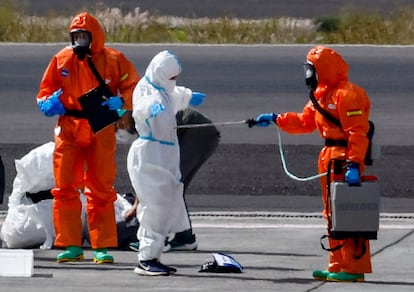

As World Health Organization (WHO) negotiators left Geneva on May 1 without managing to finalize the key annex meant to activate the global pandemic treaty approved in 2025 — the mechanism designed to prevent a repeat of the inequities seen during COVID‑19 — a hantavirus outbreak was beginning to trigger international alarm. The next day, health authorities reported several confirmed and suspected cases aboard the Arctic cruise ship MV Hondius, which had departed from Argentina. The sequence — diplomatic failure one day and a health alert the next — underscores how the international community is still debating the rules for confronting the next pandemic while pathogens continue to spread without waiting for political consensus.
“The outbreak is yet another reminder of the threat that emerging viruses pose to humans,” says Neil Vora, an epidemiologist and executive director of Preventing Pandemics from the Source (PPATS). “Seeing a hantavirus outbreak on a cruise ship is unexpected, but not entirely surprising, given how people travel the world and how we interact with animals.”
The specialist stresses that the pathogen involved — the Andes virus — is the only hantavirus in which person‑to‑person transmission has been documented, and although the risk to the general population is low, the episode “deserves very close international attention” because of the possibility of new cases appearing in different countries.
For Vora, the outbreak’s overlap with the diplomatic deadlock in Geneva is not merely symbolic. “In recent weeks, we have seen the negotiation of the annex regulating the Pathogen Access and Benefit-Sharing System [PABS] fail, and that is a loss for everyone,” he says.
That annex is the cornerstone that should transform the pandemic treaty into an operational tool: it’s the mechanism that will establish how countries share samples and sequences of viruses with pandemic potential and, in return, receive timely access to vaccines, treatments, and diagnostics when an emergency erupts. The mechanism is supposed to be approved at the next WHO World Health Assembly, scheduled between May 18 and 23. The talks, however, again ended on 1 May without consensus, forcing yet another delay in the implementation of the pandemic treaty.
The hantavirus outbreak has, however, triggered the International Health Regulations (IHR), the WHO’s main instrument for managing cross-border alerts. As WHO Director-General Tedros Adhanom Ghebreyesus noted last Thursday, the episode “shows why the international health regulations exist and how they work,” providing a framework for notification and coordinated response. But they do not regulate access to vaccines, treatments, or diagnostics — the gap the PABS is meant to fill.
No room for ambiguity
“The devil is in the details,” says Michel Kazatchkine, a member of the Independent Panel for Pandemic Preparedness and Response, who has closely followed the negotiations. “The agreement deals with very fundamental issues: what exactly constitutes a technology transfer, what kind of contracts will be involved, how financial flows will work, and whether the agreements will apply only during a pandemic or also between pandemics.”
According to the French expert, while the pandemic treaty is “a framework that allows for some flexibility in interpretation, the annex gets down to specifics: whether 20% or 10% [of the vaccines] are donated, whether it’s mandatory or not… That’s why the negotiations are so difficult.”
During that crisis, Kazatchkine recalls, many states quickly shared samples and genetic sequences of the virus, but were left behind when vaccines, diagnostics, and other essential supplies became available. Although Article 12 of the already approved pandemic treaty enshrines real‑time access to vaccines and treatments, the PABS must establish the mechanisms for sharing data on new pathogens without allowing the benefits to become concentrated once again in the hands of a few.
“The genetic sequence of a new pathogen should be a global public good,” says Kazatchkine, who warns that this principle clashes with the current biomedical innovation system. “If the data is sent to an open database, it is very difficult to organize a profit-sharing system,” he explains, because different industries can use it to develop products without being required to contribute to any benefit‑sharing arrangement. This is why many countries in the Global South are demanding binding guarantees of access to vaccines and treatments before releasing such data, while states with major pharmaceutical industries are wary of mechanisms that could affect intellectual property or research and development.
Pedro Gullón, Spain’s director‑general for Public Health and Health Equity and one of the country’s negotiators, acknowledges that the deadlock reflects — “to simplify a lot” — the divide between the global North and South. As he and Kazatchkine both note, the main sticking points remain twofold: the scope of the system — which pathogens would fall under the mechanism — and how the benefits derived from their use would be distributed in concrete terms.
“These are fundamental issues that require more time, flexibility, and a political leap forward from all sides,” he says. Spain, he adds, has tried to play a mediating role to “move toward an operational agreement,” even if that means accepting an annex less ambitious than the ideal, as long as it allows the pandemic treaty to be activated as soon as possible.
Kazatchkine also questions the extent to which the world is better prepared today for a new health crisis. “It is estimated that around $10 billion a year would be needed for pandemic preparedness, but the Pandemic Fund created after COVID-19 has barely raised around $2 billion,” he says. In his view, despite some progress, this gap reflects a lack of sustained political leadership: “No one is clearly stating today that this is a global problem and that no one will be safe until everyone is safe,” he warns.
This lack of preparedness explains precisely why there is little room left to wait. Even so, both Gullón and Kazatchkine agree that the fact that no agreement has been reached on the annex does not necessarily mean the treaty is doomed. “It shouldn’t be seen as a failure,” says Kazatchkine. But, he adds, time is working against them: “The PABS agreement is key because, without its signature, the ratification process for the pandemic treaty cannot begin. We all know there will be another pandemic, and right now we are witnessing another worrying outbreak. That’s why there is so much pressure.”









































