
Richard Hatchett, epidemiologist: ‘The risk of a pandemic is greater today than it was in 2019’
The head of the Coalition for Epidemic Preparedness Innovations warns of the dangers of artificial intelligence and biodesign to global health, and advocates for dialogue with those who are wary of vaccines
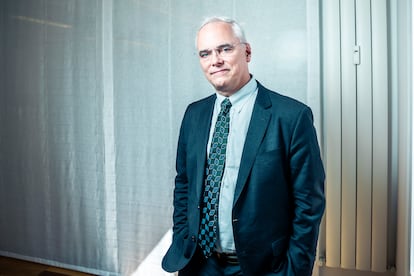

The world is no better prepared for a pandemic today than it was before COVID-19. On the contrary, the risk is greater. With this warning, Richard Hatchett, executive director of the Coalition for Epidemic Preparedness Innovations (CEPI), summarizes the current state of global health. The American epidemiologist recently visited Madrid to present the new strategy of this international alliance, created in 2017 to accelerate the development of vaccines against emerging infectious threats. His organization is promoting, among other objectives, the so-called 100-day mission: reducing the development time for vaccines against a new pathogen to just over three months.
From the capital of Spain, one of the countries that finance CEPI and with one of the few governments that maintain their commitment to global health in a context of cuts, Hatchett argues that investing now in preparedness is not an option, but a strategic necessity: not doing so is equivalent to “building up a debt” that will be paid with more deaths, greater economic impact and longer crises when the next pandemic arrives, which he considers “inevitable.”
Question. Do you think a new pandemic is likely?
Answer. After the COVID-19 pandemic, we need to reflect on the nature of the infectious disease threats that we face. The risk of a new pandemic is greater today than it was in 2019 for a lot of reasons.
Q. Which ones?
A. During the pandemic, there were great debates about the origins of the virus SARS-CoV-2, whether it was a naturally emerging virus, whether it might have passed through a laboratory or been released as a result of an accident. That controversy hasn’t been resolved, and personally, I’m not sure it ever will be, but all of those scenarios were plausible. We have to be prepared for the naturally emerging diseases, and as the number of high-containment laboratories around the world is growing, it’s creating the potential for accidents or leaks. And, unfortunately, artificial intelligence (AI) and the bio design tools accelerating innovation can potentially be misused.
Q. In what way?
A. Perhaps not today, but we have to plan for a future where these tools become more powerful and can potentially be misused to design new threats. And we have make sure we have the right tools to be able to do that. So for a lot of reasons I think that the urgency of the work that CEPI is doing and that many others are doing is even greater than previously.
Q. Are you concerned that the global health cuts being made by the United States and other European powers will affect preparedness for a future pandemic?
A. Cuts to emergency health preparedness and the progressive and systemic underfunding of public health, and especially infectious disease surveillance worldwide, are eroding our capacity to prepare for a potential pandemic. I understand that we are in a period of many simultaneous crises and that the fiscal space governments have to allocate funds to this type of work is becoming more constrained. But it is important to remember that health security affects national security and economic security.
“AI will become increasingly powerful and could be used to design new threats to health
Q. Not investing in global health can be costly?
A. That’s right. Cutting funding now because there are other problems that need to be addressed and thinking that you are saving money by reducing your investment in preparedness is actually building up a debt. Everything that you don’t invest now creates a debt that will be paid back compounded over time when the next crisis comes, and it is inevitable that infectious disease crises will come. That unpreparedness means more people will die, the economic costs will be greater, the impact on society will be great, and probably the epidemic or pandemic will last longer.
Q. In that context, the international agreement on pandemics has been presented as a milestone. What can actually change?
A. It is very important, both for its content and its symbolic value. It recognizes that health threats transcend national boundaries and political rivalries. But the real work actually begins once the agreement is in place: it’s about developing real capabilities and strengthening collaboration between countries.
Q. CEPI has launched the so-called “100-day mission,” with the goal of developing a new vaccine within that timeframe after a new pathogen is detected. Is it really possible?
A. During the pandemic, we responded faster than ever to a new threat: we developed vaccines in 11 months, scaled up their production like never before, and distributed them globally at an unprecedented pace. But even so, it was clearly not fast enough. We haven’t set a 10-day mission, and while the 100-day mission is ambitious, we believe it’s achievable if a lot of groundwork is laid: preparing vaccine production platforms, accelerating regulatory processes, improving clinical trials, increasing industrial capacity, and having much faster threat detection and characterization mechanisms.
Q. Are there any recent developments that lead you to believe it is feasible?
A. An example is what happened with the Rift Valley fever outbreak last year in Senegal and Mauritania. We had been working with Oxford for some time on a vaccine for this disease, based on the same adenoviral platform that was used during the pandemic. The problem was that we only had enough doses for a clinical trial in Kenya, not enough to respond to the outbreak. So, we transferred the master vaccine seed [the initial biological material from which all doses are manufactured] to the Serum Institute in India [the world’s largest vaccine manufacturer by volume of doses produced and sold globally]. In just 16 days, they produced 500,000 doses. They then completed the fill-and-finish process and carried out the necessary quality controls, which took approximately another month, before sending the doses for trials in Senegal and Mauritania. This case demonstrates that if manufacturers have the technology in place before an emergency, sending them the design of a new vaccine allows for much faster production and scaling up.
Cuts to emergency health preparedness are eroding our ability to prepare for a potential pandemic
Q. Part of your strategy is to strengthen scientific and productive autonomy in the Global South. What progress are you seeing?
A. Africa starts with weaknesses, but it also has top-level institutions. There are centers of excellence in genomic surveillance, such as Redeemer’s University in Nigeria or Tulio de Oliveira’s group in South Africa, which was the first to identify the omicron variant. The human potential is enormous, and although there are still gaps, I am optimistic in the long term. At CEPI, we work to ensure that our investments accelerate these capabilities sustainably. A good example is Lassa fever [an acute viral disease transmitted through contact with rodent urine or feces] in West Africa: since 2017, we have funded vaccines, most of which are developed in the Global North, as well as large-scale epidemiological studies that have enabled the training of local epidemiologists and the preparation of clinical trials. We are now helping to create country-run clinical trial sites. One of them, in Nigeria, has been selected by Novartis for a phase 3 trial of a therapy for sickle cell anemia, making that capability sustainable and useful beyond infectious diseases.
Q. Is the goal to have the vaccines manufactured in Africa?
A. Yes. For example, we want Lassa fever vaccines to be produced in West Africa in the future, as part of the continental push to achieve manufacturing sovereignty. And we want to replicate this model in Central and East Africa, and we are studying how to do it in Southeast Asia as well. Latin America, which already has more installed capacity, can also benefit from this approach.
Q. How to deal with misinformation and anti-vaccine movements, especially in a context where the aim is to develop vaccines in just 100 days?
A. The loss of trust in science and institutions is one of the main risks. The speed required by the 100-day mission may raise legitimate concerns: people may wonder if we are cutting corners. We must acknowledge these concerns, communicate transparently, explain what we know and what we don’t know, and how scientific knowledge is evolving. We cannot prevent intentional misinformation, but we can maintain an honest dialogue with those who have doubts and need reliable information.
Sign up for our weekly newsletter to get more English-language news coverage from EL PAÍS USA Edition









































